
Official statement
Other statements from this video 18 ▾
- □ Does canonical alone really prevent syndicated content from appearing in Discover, or do you actually need to add noindex?
- □ Are your JavaScript library vulnerabilities causing your Google rankings to plummet?
- □ Can you really prevent Google from crawling certain parts of a webpage?
- □ Is it really worth your time submitting an XML sitemap to Google?
- □ Why isn't schema.org compliance enough to guarantee Google rich results?
- □ Do HSTS headers really impact your SEO performance?
- □ Does Google really reprocess your sitemap on every crawl?
- □ Does Google really care about the difference between HTML and XML sitemaps? Here's what John Mueller revealed
- □ Does Google really ignore structured data that contains parsing errors?
- □ Do numbers in your URLs really hurt your search rankings?
- □ Does index bloat really exist at Google?
- □ How can you permanently block Googlebot from crawling your website?
- □ Does Google really issue official SEO certifications?
- □ Do multiple navigation menus really hurt your SEO?
- □ Are host groups really a sign of cannibalization you need to fix?
- □ Can you really disavow toxic backlinks by targeting their IP address in Google's tool?
- □ Should you remove the NOODP meta tag from your Blogger sites?
- □ How do you get a video thumbnail in Google search results: what does Google really mean by 'main content'?
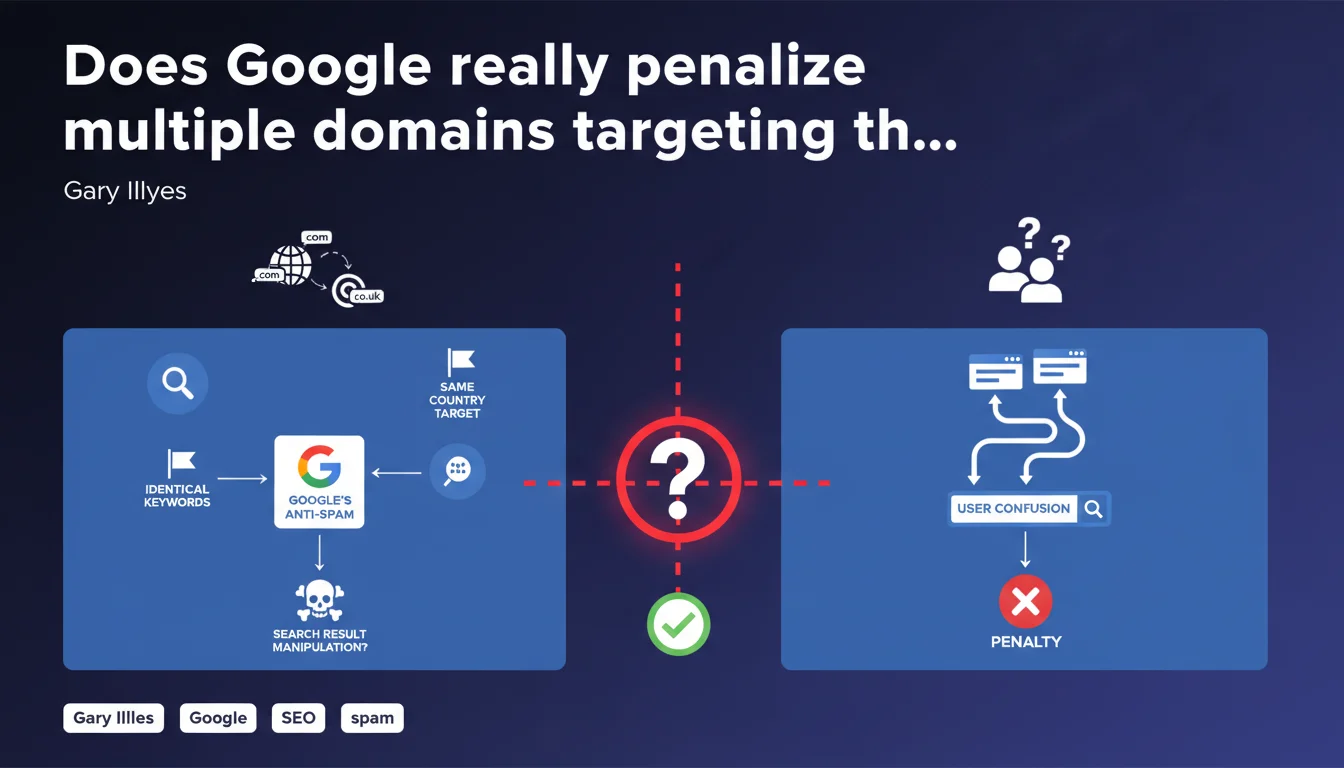
Google considers using two domains with different TLDs targeting the same country and identical keywords as potential manipulation. User confusion serves as the official justification, but the real reason is SERP control. Legitimate multi-domain architecture cases remain unclear.
What you need to understand
Why does Google view this practice as manipulative?
Gary Illyes' statement places this practice under Google's anti-spam policies. The official argument: two domains with distinct TLDs (.fr and .com for example) targeting the same country with identical keywords create user confusion. In reality, it's primarily a strategy aimed at multiplying positions in the SERPs for the same actor.
Google interprets this behavior as an attempt to monopolize organic search space. If a company occupies two results on the first page with two different domains for the same content or intent, it mechanically reduces its competitors' chances. This is precisely what Google seeks to limit.
Which types of domains are affected by this rule?
The specification focuses on domains with different TLDs — typically a .fr and a .com, or an .es and a .com. What matters is the combination: identical geographic targeting (via Search Console, hreflang, or implicit signals) and identical search intent across the same queries.
Ambiguity persists regarding cases where domains serve distinct objectives: for example, an institutional site on one TLD and an e-commerce site on another. Google doesn't detail the boundary between legitimate architecture and manipulation — which opens the door to interpretation and risk.
What is the definition of "same country" in this context?
Google likely relies on geographic targeting declared in Search Console, hreflang tags, and contextual signals (content language, physical addresses, currency). If two domains send convergent signals toward the same market — say France — they fall within the scope of this rule.
The problem: this definition remains implicit. Google doesn't publish a technical interpretation guide. Is a .com domain with hreflang fr-FR and a .fr without hreflang but hosted in France and written in French equivalent? [To verify] — no official confirmation.
- Google considers two domains targeting the same country with identical keywords as potentially manipulative
- The official argument is user confusion, but the real reason is SERP diversity control
- Affected cases: different TLDs, identical geographic targeting, same strategic queries
- The boundary between legitimate architecture and manipulation remains intentionally vague
- No precise technical definition of "same country" or "same keyword"
SEO Expert opinion
Is this statement consistent with practices observed in the field?
Yes and no. Google does penalize certain actors who saturate SERPs with multiple domains — we see this in competitive niches where the same publisher owns 3-4 affiliate content sites. But in other sectors, particularly e-commerce or large international groups, this practice persists without visible penalty.
The reality: Google applies this rule in a selective and contextual manner. A large retailer with a .fr and a .com can get away with it if content differs sufficiently or if targeted intents diverge. A small structure with two near-identical domains faces higher risk. Treatment fairness remains questionable.
What nuances should be applied to this rule?
Gary Illyes' statement doesn't distinguish legitimate multi-domain architecture cases. A company can have a corporate domain (.com globally) and local domains (.fr, .de, .es) for legal compliance, technical performance, or commercial strategy reasons. If content is adapted to local markets and keywords don't overlap massively, risk decreases.
But Google provides no threshold. How many common keywords before being deemed manipulative? 10%? 50%? [To verify] — no official data. This absence of quantified metrics places SEOs in an uncomfortable gray zone.
Another nuance: the statement says "may be considered manipulation." This is conditional language. Google reserves the right to evaluate case by case, which amounts to saying: we'll decide if you're in violation or not, without public criteria.
In which cases does this rule probably not apply?
Architectures where domains serve distinct and documented purposes should escape this rule. For example: one domain for B2B, another for B2C. An editorial content site versus a transactional store. Different brands within the same group, with separate product positioning.
The determining criterion seems to be manipulation intent. If the objective is clearly to capture the same audience twice on identical queries with redundant content, Google will penalize. If domains address different user needs, risk decreases — but nothing is guaranteed.
Practical impact and recommendations
What should you do concretely if you manage multiple domains?
First step: audit keyword overlap between your domains. Extract Search Console positions for each domain, cross-reference queries, identify overlaps. If two domains rank for 80% of the same terms with similar content, you're in the red zone.
Next, assess functional differentiation. Do your domains have distinct objectives for users? Different target audiences? A unique value proposition? If the answer is no, consider consolidation or thematic specialization of each domain.
On the technical side, verify geographic targeting signals: Search Console parameters, hreflang tags, address mentions, primary content language. If two domains send identical signals toward the same country, clarify strategy or redirect one to the other.
What critical mistakes should you absolutely avoid?
Never duplicate content between two domains targeting the same country. Even with partial rewriting, Google detects semantic similarities. This compounds both manipulation risk and duplicate content risk — double potential penalty.
Avoid multi-domain structures solely for link building strategy reasons. If you create a second domain to conduct internal link building or to multiply backlinks to your main domain, Google will likely consider it a PBN (Private Blog Network) or PageRank manipulation.
Don't use alternating redirects based on user geolocation to force passage from one domain to another on identical queries. Google interprets this behavior as an attempt at artificial SERP control.
How do you verify your configuration is compliant?
- Extract the top 1000 queries for each domain via Search Console and calculate overlap rate
- Verify that each domain has distinct geographic targeting or clearly differentiated user intent
- Audit content to detect duplications or semantic similarities between domains
- Document the business logic of multi-domain architecture (objectives, audiences, distinct products)
- Control hreflang tags to avoid contradictory geographic targeting signals
- Monitor manual actions in Search Console for each domain
- Compare backlink profiles to detect suspicious cross-linking patterns
❓ Frequently Asked Questions
Deux domaines avec le même TLD (.fr/.fr) sont-ils concernés par cette règle ?
Un domaine .com global et un .fr local avec des contenus traduits sont-ils à risque ?
Peut-on rediriger un domaine vers l'autre pour éviter le problème ?
Google détecte-t-il automatiquement cette configuration ou faut-il une action manuelle ?
Faut-il déclarer plusieurs domaines dans le même compte Search Console ?
🎥 From the same video 18
Other SEO insights extracted from this same Google Search Central video · published on 07/06/2023
🎥 Watch the full video on YouTube →
💬 Comments (0)
Be the first to comment.