
Official statement
Other statements from this video 18 ▾
- □ Does canonical alone really prevent syndicated content from appearing in Discover, or do you actually need to add noindex?
- □ Does Google really penalize multiple domains targeting the same market, or is this just another SEO myth?
- □ Are your JavaScript library vulnerabilities causing your Google rankings to plummet?
- □ Can you really prevent Google from crawling certain parts of a webpage?
- □ Is it really worth your time submitting an XML sitemap to Google?
- □ Why isn't schema.org compliance enough to guarantee Google rich results?
- □ Do HSTS headers really impact your SEO performance?
- □ Does Google really reprocess your sitemap on every crawl?
- □ Does Google really care about the difference between HTML and XML sitemaps? Here's what John Mueller revealed
- □ Do numbers in your URLs really hurt your search rankings?
- □ Does index bloat really exist at Google?
- □ How can you permanently block Googlebot from crawling your website?
- □ Does Google really issue official SEO certifications?
- □ Do multiple navigation menus really hurt your SEO?
- □ Are host groups really a sign of cannibalization you need to fix?
- □ Can you really disavow toxic backlinks by targeting their IP address in Google's tool?
- □ Should you remove the NOODP meta tag from your Blogger sites?
- □ How do you get a video thumbnail in Google search results: what does Google really mean by 'main content'?
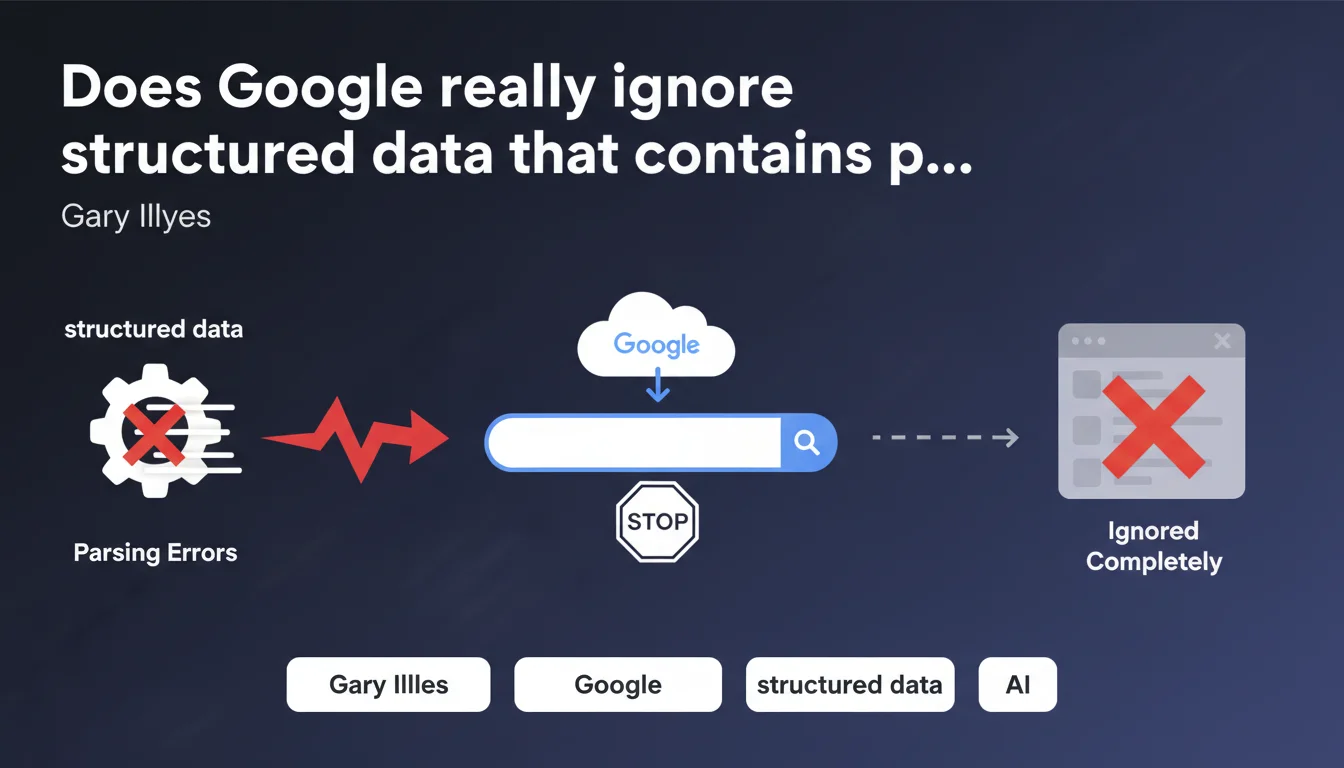
Google completely ignores structured data that contains parsing errors — no partial processing, no graceful recovery. If your Schema.org markup is malformed, it simply doesn't exist in the eyes of the search engine. It's a binary signal: it passes or it breaks.
What you need to understand
What does a "parsing error" concretely mean?
A parsing error occurs when Google fails to correctly read the JSON-LD, Microdata, or RDFa structure you've implemented. A missing comma, a poorly closed quote, a misspelled Schema.org property, an incompatible type — anything that prevents the parser from building a valid object.
Contrary to what some hope, Google doesn't do "automatic repair." The parser is not your IDE: it doesn't guess your intention. If the JSON is broken, the entire block of structured data is ignored, even if 95% of the content is correct.
Why does Google adopt such a strict stance?
Because ambiguity is expensive in terms of crawl resources and rich snippet reliability. Imagine if Google tried to "repair" your errors: it would have to interpret your intentions, which would open the door to unpredictable and non-reproducible results.
By requiring strictly valid markup, Google guarantees that the data it displays in the SERPs (price, reviews, availability) reflects exactly what the webmaster declared — without approximation or algorithmic hallucination.
What sets this approach apart from other engines or crawlers?
Some crawlers are more permissive and attempt partial recovery. Bing, for example, can sometimes extract fragments of structured data even in the presence of minor errors. Google, on the other hand, has clearly chosen the path of all or nothing.
This statement from Gary Illyes removes all ambiguity: no gray area, no degraded processing. If Search Console reports a parsing error, your markup is invisible to Google's algorithms.
- Parsing errors make the entire block of structured data invisible to Google
- No partial processing or automatic recovery is performed
- Strict validation ensures the reliability of rich snippets displayed in the SERPs
- Google adopts a binary approach: valid or ignored, with no gray area
- Search Console is the reference tool for detecting these errors
SEO Expert opinion
Is this statement consistent with real-world observations?
Yes, and it's actually one of the rare Google statements that matches exactly what we observe. Across thousands of audits, I've never seen Google exploit structured data with parsing errors flagged in Search Console. The behavior is systematic and reproducible.
However — and this is where it gets interesting — Google sometimes shows surprising tolerance for semantic errors (misused properties, approximate types) that don't break the parsing. It passes, but the rich snippet might not display as intended. [To be verified]: the boundary between "parsing error" and "semantic error" remains fuzzy in the official documentation.
What nuances should be added to this absolute rule?
First point: this rule applies at the level of the structured data block, not necessarily to the entire page. If you have three JSON-LD scripts on a page and only one contains an error, the other two can be exploited normally. This is granular isolation that many overlook.
Second nuance: Google can still index and rank your page normally, even if your structured data is ignored. You lose the rich snippets, the stars, the displayed prices — but not your basic organic ranking. The damage is primarily on click-through rate, not on direct ranking.
In what cases can this rule create an unforeseen problem?
Multi-language e-commerce sites with dynamic Schema.org generation are particularly exposed. A poorly escaped variable in a single language can break the JSON-LD for all product sheets in that locale. And since parsing fails, zero rich snippets appear, even if 99% of the catalog is technically correct.
Another tricky case: special characters in customer reviews or product descriptions. A single unescaped quote in a dynamic testimonial is enough to invalidate the entire Product block. You can have a perfect schema in theory, and chaos in production because of poorly sanitized user input.
Practical impact and recommendations
What should you concretely do to avoid these errors?
First line of defense: systematically validate your structured data with Google's Rich Results Test and the Schema.org validator before any production deployment. These tools detect the majority of JSON syntax errors and structural issues.
Next, automate monitoring. Set up alerts in Search Console to be notified as soon as a parsing error appears on a critical markup type (Product, Article, FAQ). Don't rely on a weekly manual check — errors can emerge after a deployment or plugin update.
- Validate all new markup with the Rich Results Test before deployment
- Configure Search Console alerts for structured data errors
- Audit high-traffic pages at least monthly
- Properly escape special characters in dynamic content
- Test structured data after each CMS or plugin update
- Isolate JSON-LD blocks to limit the impact of an error to a single markup type
- Maintain a staging environment to test schema modifications
Which critical errors deserve immediate attention?
JSON syntax errors (commas, quotes, braces) must be corrected with absolute priority — they break the entire block. Missing required properties (such as @type, name, or image depending on the schema) come right after.
Semantic errors (wrong property type, value outside expected format) are less binary, but can still prevent rich snippet display. Google doesn't always qualify them as "parsing errors," but the practical result is identical: no enriched snippet.
How do you verify that your site is compliant and protected?
Implement continuous monitoring with a tool like OnCrawl, Screaming Frog, or Sitebulb that parses your structured data on every crawl. Compare monthly reports to detect any regression.
For sites with more than 10,000 pages, consider an automated script that tests a representative sample via the Rich Results Test API. You'll identify error patterns (defective templates, problematic categories) without manually inspecting each URL.
Structured data with parsing errors is completely invisible to Google — no exceptions, no tolerance. Prevention involves systematic validation before deployment and continuous monitoring in production.
Given that the complexity of Schema.org implementations increases with eligible rich snippets (Product, Recipe, FAQ, HowTo, Video...), and each error can cost dozens of CTR points, it becomes strategic to rely on specialized expertise. Engaging an SEO agency that masters these technical markups allows you to secure implementation, automate checks, and respond quickly to alerts — often far more efficiently than fragmented internal management.
❓ Frequently Asked Questions
Une erreur de parsing sur un bloc JSON-LD affecte-t-elle les autres blocs de la même page ?
Mes données structurées invalides peuvent-elles nuire à mon classement organique ?
Comment savoir si Google a détecté une erreur de parsing sur mes pages ?
Les erreurs sémantiques (propriété mal utilisée) sont-elles considérées comme des erreurs de parsing ?
Faut-il supprimer complètement un balisage défectueux ou peut-on le laisser en attendant de le corriger ?
🎥 From the same video 18
Other SEO insights extracted from this same Google Search Central video · published on 07/06/2023
🎥 Watch the full video on YouTube →
💬 Comments (0)
Be the first to comment.