
Official statement
Other statements from this video 18 ▾
- □ Does canonical alone really prevent syndicated content from appearing in Discover, or do you actually need to add noindex?
- □ Does Google really penalize multiple domains targeting the same market, or is this just another SEO myth?
- □ Are your JavaScript library vulnerabilities causing your Google rankings to plummet?
- □ Can you really prevent Google from crawling certain parts of a webpage?
- □ Is it really worth your time submitting an XML sitemap to Google?
- □ Why isn't schema.org compliance enough to guarantee Google rich results?
- □ Do HSTS headers really impact your SEO performance?
- □ Does Google really care about the difference between HTML and XML sitemaps? Here's what John Mueller revealed
- □ Does Google really ignore structured data that contains parsing errors?
- □ Do numbers in your URLs really hurt your search rankings?
- □ Does index bloat really exist at Google?
- □ How can you permanently block Googlebot from crawling your website?
- □ Does Google really issue official SEO certifications?
- □ Do multiple navigation menus really hurt your SEO?
- □ Are host groups really a sign of cannibalization you need to fix?
- □ Can you really disavow toxic backlinks by targeting their IP address in Google's tool?
- □ Should you remove the NOODP meta tag from your Blogger sites?
- □ How do you get a video thumbnail in Google search results: what does Google really mean by 'main content'?
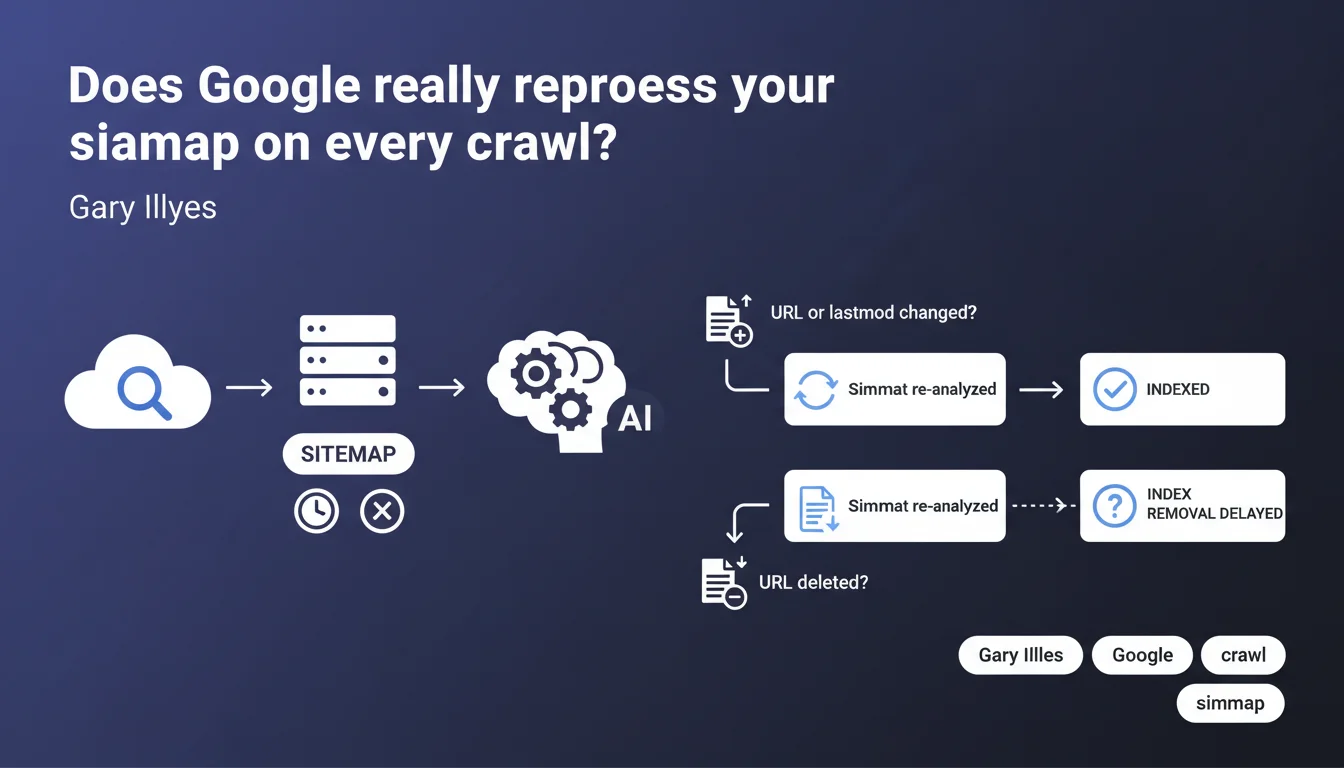
Google doesn't reprocess a sitemap identical to the last crawl — pure resource optimization. As soon as a URL or lastmod changes, the sitemap is analyzed again. Removing a URL from the sitemap absolutely does not guarantee its rapid removal from the index.
What you need to understand
How does Google detect that a sitemap has changed?
Google compares the current version of the sitemap with the one recorded during the previous crawl. If the content is strictly identical — same XML structure, same URLs, same lastmod attributes — the file is not reprocessed.
This is a strategy for resource optimization on Google's side. Why analyze 10,000 URLs if nothing has changed? The bot saves processing time and crawl budget for other tasks.
What triggers a new sitemap processing?
Two main elements: the addition or deletion of a URL, and the modification of a lastmod tag. Even a single modified line is enough to restart the full analysis of the file.
Concretely? If you add a new page or change the last modification date of an existing URL, Google reprocesses the entire sitemap during the next crawl.
Does removing a URL from the sitemap force its deindexation?
No. It's a common misconception to believe that deleting a URL from the sitemap leads to its rapid removal from the index.
The sitemap is a discovery signal, not a deindexation order. Google can keep the URL in the index if it remains accessible and linked from other pages.
- The sitemap is not reprocessed if no changes are detected since the last crawl
- Any URL or lastmod modification triggers a complete reprocessing
- Removing a URL from the sitemap doesn't guarantee its removal from the index
- The sitemap remains a discovery signal, not a strict indexation control tool
SEO Expert opinion
Does this statement match field observations?
Yes. We've observed for years that Google doesn't systematically crawl static sitemaps. Logs clearly show that some XML files aren't even touched for weeks if the site doesn't evolve.
However, Gary Illyes remains vague about verification frequency. How long does Google wait before checking if a sitemap has changed? It depends on crawl budget, site popularity, content freshness — in short, no universal rule. [To verify] case by case through logs.
Should you really rely on lastmod to force reprocessing?
Lastmod is a signal, not a guarantee. Google can ignore it if it detects that the page hasn't actually changed — or if it suspects manipulation.
Artificially modifying all lastmod dates to "wake up" Google? Bad idea. The bot isn't fooled: if the HTML content remains identical, the signal loses its credibility. Over time, Google could completely ignore your lastmod values.
Why isn't removing a URL from the sitemap enough to deindex it?
Because the sitemap is just one of the discovery channels. Google can find the URL through internal linking, external backlinks, crawl history — and keep it in the index as long as it returns a 200.
To deindex properly: combination of noindex + sitemap removal + possibly robots.txt if you want to block crawling. Or better: 404/410 if the page no longer needs to exist.
Practical impact and recommendations
How do you optimize your sitemap management?
First rule: don't overload your sitemaps with unnecessary URLs. If Google doesn't reprocess an identical file, you might as well ensure it contains only strategic pages.
Segment your sitemaps by content type or freshness. A sitemap dedicated to new content will be reprocessed more often than a static file with old pages rarely modified.
What errors should you avoid with lastmod attributes?
Don't systematically modify all lastmod dates with every sitemap generation. It's counterproductive and degrades the trust that Google places in your signals.
Update lastmod only when the page content has actually changed — redesign, section additions, key information updates. Not for a simple footer change or ad slot modification.
How do you force deindexation of URLs removed from the sitemap?
Removing a URL from the sitemap isn't enough. Winning combination: 404 or 410 if the page no longer exists, or noindex if it should remain accessible but out of the index.
Then request a recrawl via Search Console to speed up implementation. Monitor logs to verify that Google actually crawls the affected URLs.
- Segment sitemaps by content type or update frequency
- Only modify lastmod when page content has genuinely changed
- Never rely solely on the sitemap for deindexation — use 404/410 or noindex
- Verify through logs that Google crawls modified sitemaps
- Avoid overloaded sitemaps with thousands of low-strategic URLs
- Request manual recrawl via Search Console for critical changes
❓ Frequently Asked Questions
Google crawle-t-il mon sitemap à chaque fois qu'il visite mon site ?
Modifier uniquement le lastmod suffit-il à forcer un nouveau traitement du sitemap ?
Retirer une URL du sitemap la fait-elle disparaître de l'index ?
Combien de temps Google met-il à détecter un changement dans mon sitemap ?
Puis-je segmenter mes sitemaps pour optimiser leur retraitement ?
🎥 From the same video 18
Other SEO insights extracted from this same Google Search Central video · published on 07/06/2023
🎥 Watch the full video on YouTube →
💬 Comments (0)
Be the first to comment.