
Official statement
Other statements from this video 18 ▾
- □ Does canonical alone really prevent syndicated content from appearing in Discover, or do you actually need to add noindex?
- □ Does Google really penalize multiple domains targeting the same market, or is this just another SEO myth?
- □ Are your JavaScript library vulnerabilities causing your Google rankings to plummet?
- □ Can you really prevent Google from crawling certain parts of a webpage?
- □ Is it really worth your time submitting an XML sitemap to Google?
- □ Why isn't schema.org compliance enough to guarantee Google rich results?
- □ Do HSTS headers really impact your SEO performance?
- □ Does Google really reprocess your sitemap on every crawl?
- □ Does Google really care about the difference between HTML and XML sitemaps? Here's what John Mueller revealed
- □ Does Google really ignore structured data that contains parsing errors?
- □ Do numbers in your URLs really hurt your search rankings?
- □ Does index bloat really exist at Google?
- □ How can you permanently block Googlebot from crawling your website?
- □ Does Google really issue official SEO certifications?
- □ Do multiple navigation menus really hurt your SEO?
- □ Are host groups really a sign of cannibalization you need to fix?
- □ Should you remove the NOODP meta tag from your Blogger sites?
- □ How do you get a video thumbnail in Google search results: what does Google really mean by 'main content'?
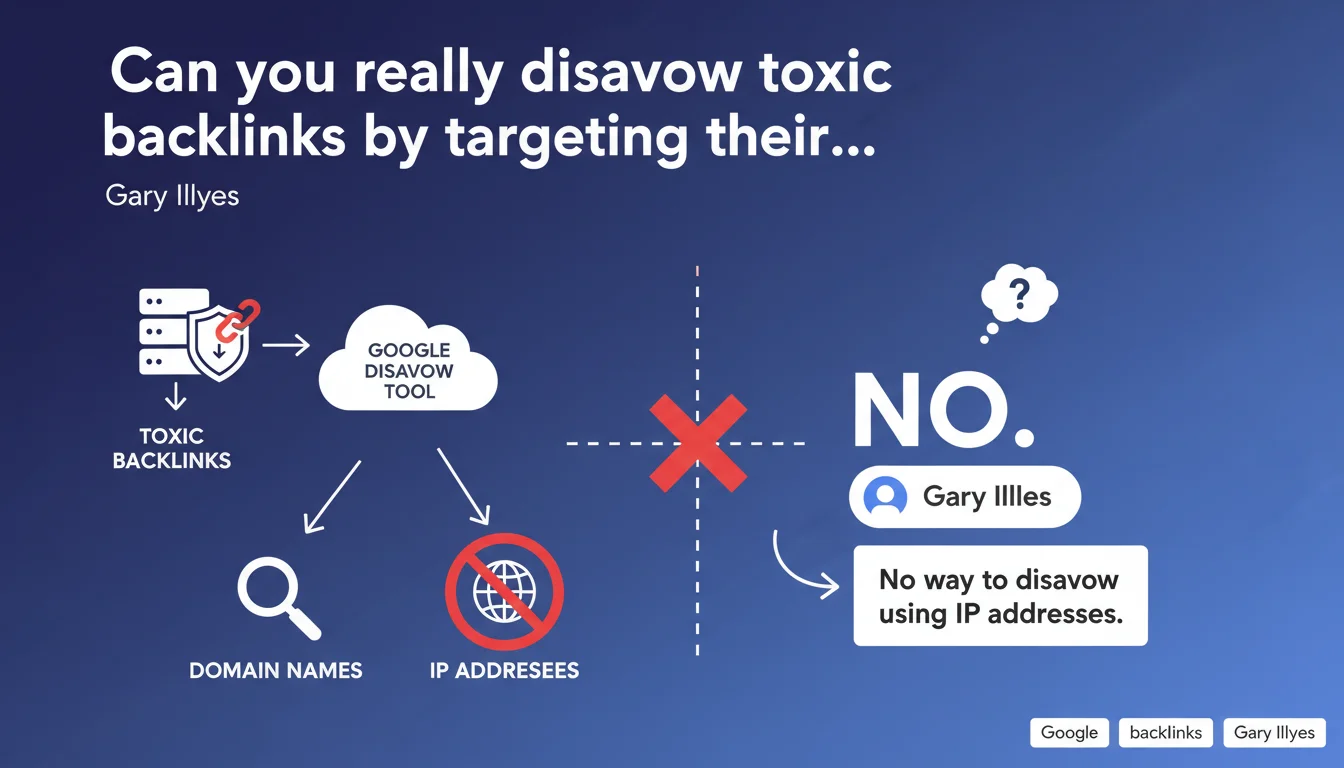
Google confirms the impossibility of disavowing links via IP addresses in its Disavow tool. Only domain names and URLs are accepted. This technical limitation directly impacts link profile cleanup strategies, especially against spam networks distributed across multiple IPs.
What you need to understand
Why does this technical limitation exist?
Google's disavow tool works exclusively with standard web identifiers: full domain names or individual URLs. Technically, IP addresses don't constitute a stable or reliable identifier for characterizing a link — a single server can host hundreds of different sites, some legitimate, others toxic.
This restriction forces SEOs to work at the referring domain level rather than the infrastructure level. Practically speaking, it's impossible to block en masse all sites hosted on a suspicious IP — you must identify and disavow them one by one.
Which use cases are directly affected?
Spam networks that multiply domains on the same infrastructure become harder to neutralize quickly. You spot 50 terrible domains on the same IP? You'll have to list these 50 domains in your disavow file, not just the IP.
Automated negative SEO attacks exploiting farms of expired domains also become more time-consuming to clean up. Individual identification of each toxic domain becomes mandatory.
How does Google actually handle these situations?
Google has claimed for years that its algorithm naturally ignores manipulative links without manual intervention being necessary. This statement reinforces that position: the disavow tool remains a marginal safety net, not a mass cleanup weapon.
In practice, Gary Illyes suggests that disavowing at the IP level would be ineffective anyway — Google's algorithmic signals already operate at a more granular level, at the domain or page level.
- The Disavow tool only accepts domains and URLs, never IP addresses
- A single server can host hundreds of sites with different profiles
- Multi-domain spam networks require domain-by-domain disavowal
- Google considers its algorithm robust enough to ignore spam without systematic manual intervention
- This technical limitation reflects Google's philosophy: treat spam at the source (the algorithm), not through massive manual tools
SEO Expert opinion
Is this restriction consistent with real-world observations?
Let's be honest: in 90% of cases, disavowing at the IP level would indeed make no sense. Shared hosting providers group thousands of unrelated sites together — blocking an IP would amount to blindly disavowing hundreds of legitimate domains.
But — and this is where it gets sticky — the remaining 10% pose a problem. Some Private Blog Networks (PBN) or spam farms effectively use entire dedicated servers for their operations. In these specific cases, targeting the IP would technically be more efficient than domain-by-domain disavowal.
What nuances should be applied to this statement?
Google isn't saying that IP-level disavowal would be useless — it's simply saying that the tool doesn't allow it. Important distinction. Technically, nothing would prevent Google from implementing this functionality; they chose not to.
Why? Probably to limit collateral damage. A rushed SEO who disavowed a range of IPs without careful analysis could destroy their link profile by blocking legitimate sources hosted on the same infrastructure. Google prefers to enforce granularity.
[To verify] — Gary Illyes doesn't specify whether the algorithm's automatic spam detection itself uses signals at the IP level. It probably does for certain patterns (notably hosting footprints), but this part remains opaque.
In what cases does this limitation actually become problematic?
Three concrete scenarios:
1. Massive negative SEO attack with automatic generation of thousands of expired domains pointing to your site. Having to list each domain individually in the disavow file becomes Kafkaesque. Google will probably say its algorithm already ignores these links — but manual penalties still exist.
2. Spam networks identified by IP during forensic analysis. You spot 200 domains across 5 dedicated IPs, all with the same technical footprint. IP-level disavowal would be surgical — but impossible. You must extract, list, format these 200 domains manually.
3. Continuous link profile monitoring. SEO tools often detect toxic networks by clustering IPs. Having to translate these clusters into domain lists adds a layer of complexity and latency to your response.
Practical impact and recommendations
What should you concretely do to clean up your link profile?
First step: identify toxic domains individually, not IPs. Use Search Console, Ahrefs, Majestic, or Semrush to extract the complete list of referring domains. Filter by quality metrics (Trust Flow, Domain Authority, spam score).
Second step: analyze the hosting context to identify networks. If 50 domains share the same IP with identical footprints (same CMS, same structure, same anchors), explicitly list these 50 domains in your disavow file. No shortcuts possible.
Third step: prioritize disavowals. Don't waste time disavowing every low-quality link — Google probably ignores them already. Focus on clear patterns of manipulation: oversaturated anchors, identified networks, automated spam.
What mistakes should you avoid in this situation?
Classic mistake: wanting to disavow "just in case" hundreds of suspect domains without careful analysis. The disavow file isn't a vacuum — it's a surgical scalpel. Each line has a cost: you explicitly tell Google to ignore these signals. If you block neutral or slightly positive links, you lose juice.
Another trap: using automated tools that generate huge disavow files based on arbitrary "toxicity" thresholds. These scores are third-party estimates, not Google verdicts. A domain with a 60% spam score on Moz might very well transmit valid PageRank according to Google.
And that's where it gets tricky: it's impossible to know with certainty whether a link is ignored by the algorithm or taken into account negatively. Google deliberately maintains this fog. Result: many unnecessary disavowals, some counterproductive.
How should you structure your disavow file effectively?
Simple format, one instruction per line:
- Use
domain:example.comto block all links from an entire domain (faster than listing each URL) - Use full URLs only if you want to disavow a specific page from an otherwise legitimate site
- Group by topic with comments (
# PBN network detected on...) to facilitate future audits - Keep a history of your disavow files — Google overwrites the previous one with each upload
- Check syntax: no unnecessary spaces, no http:// before domains, no wildcards unless you master them
- Limit yourself to truly toxic links: identified networks, proven spam, obvious black-hat anchors
- Reassess every 6-12 months: some disavowed domains may have changed ownership and become legitimate again
The domain-level restriction imposes a granular and documented approach to link profile cleanup. Out with massive IP disavowals, in with domain-by-domain forensic analysis.
Concretely? Invest in tools capable of clustering toxic networks by technical footprints, then export domain lists to feed your disavow file. Automate detection, but manually validate before disavowing.
These link profile analyses and proactive disavow management can quickly become time-consuming, especially on sites with thousands of backlinks. If your internal expertise is limited or you lack the time for these regular audits, support from an SEO agency specialized in cleaning toxic profiles can prove invaluable — not just to identify real risks, but especially to avoid counterproductive disavowals that would weaken your authority.
❓ Frequently Asked Questions
Pourquoi Google ne permet-il pas le désaveu par adresse IP ?
Les réseaux de spam sur IP dédiée sont-ils plus difficiles à nettoyer ?
L'algorithme Google détecte-t-il le spam au niveau IP ?
Faut-il désavouer tous les liens d'un réseau détecté sur la même IP ?
Peut-on utiliser des wildcards pour cibler plusieurs domaines d'un coup ?
🎥 From the same video 18
Other SEO insights extracted from this same Google Search Central video · published on 07/06/2023
🎥 Watch the full video on YouTube →
💬 Comments (0)
Be the first to comment.