
Official statement
Other statements from this video 2 ▾
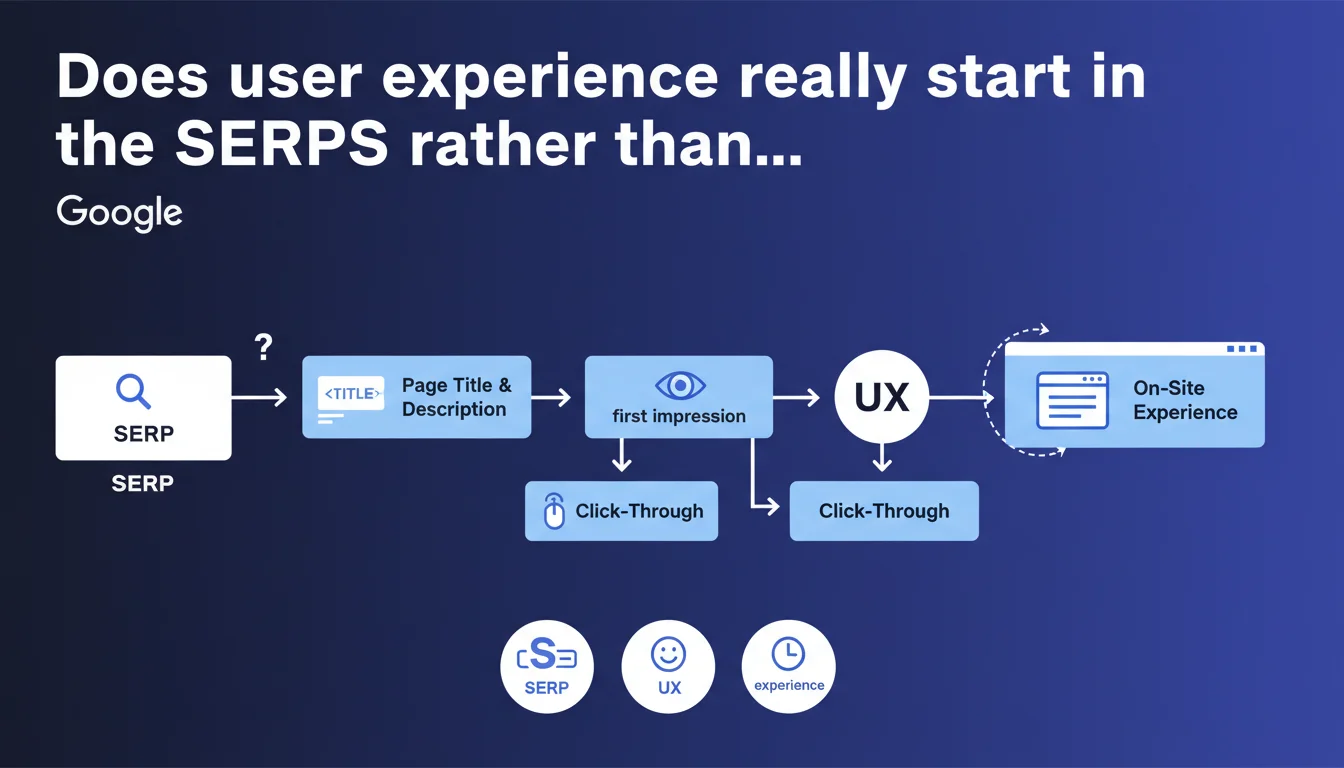
Google claims that user experience starts in the search results, not just on your site. Titles and descriptions are integral parts of the user journey. In practice, this means a poorly optimized snippet damages UX before users even click through.
What you need to understand
Why is Google redefining the boundaries of UX?
Google is expanding the scope of user experience beyond the traditional limits of a website. According to this statement, UX is no longer limited to page speed, mobile usability, or Core Web Vitals — it begins the moment users scan search results.
This approach repositions meta titles and meta descriptions as full UX components, not mere technical tags. The snippet becomes your first interaction with users, the first relevance test before even a single byte of your page is downloaded.
What does this actually change for SEO professionals?
It changes the way you prioritize optimizations. A technically flawless site with vague or misleading snippets delivers degraded UX right from the SERP — and Google knows it.
The logic: if a user clicks a result and immediately bounces back because the content doesn't match the snippet, that's a UX failure signal Google can measure. Fast bounce rates, failed pogo-sticking, all of it gets recorded.
Is this vision shared by other search engines?
Google isn't alone in this thinking. Bing and alternative search engines also place growing importance on snippet-content consistency. But Google goes further by explicitly integrating this dimension into its overall UX discourse.
What's new is the public statement that UX begins before the site. This opens the door to ranking factors related to snippet quality — even if Google remains vague about the exact mechanisms.
- UX is no longer confined to the technical boundaries of the site
- Snippets are UX components measurable by Google
- A snippet-content gap generates negative behavioral signals
- This approach expands the scope of traditional SEO optimizations
SEO Expert opinion
Is this statement consistent with observed practices?
Yes and no. In the field, we've observed for years that click-through rates (CTR) vary dramatically based on snippet quality. A poorly crafted title can cut CTR in half, even in position 1. That's an established fact.
What's less clear is how Google values this pre-site UX in its algorithm. Google says snippets are part of overall UX, but never explicitly states: "a good snippet improves your ranking." [Needs verification] — no direct correlation has been publicly demonstrated.
What nuances should we add?
Google rewrites titles and descriptions massively. According to several studies, between 60% and 80% of titles are modified in the SERPs. So how much real control do you actually have over pre-site UX?
You can optimize your tags as much as you want — if Google decides to rewrite them with random content snippets, your UX work goes out the window. This is a major limitation of this vision. Google tells you "snippets are part of UX", but Google ultimately controls them in the end.
In which cases does this rule apply less?
For navigational queries (brand searches), snippet UX matters far less. The user already knows where they're going, they click the first result anyway. The snippet can be poor, it won't change behavior.
However, for informational or transactional queries where competition is fierce, the snippet becomes a major differentiator. That's where pre-site UX really tips the balance.
Practical impact and recommendations
What should you do concretely to optimize pre-site UX?
First step: audit your current snippets. Use Search Console to identify pages with abnormally low CTR relative to their position. This often signals a snippet that isn't converting.
Next, work on promise-content consistency. If your title promises a solution in 5 steps, your content must deliver exactly that. A gap = disappointment = fast bounce = negative signal for Google.
What mistakes should you absolutely avoid?
Don't over-optimize your titles with grotesque keyword stuffing. Google rewrites them systematically anyway, and it degrades actual UX on top of that. A readable, informative title always outperforms a keyword-stuffed one.
Avoid generic descriptions like "Discover our quality services." Zero added value. A good description addresses search intent and gives a concrete preview of content. Be specific.
How do you verify that your snippets are performing?
Search Console is your best friend here. Segment your pages by type (categories, product sheets, articles) and compare average CTR by position. Identify outliers — pages underperforming at equivalent positions.
Also test variations with power words or numbers in titles. Snippets with concrete elements ("7-Step Guide," "Save 30%") typically generate better CTR. Measure, iterate, improve.
- Audit the actual CTR of your strategic pages in Search Console
- Verify that your titles/descriptions aren't systematically rewritten by Google
- Strictly align the snippet promise with your page's actual content
- Remove generic descriptions and replace them with specific content
- Test variations with numbers, power words, or differentiating elements
- Monitor CTR evolution after each snippet modification
Optimizing snippets for pre-site UX requires a data-driven approach and rigorous monitoring. Between Google's automatic rewrites, empirical A/B testing, and detailed behavior analysis, complexity can escalate quickly.
For high-volume sites or competitive sectors, it can be worthwhile to work with a specialized SEO agency capable of conducting these optimizations methodically, correctly interpreting Search Console data, and cross-referencing behavioral signals with business performance. Personalized support often reveals levers invisible in superficial analysis.
❓ Frequently Asked Questions
Google pénalise-t-il les sites dont les snippets sont mal optimisés ?
Pourquoi Google réécrit-il mes titles alors qu'ils sont optimisés ?
Un bon CTR améliore-t-il directement mon classement ?
Les rich snippets comptent-ils aussi dans cette UX pré-site ?
Dois-je optimiser différemment mes snippets selon le type de requête ?
🎥 From the same video 2
Other SEO insights extracted from this same Google Search Central video · published on 21/11/2024
🎥 Watch the full video on YouTube →
💬 Comments (0)
Be the first to comment.