
Official statement
Other statements from this video 2 ▾
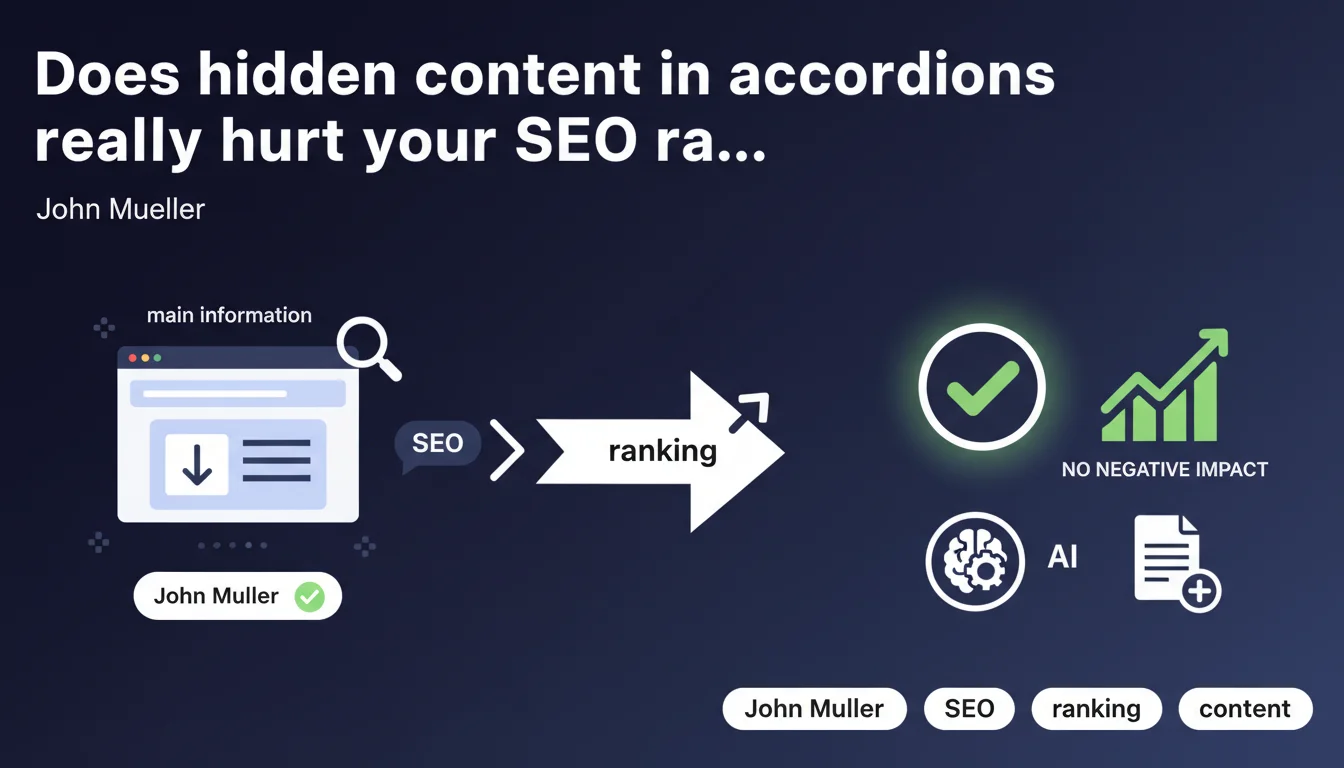
Google confirms that content placed behind accordions or expandable elements has no negative impact on search rankings. The key is that the main information remains visible immediately — the rest can be structured according to your UX needs without fear of penalty.
What you need to understand
Why does this accordion question keep coming up again and again?
For years, hidden content has been a hotly debated topic in the SEO community. The idea was straightforward: if Google doesn't see the content immediately, it might devalue it or ignore it completely.
This fear stemmed from an era when cloaking techniques and hidden text were used to manipulate rankings. Google had therefore hardened its stance on all content not visible on page load.
What exactly does Mueller say about accordions?
The statement is clear: from an SEO perspective, hiding content behind expandable elements is acceptable. Google does not penalize this interface pattern as long as the main information remains accessible immediately.
The important nuance here? "The main information that people are searching for is generally visible anyway." In other words, if you bury the essentials behind an accordion, you're missing the point.
How does Google technically handle this content?
Google crawls and indexes content present in the DOM, whether it's visible or hidden via CSS/JavaScript. Accordions and tabs are rendered during page exploration.
However, there is an implicit hierarchy: content immediately visible probably carries more weight in determining the main topic of the page. Expanded content serves more as contextual enrichment.
- Content in accordions is crawled and indexed normally
- Main information must remain visible without user interaction
- This UX pattern entails no direct SEO penalty
- The distinction between priority and secondary content remains important
- Google prioritizes user experience above all else
SEO Expert opinion
Is this statement consistent with real-world observations?
Yes and no. On e-commerce sites or product detail pages, we do see that technical descriptions placed in accordions rank correctly. Featured snippets regularly pull from these expandable sections.
However — and this is where it gets tricky — some tests show that moving strategic content from an accordion to visible page body improves performance. Not systematically, but often enough that we can't just brush it aside.
What nuance doesn't Mueller clarify here?
He doesn't talk about volume or ratio. If 90% of your text content is hidden in accordions and only 200 characters are visible, you're taking a risk. [To be verified] on each specific case.
Mueller insists on "main information" — but who defines what's main? The user? Google? You? This gray area leaves plenty of room for interpretation. In practice, rely on search intent: what the user expects first must be visible.
In what cases might this rule not apply?
Category pages with SEO content buried under 15 filters and accordions: there, you're flirting with the limit. Google can theoretically crawl everything, but user experience becomes questionable.
Another edge case: news sites or blogs. Hiding entire paragraphs of an article behind accordions can confuse readers and dilute editorial coherence. Here, UX takes priority — and poor UX always ends up impacting SEO indirectly.
Practical impact and recommendations
What should you concretely do with your accordions?
First, map your pages that use expandable elements. Identify what content is hidden and ask yourself: does this content answer the main search intent or a secondary question?
If it's secondary (FAQ, complementary technical details), leave it in an accordion. If it's central, make it visible by default. Simple.
What mistakes should you absolutely avoid?
Don't hide your strategic keywords only within accordions. Google sees them, certainly, but you lose clarity for the user — and thus perceived relevance.
Also avoid cascading nested accordions. Three clicks to access the info? Nobody will go that far. Neither the user nor Google in terms of weight given to the content.
How do you verify your implementation is correct?
Use the URL inspection tool in Search Console and check the rendered HTML. Verify that accordion content appears in the DOM, even if hidden by CSS.
Also test on mobile. Open your page in private browsing mode on a smartphone and ensure accordions are functional and content remains accessible without friction.
- Audit your pages with accordions and identify primary vs secondary content
- Make visible the content that directly answers search intent
- Verify HTML rendering via Search Console on both desktop and mobile
- Avoid hiding strategic keywords behind multiple levels of interaction
- Structure your accordions with appropriate semantic markup (HTML5)
- Test actual UX: if you yourself find accessing content cumbersome, that's a bad sign
- Monitor engagement metrics (bounce rate, time on page) after making changes
Accordions don't harm SEO if you follow one simple rule: priority information stays visible. Everything else is just a matter of balance between UX and content accessibility.
Keep in mind that optimizing these elements requires a deep understanding of user intent and thorough technical analysis. If you manage a complex site with multiple page typologies, calling in a specialized SEO agency can help you avoid costly mistakes and maximize your results quickly.
❓ Frequently Asked Questions
Google pénalise-t-il le contenu dans les accordéons ?
Le contenu masqué a-t-il moins de poids SEO ?
Peut-on mettre toute sa description produit en accordéon ?
Les accordéons fonctionnent-ils pareil sur mobile ?
Faut-il éviter les accordéons pour le SEO ?
🎥 From the same video 2
Other SEO insights extracted from this same Google Search Central video · published on 21/11/2024
🎥 Watch the full video on YouTube →
💬 Comments (0)
Be the first to comment.