
Official statement
Other statements from this video 2 ▾
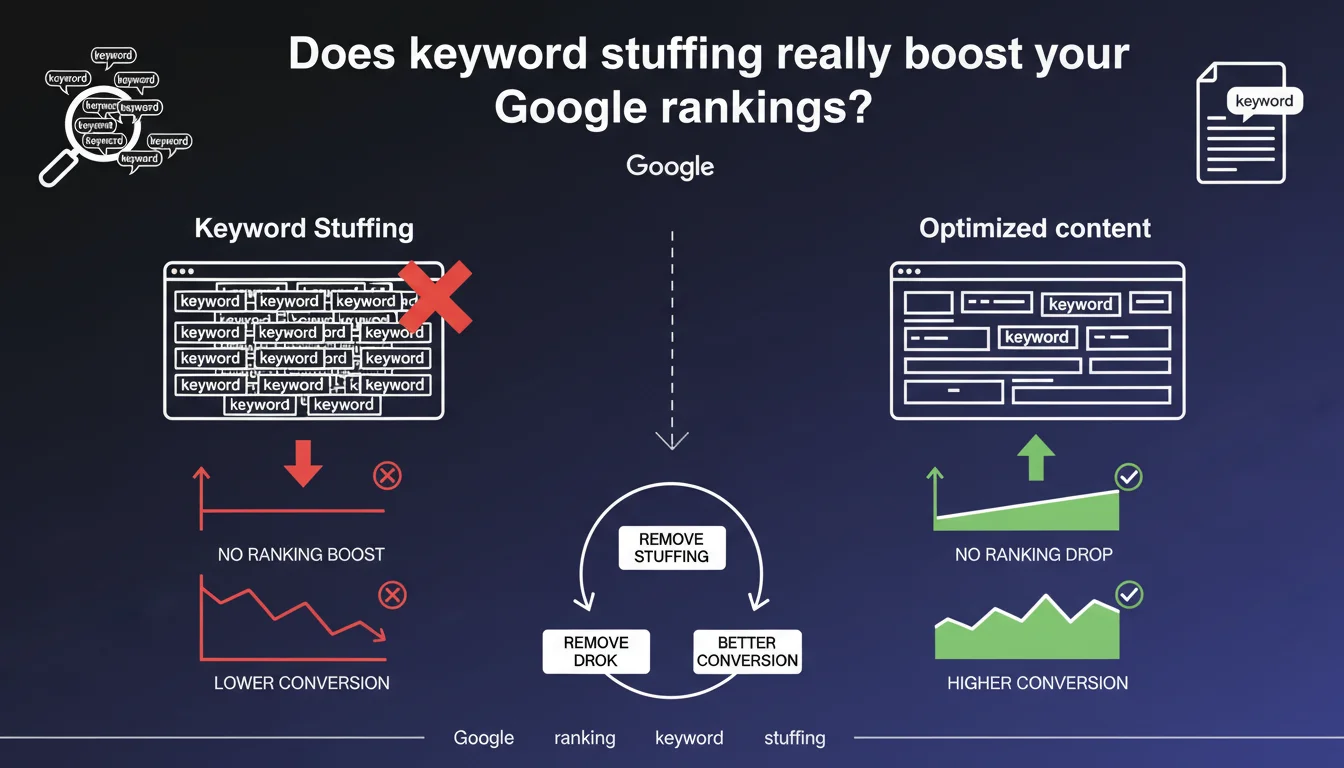
Google confirms that cramming a page with keywords does nothing for ranking. A real case study shows that a site already well-ranked suffered no loss in position after removing keyword stuffing, while improving its conversion rate. The algorithm values relevance and user experience, not keyword density.
What you need to understand
Why is Google making this statement now?
Keyword stuffing is a practice as old as SEO itself. Yet Google continues to drive home the message: this technique is ineffective. While the algorithm has evolved over the years, some practitioners still believe that high keyword density positively influences rankings.
This statement is backed by a concrete case: a well-positioned site removed its keyword stuffing without losing a single position in the SERPs. Better yet, the conversion rate climbed. This isn't theory — it's a real-world test confirming what Google has been repeating for a decade.
What exactly is keyword stuffing?
Keyword stuffing is the abusive and unnatural repetition of a keyword on a page. Concretely: clunky sentences, lists of hidden keywords in the footer, paragraphs that repeat the same term 10 times in 5 lines. In short, anything that makes text painful to read for humans.
Google distinguishes this from legitimate keyword usage. If your page is about "women's running shoes," it's normal for the phrase to appear in the title, a few subheadings, and naturally in the body text. The problem is deliberate excess meant to manipulate the algorithm.
Does this case study really prove that keyword stuffing is useless?
A single case doesn't make absolute truth, but it illustrates a trend observed for years. Google's algorithm relies on natural language models capable of understanding context and intent without mechanically counting word occurrences.
The fact that the tested site maintained its ranking by removing stuffing confirms that Google doesn't weight rankings on raw density. And the improvement in conversion rate? Logical: fluent text converts better than text stuffed with repetition.
- Keyword stuffing provides no measurable advantage in terms of Google rankings
- Removing keyword stuffing does not cause a well-positioned site to drop
- Natural, readable content improves conversion rate
- Google uses semantic algorithms that understand context, not just word frequency
- Keyword stuffing is even a negative signal for user experience, which can indirectly harm SEO
SEO Expert opinion
Is this statement really consistent with on-the-ground observations?
Yes, and it's not even new. Since Panda arrived in 2011, then Hummingbird and BERT, Google has gradually refined its understanding of natural language. Sites that continued stuffing keywords either stagnated or fell behind competitors focusing on editorial quality.
What's interesting here is that Google provides a concrete case. Too often, official statements remain vague. Here, we have a real test: removal of keyword stuffing, maintenance of ranking, improvement in conversion rate. Hard to be clearer than that.
What nuances should we consider?
Attention: saying that keyword stuffing is useless does not mean keywords are dead. Google still needs semantic signals to understand what a page is about. The main keyword should appear in strategic areas: title, H1, a few H2s, naturally in the body text.
The problem is excess. And that's where it gets tricky: where to draw the line? Google provides no numbers. No "ideal density," no magic threshold. This vagueness maintains a gray area where some SEOs continue testing the limits. [To verify]: Google doesn't specify at what frequency usage becomes "stuffing." It's subjective, and the algorithm probably evaluates it on a case-by-case basis.
In what cases might this rule not apply?
Let's be honest: on ultra-competitive niches, some overoptimized sites continue to rank. Not because keyword stuffing works, but because they compensate with other factors (massive backlinks, domain authority, age). Stuffing doesn't help them — it doesn't sink them either if everything else is solid.
Another case: technical or legal pages where repetition of a term is mandatory (legal notices, terms and conditions, standardized product sheets). There, Google knows how to distinguish between legitimate repetition and manipulation. At least in theory.
Practical impact and recommendations
What should you do concretely on your existing pages?
First step: audit your content. Identify pages where a keyword returns excessively, often in awkward turns of phrase. Read your texts aloud — if it sounds artificial, there's a problem.
Next, rewrite. Vary your formulations. Use synonyms, related expressions, connected terms. Google perfectly understands that "SEO agency," "search engine optimization agency," and "SEO expert" all refer to the same concept. No need to repeat the exact same phrase 20 times.
What mistakes should you avoid going forward?
Don't fall into the opposite trap: under-optimizing. Some SEOs, frightened by keyword stuffing, dilute their keywords so much they lose clarity. Google needs to know what your page is about. The main keyword should appear in the title, the H1, and naturally in the text.
Another common mistake: stuffing alt tags and internal link anchors. Same logic: an image of "women's running shoes" doesn't need an alt that says "women's running shoes cheap women's running shoes on sale." Describe the image normally.
How can you verify that your site respects this rule?
Use semantic analysis tools to measure keyword density on your pages. Not to reach a magic number, but to spot blatant excess. If a term exceeds 3-4% density, it's probably too much.
Have your pages tested by real users. If several people tell you a text feels heavy or repetitive, that's a clear signal. SEO is first and foremost for humans — the algorithm follows.
- Audit your content to spot excessive keyword repetition
- Rewrite artificial passages by varying formulations and using synonyms
- Ensure the main keyword appears in strategic areas (title, H1, H2) but naturally
- Avoid stuffing in alt tags, internal link anchors, and meta descriptions
- Use semantic analysis tools to detect density excess
- Test the readability of your texts with real users
- Always prioritize fluency and user experience over mechanical repetition
Google's message is simple: write for humans, not for the algorithm. Natural, well-structured, and enjoyable-to-read content performs better than text stuffed with keywords. If you find that your pages are over-optimized, a rewrite can not only preserve your ranking but also boost your conversions.
These editorial optimizations, while conceptually simple, require an expert eye to be executed effectively at scale. Between semantic auditing, strategic rewriting, and performance tracking, it may be wise to work with a specialized SEO agency that knows how to balance technical optimization and editorial quality without compromising your results.
❓ Frequently Asked Questions
Quelle est la densité de mots-clés idéale pour une page ?
Peut-on perdre des positions en supprimant le keyword stuffing ?
Les synonymes et variantes de mots-clés sont-ils pris en compte par Google ?
Le keyword stuffing dans les balises alt est-il pénalisé ?
Faut-il encore optimiser ses contenus pour des mots-clés spécifiques ?
🎥 From the same video 2
Other SEO insights extracted from this same Google Search Central video · published on 21/11/2024
🎥 Watch the full video on YouTube →
💬 Comments (0)
Be the first to comment.