
Official statement
Other statements from this video 13 ▾
- □ Is technical SEO really still essential for search rankings?
- □ Are You Wasting Time on Obscure Technical SEO Details Instead of Mastering the Basics?
- □ Is Search Console really the solution to fix all your SEO problems?
- □ Does Google really prioritize your homepage first when it comes to crawling and indexing?
- □ Does duplicate content really always come from exact copy-paste?
- □ Are user feedback signals more revealing than traffic metrics when assessing page quality?
- □ Does SEO quality really come down to helping users accomplish what they came to do?
- □ Does a truly unique perspective really hold the key to ranking in saturated niches?
- □ Should you really delete low-traffic pages from your website?
- □ Should you really be merging and redirecting content regularly to boost your SEO performance?
- □ Should you really treat all crawl errors the same way?
- □ Do you really need to match your title tag and H1 for SEO success?
- □ Should you be using generative AI to write your SEO content?
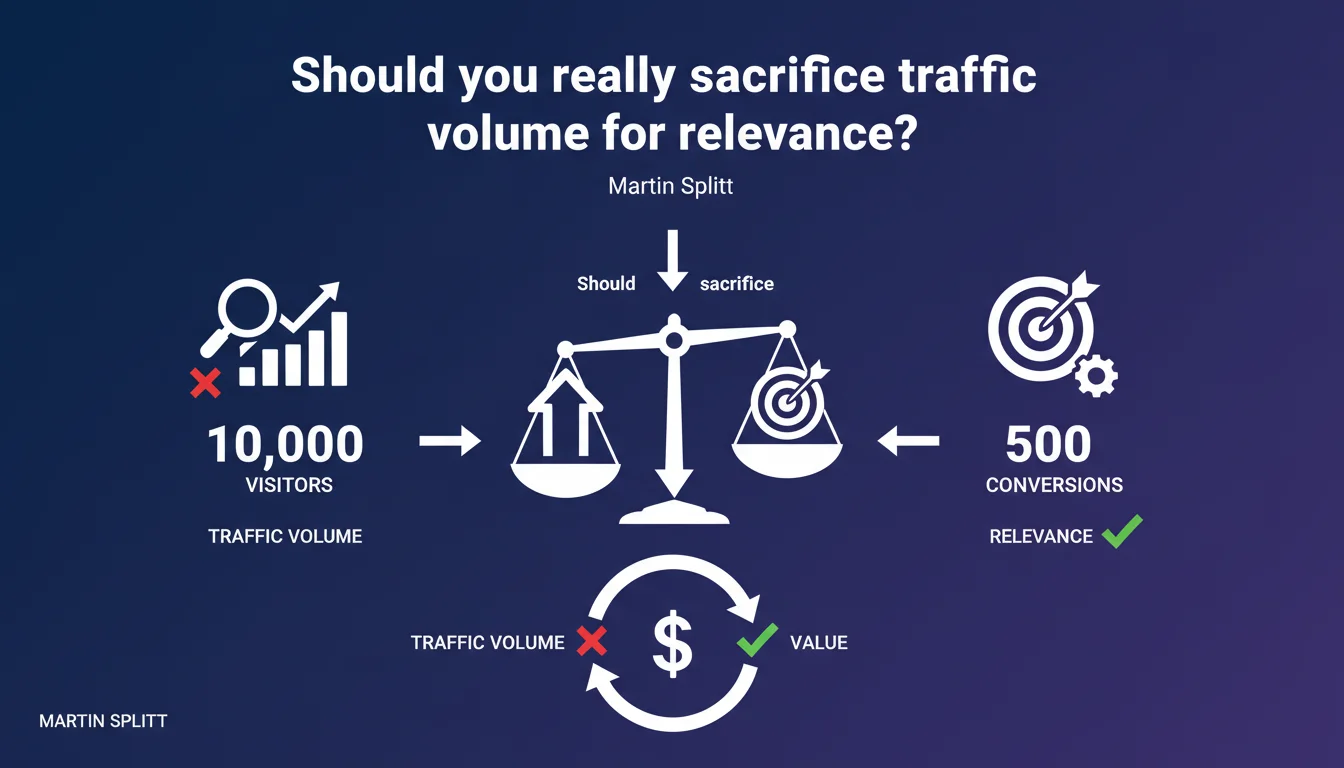
Google claims that high traffic without relevance has no real value. Martin Splitt insists: looking at volume numbers alone is misleading — traffic relevance is what matters. For SEOs, this means rethinking KPIs and prioritizing visitor quality over raw numbers.
What you need to understand
Why does Google emphasize relevance over volume?
Martin Splitt's statement breaks a historical SEO metric: raw traffic. For years, client reports have highlighted visitor numbers as a success indicator. Google is reminding us here that this number doesn't reflect business value if visitors don't match the site's true intent.
Concretely? An e-commerce site that attracts 100,000 visitors looking for free content rather than products generates volume without conversion. Relevance measures the alignment between search intent and the site's offering. This alignment is what transforms a visitor into a customer, lead, or engaged user.
What is "non-relevant" traffic according to Google?
Non-relevant traffic consists of visitors who land on your site through poorly targeted queries or misleading content. For example: optimizing an article with high-volume keywords that have no connection to your core business.
Another classic case: sites that attract massive informational traffic while selling services. Users arrive, consume free content, then leave. Bounce rate skyrockets, session duration plummets — and Google records these behavioral signals.
How do you measure the "real value" of traffic?
Google provides no precise metric here — as usual, the statement remains vague. In practice, value is measured through business indicators: conversion rate, average order value, form submissions, page views per session on strategic content.
A good SEO proxy: compare engagement rate (qualified sessions / total sessions) across different organic traffic channels. If certain pages generate 80% immediate bounce rate, their relevance is questionable — no matter how much volume they attract.
- Relevance > Volume: qualified traffic of 10,000 visitors beats generic traffic of 50,000
- Behavioral signals (bounce, duration, engagement) likely influence rankings
- Optimizing for high-volume keywords off-target dilutes your site's relevance
- Google implicitly encourages sites to target intentional queries aligned with their offering
SEO Expert opinion
Is this statement consistent with observed practices?
Yes and no. In the field, sites that optimize for pure relevance do see better conversion rates. But Google continues to favor high-traffic sites in its algorithms — authority is built by satisfying large volumes of searches.
The paradox: a site attracting 500,000 monthly visitors (even with 40% low-relevance traffic) accumulates more positive signals than an ultra-targeted site with 10,000 visitors. Relevance alone doesn't compensate for lacking authority. [To verify]: Google doesn't explain how its algorithm weights relevance vs. volume in actual rankings.
What nuances should we add to this view?
Martin Splitt speaks here from a webmaster / business perspective, not pure algorithm. What he says is true for your ROI — relevant traffic generates more returns. But this doesn't mean Google actively penalizes sites attracting broad traffic.
Important nuance: some sites must cast a wide net to exist — aggregators, media outlets, content platforms. Their model relies precisely on volume, monetized through advertising. Google's statement doesn't apply uniformly to all business models.
In which cases doesn't this rule apply?
Media sites, news blogs, content aggregators: their value lies in massive traffic, even if each individual visitor remains low-engaged. Their business model relies on total audience, not converting individual visitors.
Another exception: newly launched sites. Before optimizing for fine relevance, you must first generate minimal traffic baseline to test, iterate, understand your audience. A startup with a hyper-targeted approach risks lacking data to adjust strategy.
Practical impact and recommendations
What should you do concretely to prioritize relevance?
First step: audit your current traffic. In Google Analytics or Search Console, identify pages generating volume but zero conversion or engagement. Spot queries attracting off-target audiences — often informational keywords when you're selling a service.
Next, refocus your content strategy on transactional and commercial intent. If you sell SEO training, don't create 50 generic articles on "what is SEO" — target instead "advanced SEO training online" or "how to audit an e-commerce site". Relevant long-tail always beats generic off-target queries.
Which mistakes should you avoid?
Don't fall into the over-optimization for volume trap. Many sites create generic SEO content just to rank on high-traffic queries with no connection to their offering. Result: traffic, yes — but catastrophic bounce rate and zero business impact.
Another classic mistake: measuring SEO success solely by total sessions. If your client looks at this number in isolation, they'll push for volume. Educate them on business metrics: conversion rate, value per session, page views on strategic content.
- Analyze engagement rate per page (bounce, duration, conversions) and identify low-relevance content
- Segment traffic by intent (informational / commercial / transactional) in your reports
- Remove or redirect pages attracting off-target volume without conversion
- Refocus keyword strategy on intentional queries aligned with your offering
- Train clients or stakeholders on business KPIs rather than raw traffic
- Test relevance impact through A/B tests on targeted landing pages
Google's recommendation is clear: relevance trumps volume. But watch out — don't throw volume out the window. The ideal remains balance: traffic large enough to build authority, yet qualified enough to convert.
In practice, this requires detailed audit of your current traffic, content strategy overhaul, and rigorous business metrics tracking. These adjustments can quickly become complex, especially if your site covers multiple topics or personas. In this case, working with a specialized SEO agency can help identify priority levers and manage the transition without sacrificing current visibility.
❓ Frequently Asked Questions
Un trafic élevé mais peu pertinent peut-il pénaliser mon site dans Google ?
Comment savoir si mon trafic est pertinent ou non ?
Dois-je supprimer les contenus qui attirent du trafic non pertinent ?
Est-ce que privilégier la pertinence signifie cibler uniquement des mots-clés transactionnels ?
Google favorise-t-il les sites à fort trafic malgré cette déclaration ?
🎥 From the same video 13
Other SEO insights extracted from this same Google Search Central video · published on 21/11/2023
🎥 Watch the full video on YouTube →
💬 Comments (0)
Be the first to comment.