
Official statement
Other statements from this video 13 ▾
- □ Is technical SEO really still essential for search rankings?
- □ Are You Wasting Time on Obscure Technical SEO Details Instead of Mastering the Basics?
- □ Is Search Console really the solution to fix all your SEO problems?
- □ Does Google really prioritize your homepage first when it comes to crawling and indexing?
- □ Does duplicate content really always come from exact copy-paste?
- □ Should you really sacrifice traffic volume for relevance?
- □ Are user feedback signals more revealing than traffic metrics when assessing page quality?
- □ Does SEO quality really come down to helping users accomplish what they came to do?
- □ Should you really delete low-traffic pages from your website?
- □ Should you really be merging and redirecting content regularly to boost your SEO performance?
- □ Should you really treat all crawl errors the same way?
- □ Do you really need to match your title tag and H1 for SEO success?
- □ Should you be using generative AI to write your SEO content?
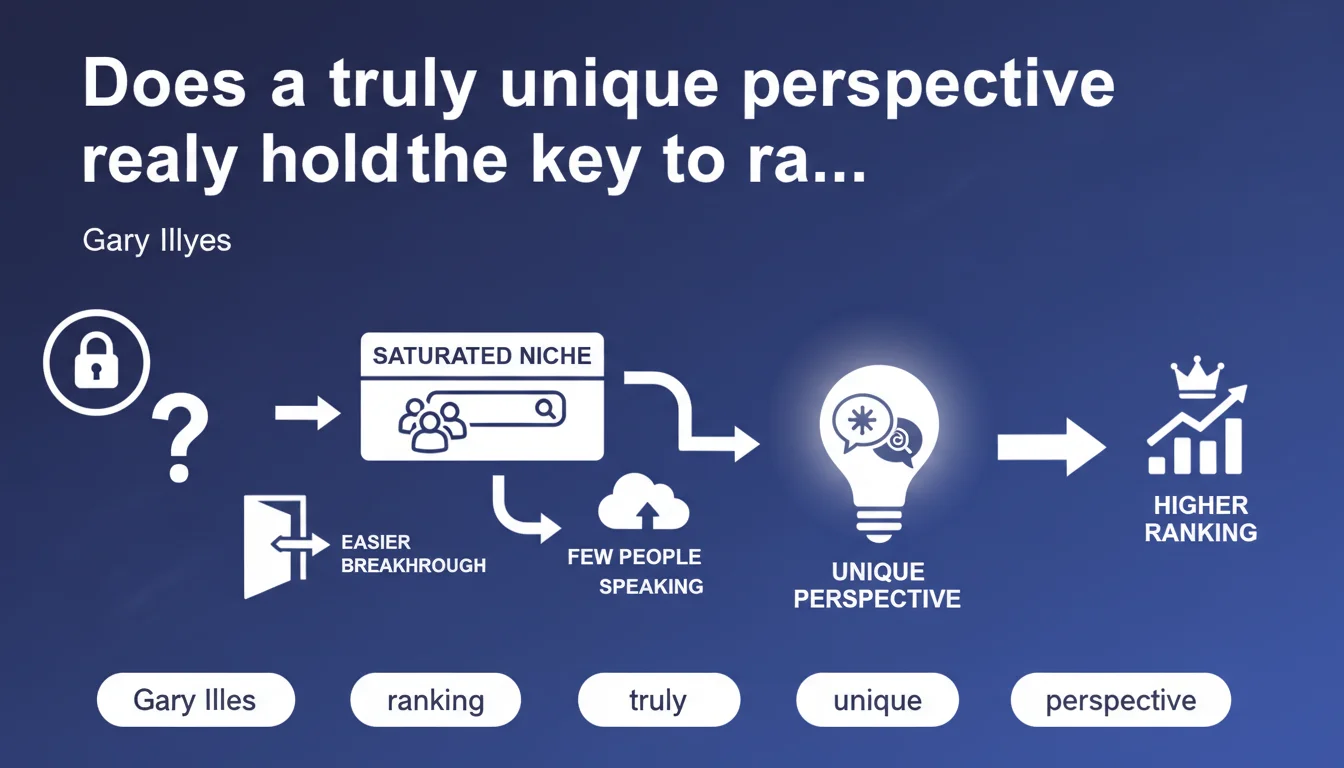
Gary Illyes asserts that offering a unique perspective or positioning yourself on niche topics with little coverage makes SEO easier. Thematic saturation makes breakthrough difficult without clear differentiation. Google would therefore favor originality and distinctive editorial angles over repetition of generic content.
What you need to understand
What does "offering a unique perspective" concretely mean for Google?
Google doesn't demand an editorial revolution in every article. A unique perspective refers to an original treatment angle, documented field experience, or an assumed positioning that distinguishes your content from competitors'.
In a saturated niche, SERPs overflow with content that rephrases the same ideas with different words. Google seeks to identify pages that deliver real added value — exclusive data, hands-on experience, in-depth analysis — rather than simple summaries.
Why do lesser-covered topics make ranking easier?
The logic is straightforward: less competition means fewer conflicting signals for the algorithm. On a virgin or overlooked topic, even mediocre content can rank for lack of better alternatives.
But be warned — "few people talk about it" doesn't mean "nobody searches for it." You must always validate actual demand with keyword research tools before investing time in an ultra-niche angle.
Is this statement an algorithmic novelty or a principle reminder?
It's a reminder. The editorial differentiation principle has circulated for years in Quality Rater guidelines, particularly through the E-E-A-T concept (Experience, Expertise, Authoritativeness, Trustworthiness).
Gary Illyes reformulates here a structural truth: Google values content that enriches the web, not content that saturates it with redundancy. Nothing revolutionary, but a solid reminder facing the explosion of automatically generated content.
- Unique perspective = distinctive editorial angle, not necessarily rare expertise
- Under-covered niches offer opportunities for quick visibility
- This principle aligns with the already-known E-E-A-T logic
- Validate demand before launching on an ultra-specific angle
- Differentiation matters more in saturated sectors (finance, health, tech)
SEO Expert opinion
Is this statement consistent with real-world observations?
Yes and no. In saturated niches (SEO, digital marketing, personal finance), observations indeed show that clone content struggles to rank durably. Sites that emerge often bring proprietary case studies, exclusive data or assumed controversial angles.
But — and here's where it pinches — "unique perspective" isn't enough if technical fundamentals are broken. A slow, poorly structured site without quality backlinks will stay invisible even with the world's best editorial angle. [To verify] whether unique perspective alone compensates for major SEO weaknesses.
What nuances should be added to this advice?
First point: not all sectors are equal. In certain transactional niches (commodity e-commerce, price comparators), editorial originality weighs less than price freshness, product availability, or loading speed. The unique angle won't fix a broken UX.
Second point: "few people talk about it" can also signal a demand desert. Covering a topic nobody searches for won't make you visible, however unique your perspective. The trade-off between search volume and competition remains crucial.
Third point — rarely stated — Google detects "angle novelty" poorly on ultra-competitive queries where historical signals (domain age, accumulated backlinks) crush editorial freshness. A new site with an original angle will take months to break through versus an established competitor, even if its content is objectively better.
In which cases does this rule not apply?
On informational queries with fixed intent ("definition of X," "who invented Y"), originality matters little. Google then favors conciseness, authoritative source, and freshness. A well-maintained Wikipedia will always crush a blog with creative angles.
Same finding on featured snippets: Google often extracts the most structured and most direct content, not necessarily the most original. If your unique perspective stretches the answer by 300 words, you lose position zero.
Practical impact and recommendations
What concretely should you do to apply this advice?
Start with an editorial differentiation audit. Compare your 10 most strategic pieces with the top 5 competitors in SERP. Note what they all say and what they skip. Your unique angle often hides in these white spaces: related topics not covered, unanswered user questions, missing data.
Next, leverage your proprietary data. Client case studies, log analysis, internal benchmarks — anything a competitor can't copy-paste. If you lack data, create it: LinkedIn surveys, public A/B tests, cohort analysis.
On saturated niches, test alternative formats: long-form video (YouTube ranks in SERPs), podcasts with transcription, interactive infographics. Google favors format diversity when it enriches topic understanding.
What mistakes to absolutely avoid?
Don't confuse "unique perspective" with "unsupported opinion." A rant without data or credible sources doesn't build authority — just noise. Originality must rest on verifiable proof to trigger backlinks and shares.
Also avoid the micro-niche-no-volume trap. Covering a hyper-specific angle generating 10 monthly searches doesn't justify time investment, unless it's an entry point to a larger thematic cluster.
Last frequent mistake: publish unique content then abandon it. Without active promotion (outreach, social media, email follow-up), even the best angle stays invisible. Distribution matters as much as creation.
How to verify your content truly offers a unique perspective?
Run your content through a similarity detector (Copyscape, Siteliner) to measure duplication rate with competitors. If your text resembles 80% of the top 3 Google results, it's not unique.
Analyze your engagement metrics: time on page, scroll rate, social shares. Truly differentiated content generates above-average interactions for your niche. If your stats are flat, your angle isn't resonating.
Finally, monitor organic backlink acquisition. Unique content naturally attracts links without outreach. If you must beg for every link, your differentiation is weak.
- Conduct a differentiation audit against the top 5 SERP competitors
- Identify thematic white spaces not covered by competitors
- Leverage your proprietary data (case studies, internal analysis, benchmarks)
- Test alternative formats (video, podcast, interactive infographics)
- Back each original perspective with verifiable proof
- Validate search volume before launching on a micro-niche
- Actively promote each unique piece via outreach and social media
- Measure text similarity with duplication detection tools
- Track engagement metrics (time on page, scroll, shares)
- Monitor organic backlink acquisition as proof of differentiation
❓ Frequently Asked Questions
Qu'est-ce qu'une perspective unique en SEO selon Google ?
Est-ce qu'un contenu unique suffit pour ranker dans une niche saturée ?
Comment identifier un sujet peu traité qui a du potentiel SEO ?
La perspective unique fonctionne-t-elle sur les requêtes transactionnelles ?
Comment mesurer si mon contenu est réellement unique ?
🎥 From the same video 13
Other SEO insights extracted from this same Google Search Central video · published on 21/11/2023
🎥 Watch the full video on YouTube →
💬 Comments (0)
Be the first to comment.