
Official statement
Other statements from this video 13 ▾
- □ Is technical SEO really still essential for search rankings?
- □ Are You Wasting Time on Obscure Technical SEO Details Instead of Mastering the Basics?
- □ Is Search Console really the solution to fix all your SEO problems?
- □ Does Google really prioritize your homepage first when it comes to crawling and indexing?
- □ Does duplicate content really always come from exact copy-paste?
- □ Should you really sacrifice traffic volume for relevance?
- □ Are user feedback signals more revealing than traffic metrics when assessing page quality?
- □ Does SEO quality really come down to helping users accomplish what they came to do?
- □ Does a truly unique perspective really hold the key to ranking in saturated niches?
- □ Should you really delete low-traffic pages from your website?
- □ Should you really be merging and redirecting content regularly to boost your SEO performance?
- □ Should you really treat all crawl errors the same way?
- □ Should you be using generative AI to write your SEO content?
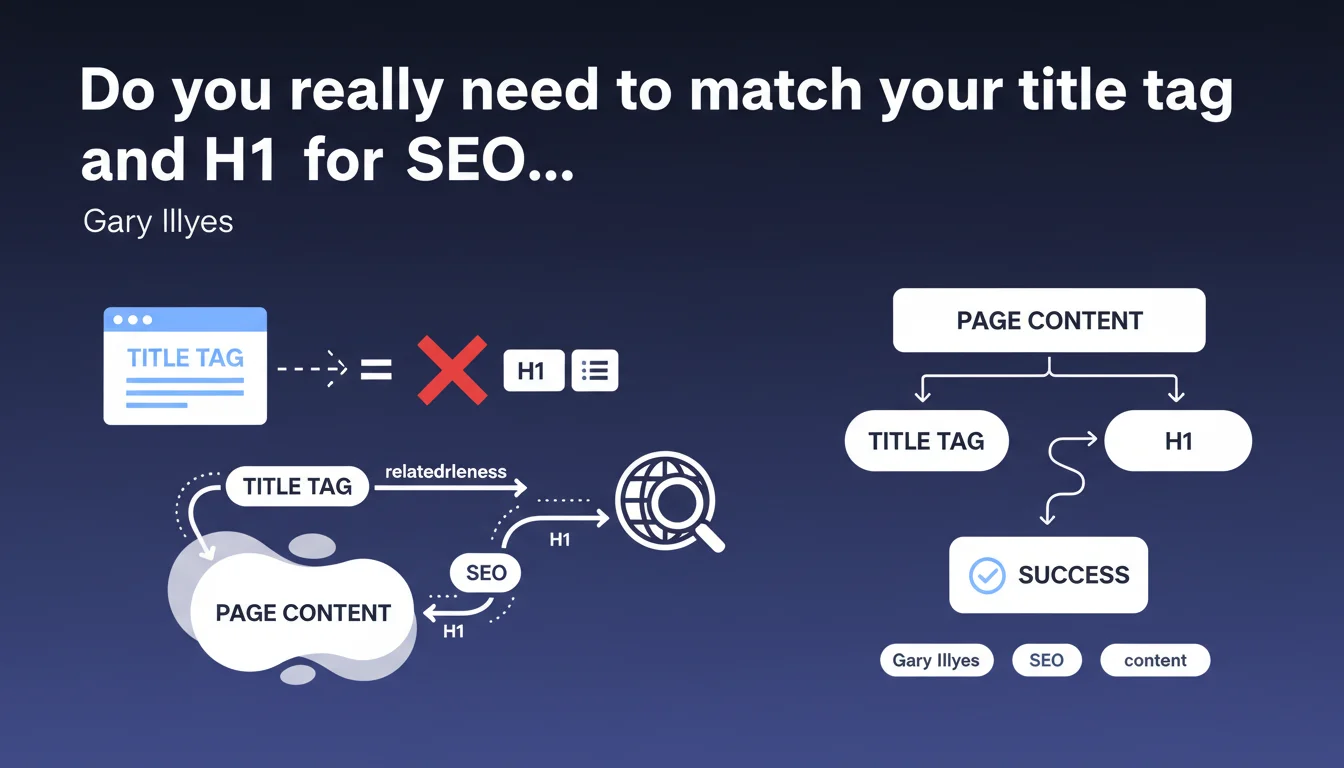
Google confirms that the page title and H1 tag can be identical or different with no direct SEO impact. The only requirement: both should be relevant to the page content. Perfect synchronization between these two tags is therefore not a ranking criterion.
What you need to understand
This statement from Gary Illyes settles a debate that has preoccupied SEO professionals for years. Many still religiously apply the rule of strictly identical titles and H1 tags, believing that any discrepancy would harm their visibility.
But let's be honest: Google doesn't operate on a points system where each element needs to check a specific box. What matters is the overall semantic coherence between these tags and the rest of your content.
Why does the confusion between title and H1 persist?
The myth originates from early SEO guides that recommended strict duplication to strengthen topicality. At that time, algorithms were rudimentary and indeed valued literal keyword repetition.
Today, with natural language models and advanced semantic analysis, Google perfectly understands that a title optimized for CTR in SERPs and an H1 oriented toward reading experience can diverge without creating any inconsistency.
What concrete freedom does this statement provide?
You can now create a compelling title to maximize click-through rate (with numbers, power words, clear promises) and a more descriptive, longer H1 that better contextualizes the subject once the user lands on the page.
Real-world example: a title "7 Fatal Email Marketing Mistakes" and an H1 "The 7 Email Marketing Mistakes That Tank Your Conversion Rates (And How to Fix Them)" work perfectly together. The first sells the click, the second establishes the topic.
- The title and H1 don't need to be identical to rank well
- The only requirement: thematic coherence with your page content
- You can optimize the title for SERP CTR and the H1 for user experience
- Google now analyzes overall semantic relevance, not literal duplication
- This flexibility allows you to tailor each tag to its specific display context
SEO Expert opinion
Is this statement consistent with real-world observations?
Absolutely. A/B tests conducted on thousands of pages show that no direct correlation exists between title/H1 similarity and SERP positions. I've seen sites rank in position one with radically different tags, and others stagnate on page two despite perfect duplication.
What truly moves the needle is overall page relevance — its ability to answer the search intent comprehensively. The title and H1 contribute to this equation, but their perfect alignment is merely a cosmetic detail.
What nuances should be added to this statement?
Caution: "can be different" doesn't mean "should be completely disconnected." If your title talks about vegetarian recipes and your H1 covers sports nutrition, you create cognitive friction that will degrade your bounce rate and send negative signals to Google.
The unwritten rule: both tags should revolve around the same central concept, but can approach it from complementary angles. The title attracts, the H1 confirms and expands. [To verify]: Google has never specified the tolerance threshold for divergence before the algorithm detects an inconsistency — this gray zone remains subject to interpretation.
In what cases does this rule require adjustments?
For transactional pages (product sheets, SEM landing pages), I still recommend strong proximity between title and H1. A user who clicks on "Nike Pegasus 40 Trail Running Shoes" expects to find this exact wording upon landing — any variation creates doubt.
Practical impact and recommendations
What should you do concretely with this information?
First step: audit your strategic pages to identify those where title and H1 are strictly identical by default, without editorial reason. If your title is 65 characters because you truncated your H1 to make it fit, that's probably a missed opportunity.
Test a differentiated approach: short, punchy title to maximize CTR (with numbers, questions, promises), longer and more explicit H1 to reassure the user and contextualize the subject. Measure the impact on organic click-through rate and time on page.
What mistakes must you absolutely avoid?
Don't create a semantic rupture between the two tags. If your title mentions "complete guide," your H1 can't suddenly talk about a "quick top 5." Users feel deceived, bounce rate explodes.
Also avoid stuffing the H1 with keywords under the pretext that it can differ from the title. Google analyzes the global context — an over-optimized H1 surrounded by hollow content will remain ineffective, regardless of its wording.
How do you verify tag coherence at scale?
Crawl your site with Screaming Frog or Oncrawl and export the title / H1 / meta description columns. Analyze pages where semantic distance (via a tool like TextRazor or even simple cosine similarity calculation) exceeds 70-80% — these are your risk zones.
For sites with thousands of pages, a Python script with spaCy or transformers can automate this analysis and flag pages where title and H1 address concepts too distant according to semantic embeddings.
- Audit pages where title and H1 are identical by default, without editorial justification
- Test variations with title optimized for CTR and H1 optimized for UX on a sample of pages
- Verify there's no major semantic rupture between the two tags
- Measure impact on organic click-through rate and engagement metrics (time on page, bounce rate)
- Automate detection of title/H1 inconsistencies on large sites (crawl + semantic analysis)
- Avoid keyword stuffing in the H1 under the pretext that it can differ from the title
- On transactional pages, maintain strong proximity between title and H1 to reassure users
❓ Frequently Asked Questions
Puis-je avoir un title de 60 caractères et un H1 de 150 caractères sans problème ?
Si mon title contient un mot-clé absent du H1, est-ce pénalisant ?
Dois-je modifier tous mes titles/H1 identiques existants ?
Google peut-il réécrire mon title s'il diffère trop du H1 ?
Cette règle s'applique-t-elle aussi aux autres balises Hn (H2, H3, etc.) ?
🎥 From the same video 13
Other SEO insights extracted from this same Google Search Central video · published on 21/11/2023
🎥 Watch the full video on YouTube →
💬 Comments (0)
Be the first to comment.