
Official statement
Other statements from this video 13 ▾
- □ Le SEO technique est-il vraiment encore indispensable pour le référencement ?
- □ Faut-il arrêter d'obseder sur les détails techniques obscurs en SEO ?
- □ Search Console est-elle vraiment efficace pour diagnostiquer vos problèmes SEO ?
- □ La duplication de contenu provient-elle vraiment toujours de copié-collé exact ?
- □ Faut-il vraiment sacrifier le volume de trafic au profit de la pertinence ?
- □ Les feedbacks utilisateurs sont-ils plus révélateurs que le trafic pour juger la qualité d'une page ?
- □ La qualité SEO se résume-t-elle vraiment à aider l'utilisateur à accomplir sa tâche ?
- □ Faut-il vraiment miser sur une perspective unique pour ranker dans une niche saturée ?
- □ Faut-il vraiment supprimer les pages à faible trafic de votre site ?
- □ Faut-il vraiment fusionner et rediriger du contenu régulièrement pour améliorer son SEO ?
- □ Faut-il vraiment traiter toutes les erreurs d'exploration de la même manière ?
- □ Faut-il vraiment aligner le title et le H1 pour performer en SEO ?
- □ Faut-il utiliser l'IA générative pour rédiger ses contenus SEO ?
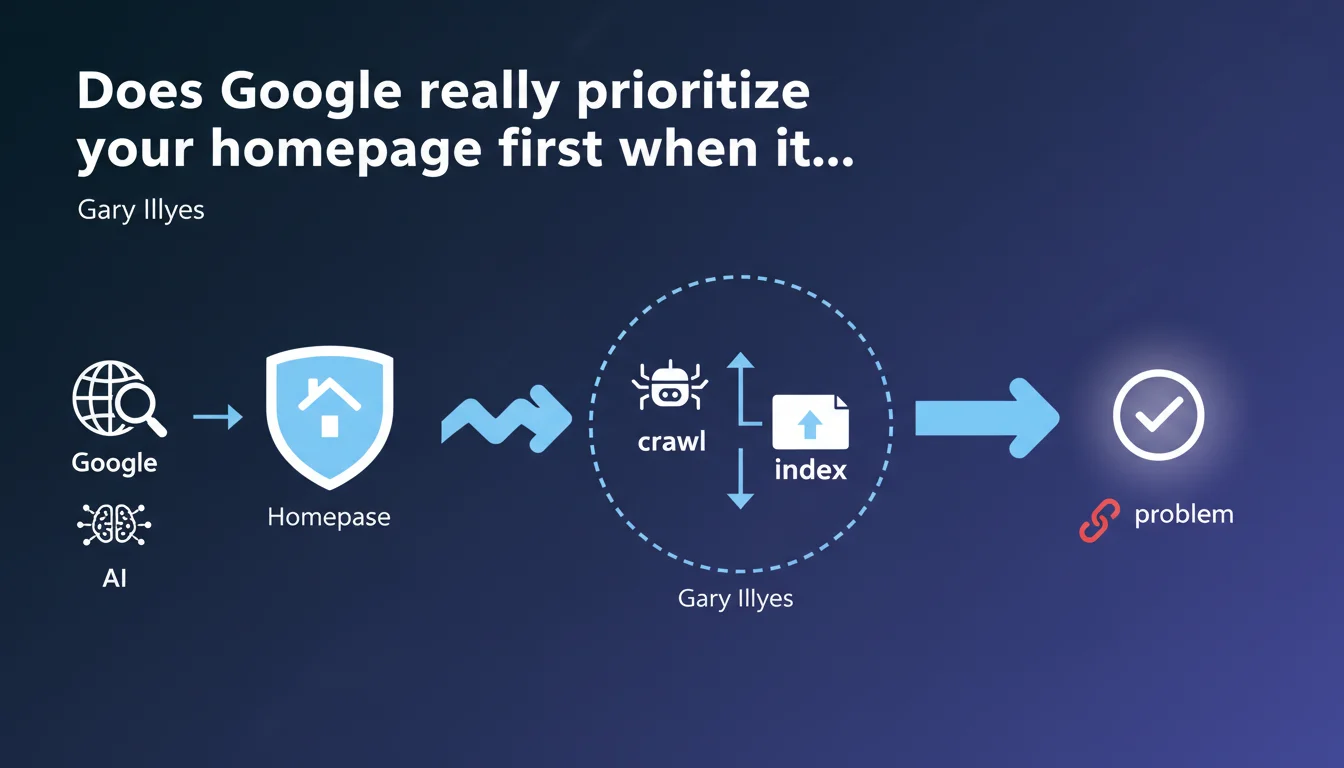
Google considers your homepage as the most important page on your site and deploys massive efforts to crawl and index it. If your homepage isn't indexed, it signals a serious structural problem that must be addressed immediately. This is where every SEO diagnosis should begin.
What you need to understand
Gary Illyes lays out here a fundamental principle that too many professionals overlook: the homepage is not just any other page in your site's architecture. For Google, it represents the natural entry point—the one users type directly into their browser.
This statement comes in the context of SEO diagnostics. When a site encounters indexation issues, many practitioners get lost analyzing deep pages when the real problem often sits much higher up the hierarchy.
What does "Google will try very hard" actually mean in practice?
This phrasing reflects an algorithmic priority. Google allocates crawl budget differently across pages, and the homepage receives preferential treatment. The bot returns more frequently, attempts to work around certain technical obstacles that would block other URLs.
If despite these efforts your homepage doesn't appear in the index, then a major blocker is preventing Googlebot from doing its job—and that blocker likely affects your entire site.
Why is the homepage such a reliable indicator of SEO health?
Because it crystallizes several critical dimensions: technical accessibility, quality signals, domain authority. A site whose homepage isn't indexed typically exhibits one or more of these structural defects.
It's also the page that naturally receives the most backlinks, direct mentions, direct traffic. If Google can't index it despite these strong signals, the problem is serious.
- The homepage receives prioritized crawl budget compared to other pages on the site
- Its absence from the index signals a critical technical problem that likely affects the entire domain
- It's the logical starting point for every SEO audit, before analyzing deeper pages
- Google invests significant resources to crawl this page—if it fails, look for the root cause
SEO Expert opinion
Is this approach still relevant given how crawling has evolved?
Let's be honest: yes, but with important caveats. In the majority of cases, an unindexed homepage does reveal a critical problem. Misconfigured robots.txt, accidental noindex, redirect loops, content blocked by JavaScript—these causes, if they hit the homepage, likely contaminate the rest of your site.
However, there are configurations where this rule becomes less relevant. Very high-volume sites (marketplaces, classified listings, aggregators) sometimes have homepages that are nothing but empty shells redirected based on geolocation or user preferences. In these cases, homepage non-indexation might be a strategic choice.
What are the limitations of this statement?
Gary Illyes doesn't specify exactly how hard Google "tries." What's the actual crawl frequency? How many attempts before giving up? [To verify]—these metrics aren't publicly documented.
Additionally, this statement dates from an era when user behavior was more linear. Today, with PWAs, single-page applications, headless sites, the very notion of "homepage" becomes fuzzy. A user might land directly on a product page via Google Shopping without ever seeing the homepage.
In what cases doesn't this rule apply strictly?
International sites with automatic geo-redirects present a borderline case. The "true" homepage (example.com) might systematically redirect to localized versions (example.fr, example.de). In this scenario, Google indexes the localized versions but not necessarily the root.
Sites undergoing migration too. During a transition phase between two architectures, it sometimes happens that the homepage is temporarily intentionally de-indexed—it's not a bug but a controlled step in the process.
Practical impact and recommendations
What should you check first if your homepage isn't indexed?
Start with your robots.txt file. A Disallow: / blocks the entire site, including the root. This sounds obvious, but it's a recurring error after going live when staging files get deployed by mistake.
Next, inspect your meta tags. An accidental noindex, often inherited from a development environment, prevents indexation despite successful crawling. Also check the X-Robots-Tag HTTP headers which can enforce a hidden noindex in your source code.
Third point: redirects. A chain of redirects 301 > 302 > 301 can exhaust crawl budget or be interpreted as a soft 404. Google typically follows up to 5 hops; beyond that it gives up.
How do you technically audit the homepage?
Use Search Console and its URL inspection tool. It will tell you exactly what Googlebot sees: HTTP status, HTML rendering, blocked resources. If Google detects a page but doesn't index it, the error message will give you the exact reason.
Also test with a crawler like Screaming Frog in Googlebot mode. Compare what the bot sees with what a regular browser displays. Discrepancies often reveal unintentional cloaking or content masked by JavaScript.
Don't forget to check loading speed. A homepage that systematically times out will never be crawled efficiently, even if technically it's accessible.
What corrective actions should you implement immediately?
- Check robots.txt and remove any Disallow blocking the root
- Verify the absence of noindex tags or restrictive X-Robots-Tag headers
- Simplify redirects: the homepage should be accessible in one hop maximum
- Ensure main content is visible in raw HTML, not just loaded via JavaScript
- Test server response time—aim for under 500ms for the homepage
- Manually submit the URL via Search Console after fixing
- Monitor crawling for 48-72 hours to confirm the problem is resolved
The homepage remains the best barometer of a site's SEO health. Its indexation reflects Google's ability to access your content and assign it value. Any diagnosis that ignores the homepage starts on the wrong foot.
These technical checks may seem simple on paper, but implementing them correctly in complex environments (multilingual sites, headless architectures, ongoing migrations) requires real expertise. If you identify anomalies on your homepage without understanding their origin, working with a specialized SEO agency will save you valuable time and prevent misguided actions that make things worse.
❓ Frequently Asked Questions
Si ma homepage est indexée mais que d'autres pages ne le sont pas, dois-je commencer par la homepage ?
Combien de temps faut-il à Google pour indexer une homepage après correction d'un blocage ?
Une homepage en redirection 301 permanente vers une autre URL peut-elle être indexée ?
Le fait d'avoir une homepage en SPA (Single Page Application) complique-t-il son indexation ?
Dois-je optimiser ma homepage pour des mots-clés génériques ou pour ma marque ?
🎥 From the same video 13
Other SEO insights extracted from this same Google Search Central video · published on 21/11/2023
🎥 Watch the full video on YouTube →
💬 Comments (0)
Be the first to comment.