
Official statement
Other statements from this video 13 ▾
- □ Le SEO technique est-il vraiment encore indispensable pour le référencement ?
- □ Faut-il arrêter d'obseder sur les détails techniques obscurs en SEO ?
- □ Search Console est-elle vraiment efficace pour diagnostiquer vos problèmes SEO ?
- □ Pourquoi Google privilégie-t-il systématiquement la page d'accueil dans son processus d'indexation ?
- □ La duplication de contenu provient-elle vraiment toujours de copié-collé exact ?
- □ Faut-il vraiment sacrifier le volume de trafic au profit de la pertinence ?
- □ Les feedbacks utilisateurs sont-ils plus révélateurs que le trafic pour juger la qualité d'une page ?
- □ Faut-il vraiment miser sur une perspective unique pour ranker dans une niche saturée ?
- □ Faut-il vraiment supprimer les pages à faible trafic de votre site ?
- □ Faut-il vraiment fusionner et rediriger du contenu régulièrement pour améliorer son SEO ?
- □ Faut-il vraiment traiter toutes les erreurs d'exploration de la même manière ?
- □ Faut-il vraiment aligner le title et le H1 pour performer en SEO ?
- □ Faut-il utiliser l'IA générative pour rédiger ses contenus SEO ?
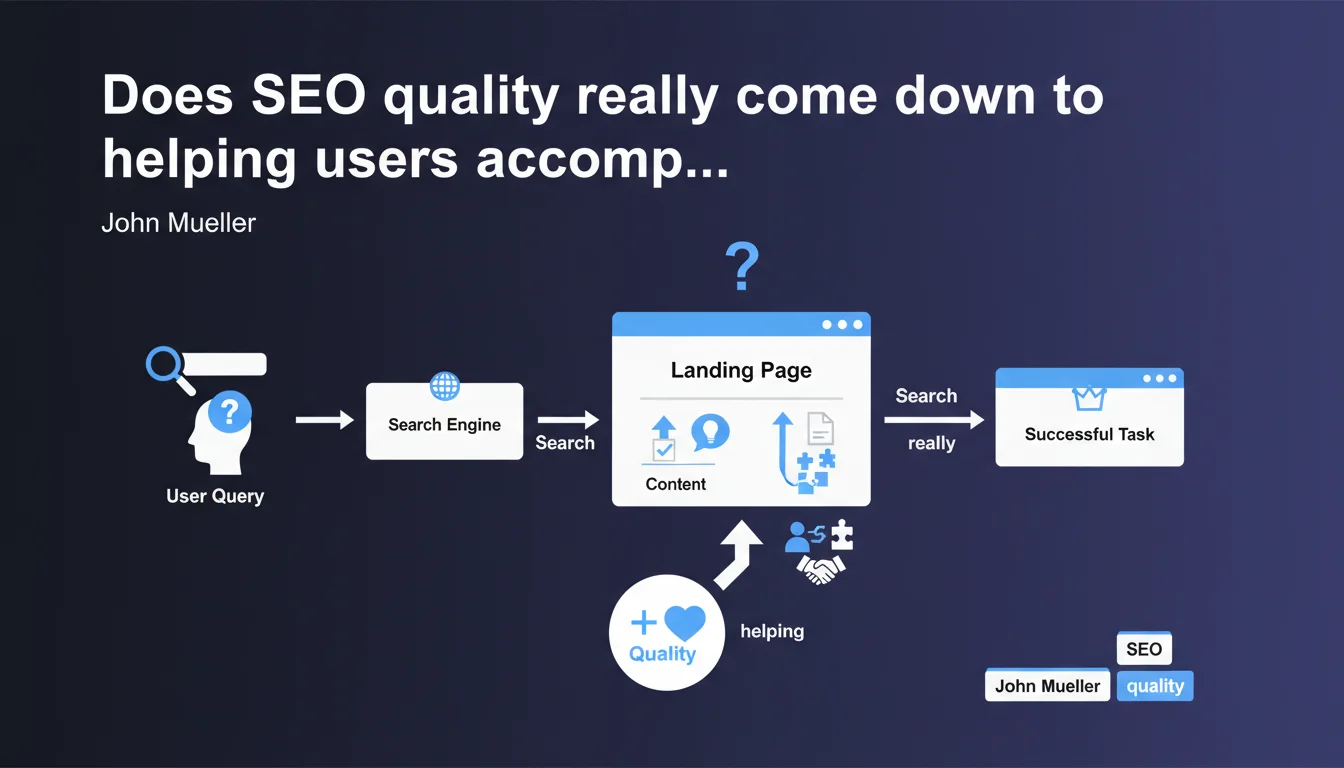
Mueller strips SEO quality down to basics: write content that genuinely helps users accomplish what they're trying to do. No complex criteria, just real usefulness. An approach that aligns with Helpful Content Updates logic, but remains vague about which technical signals algorithms actually measure.
What you need to understand
This statement from John Mueller reframes Google's quality philosophy: goodbye to obscure scoring grids, hello to functional logic. The idea? If your page answers the need of the user landing on it, it's quality.
The message continues the Helpful Content Updates momentum, which penalizes content created for engines rather than humans. Mueller deliberately simplifies the discourse — perhaps too much.
What does it concretely mean to "help the user accomplish their task"?
It depends on search intent. A user searching for "how to change iPhone 12 battery" wants a clear tutorial with photos and numbered steps. Not a 2000-word article on lithium-ion battery history.
Google measures this satisfaction through behavioral signals: time on page, bounce rate, pogo-sticking, interactions. If the user bounces back to the SERP immediately, your content missed the mark.
Does this approach replace other quality criteria?
No. Mueller simplifies, but Google continues evaluating content depth, expertise (E-E-A-T), freshness, backlinks. This statement doesn't render technical fundamentals obsolete.
It simply reminds us that shallow or off-topic content won't cut it anymore, even with perfect internal linking and top-tier Core Web Vitals.
- Search intent becomes the number-one filter for evaluating page quality
- Behavioral signals (dwell time, bounce) gain weight in the algorithm
- Useful content doesn't compensate for technical gaps, but useless content cancels out technical efforts
- Google values functional satisfaction: does the user leave with what they were looking for?
SEO Expert opinion
Is this statement consistent with real-world practices we observe?
Yes and no. On clearly informational queries, we do see that "useful" pages rank higher — those answering quickly and well. A structured tutorial often beats a lengthy academic piece.
However, on commercial or YMYL queries, usefulness alone isn't enough. An e-commerce site with flawless product sheets but no authoritative backlinks won't dethrone Amazon. [Needs verification]: Mueller doesn't specify how Google objectively measures this "task accomplishment" — which technical signals actually come into play?
What nuances should we add to this simplified vision?
Mueller sells an idealized vision. In reality, Google measures satisfaction proxies: CTR, session duration, return to SERP. These metrics are imperfect and can be biased.
"Useful" content can also be misinterpreted if the user finds their answer in 10 seconds and leaves — Google might read this as a negative bounce. Conversely, mediocre but lengthy content can show high reading time simply because the user is digging through filler for the actual info.
In which cases doesn't this rule fully apply?
On ambiguous queries, Google doesn't always know what the user wants to accomplish. "Python": the language or the snake? The algorithm has to guess, and sometimes it gets it wrong.
On YMYL queries (health, finance), expertise trumps raw usefulness. A "useful" article written by a non-expert gets outranked by less direct content signed by a recognized authority. E-E-A-T remains a safeguard.
Practical impact and recommendations
What should you concretely do to align your content with this logic?
Start by mapping intent behind each target keyword. Study the current SERPs: what do the top 3 pages offer? Format, depth, angle. That's your specifications.
Then structure content for readability: clear headings, short paragraphs, lists, explanatory visuals. If users need to scroll for 3 minutes to find the answer, you've lost them.
What mistakes must you absolutely avoid?
Don't confuse length with usefulness. A 3000-word article packed with unnecessary details doesn't beat an 800-word focused guide. Google values density of relevant information, not raw volume.
Another trap: disguised keyword stuffing. Repeating "best SEO tool" 40 times doesn't make your page more useful. Write to answer the question, not to mechanically rank.
How do you verify your content meets this standard?
- Test your pages with real users: do they accomplish their task friction-free?
- Analyze your behavioral metrics in GA4: engagement time, adjusted bounce rate, scroll depth
- Compare your content to featured snippets: if Google extracts an answer from a competitor, it judges that one more directly useful
- Audit your pages with Search Console: low CTR queries = titles or meta descriptions not clearly showing value
- Use heatmap tools (Hotjar, Clarity) to spot ignored zones or abandonment points
This statement refocuses SEO effort on functional user satisfaction. Concretely, it means redesigning every piece of content as a direct answer to an identifiable, measurable need tracked via behavioral signals.
The challenge: align your editorial structure, UX, and quality standards to this logic of immediate usefulness. Sometimes this requires profound strategic content shifts and rigorous engagement data monitoring.
These optimizations demand cross-functional expertise — editorial, technical, analytical. If your team lacks time or resources to orchestrate this transformation, partnering with a specialized SEO agency can accelerate compliance and secure traffic gains.
❓ Frequently Asked Questions
Google mesure-t-il vraiment l'utilité d'une page ou se fie-t-il à des proxys imparfaits ?
Un contenu court peut-il être considéré comme qualitatif par Google ?
Cette approche rend-elle les backlinks moins importants ?
Comment savoir si mon contenu aide vraiment l'utilisateur à accomplir sa tâche ?
Cette déclaration change-t-elle la manière de rédiger des contenus SEO ?
🎥 From the same video 13
Other SEO insights extracted from this same Google Search Central video · published on 21/11/2023
🎥 Watch the full video on YouTube →
💬 Comments (0)
Be the first to comment.