
Official statement
Other statements from this video 6 ▾
- □ Are Core Web Vitals Really a Google Ranking Factor?
- □ Should you really spend months perfecting your Core Web Vitals scores?
- □ Does Googlebot really click through your pages like a real user would?
- □ Is Google really patient with JavaScript rendering, or should you worry about speed?
- □ Can an ultra-fast but empty page rank thanks to Core Web Vitals?
- □ Has Google really transformed the web ecosystem with Core Web Vitals, or is it just marketing hype?
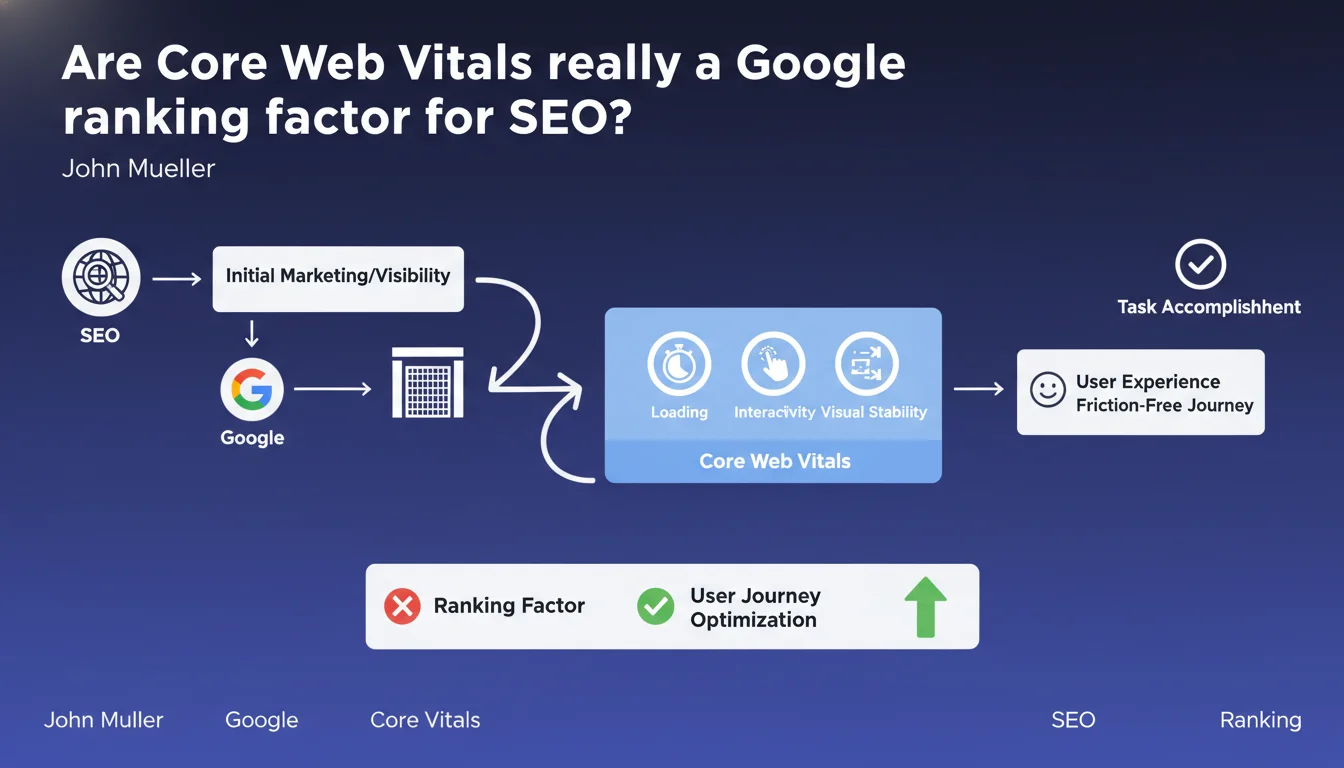
Google is repositioning Core Web Vitals: they are not levers for discoverability or initial ranking, but rather criteria for user experience once they arrive on your site. In other words, they don't help you get found, but they prevent you from losing visitors once they land. A subtle distinction that changes everything in how you prioritize your optimizations.
What you need to understand
What distinction is Google really making here?
Mueller clearly separates two dimensions: discoverability (ensuring a site gets found, indexed, and ranked) and user experience (what happens once the user clicks). Core Web Vitals, according to him, fall exclusively into the second category.
In concrete terms? A site can have catastrophic CWV and continue to rank if its content, backlinks, and topical relevance are solid. Conversely, perfect CWV will never compensate for poor content or non-existent authority.
Why this clarification now?
Because since the Page Experience Update rollout, part of the SEO industry has overinterpreted the importance of CWV in rankings. Some have even paused content or link-building projects to focus on technical optimizations whose impact on organic visibility was overestimated.
Google is setting the record straight: CWV is one factor among many, and its weight remains marginal compared to traditional signals of relevance and authority.
What does "friction-free journey" mean in this context?
Mueller emphasizes the user's ability to accomplish a task once on your site. This concerns loading speed, visual stability, interactivity — basically everything that could prevent a conversion or cause abandonment.
The idea is simple: if a user takes 5 seconds to click a button because the page is unstable (high CLS), or if the site takes 4 seconds to respond to an interaction (catastrophic FID), they leave. CWV aim to limit these frictions, not to boost your position in the SERP.
- Core Web Vitals are not visibility levers, but rather retention and conversion criteria.
- Their weight in the ranking algorithm remains secondary compared to content, backlinks, and relevance.
- A CWV optimization should be justified by business objectives (bounce rate, conversion) rather than by a hypothetical rise in search results.
- Never sacrifice a content or link-building project for CWV optimizations if your site already has an acceptable level.
SEO Expert opinion
Is this position consistent with real-world data?
Yes and no. On one hand, correlation studies do show that well-ranking sites tend to have better CWV — but that's also because they generally have more resources, better infrastructure, and regular maintenance. The reverse causality (perfect CWV = better ranking) is far from established.
On the other hand, we observe that sites with mediocre CWV retain their positions if their content and authority are solid. The CWV signal acts more as a tiebreaker between two pieces of equivalent quality content — and even then, its weight remains low.
What nuances should we add to this statement?
Mueller oversimplifies, perhaps too much. In some highly competitive verticals (e-commerce, news), where relevance gaps between competitors are minimal, CWV can tip the balance. But they never create miracles: a site that goes from red CWV to green doesn't gain 10 positions if its content is weak.
Another nuance: CWV indirectly impact SEO through behavioral metrics. A slow site generates more bounces, fewer pages per session, less engagement — all signals Google can interpret as a lack of relevance. So saying that CWV "don't affect SEO" is technically true for direct ranking, but false if you consider the ripple effect on user signals.
When doesn't this rule apply?
In searches where user intent implicitly includes a requirement for speed or fluidity: web applications, online tools, transactional sites. Here, a slow or unstable site will likely be disadvantaged, because it doesn't meet user expectations — and Google will detect this through behavioral signals.
Similarly, in mobile environments with weak connectivity (3G, rural areas), CWV become a real survival criterion. A site that doesn't load in less than 3-4 seconds loses the user before they can even evaluate content relevance. [To verify]: Google has never confirmed differentiated treatment based on the user's network context, but real-world data suggests it does.
Practical impact and recommendations
What should you do concretely with this information?
Recalibrate your priorities. If you have CWV in the yellow or red zone, that's a problem — but it's probably not your first problem if your content is weak, your internal linking non-existent, or your backlink profile poor.
Ask yourself: are my users abandoning because of site slowness, or because the content doesn't answer their need? If it's the latter, optimizing CWV won't change your organic traffic.
What mistakes must you absolutely avoid?
Never pause a content or link-building project to focus on CWV, unless your engagement metrics (time on page, bounce rate, pages per session) show a real retention problem.
Also avoid over-interpreting Search Console alerts. A "red" CWV is not a penalty — it's a diagnosis. If your conversions are good and your traffic stable, the problem may be less urgent than it seems.
- Audit your behavioral metrics (Google Analytics) before launching a major CWV project.
- Prioritize strategic pages (landing pages, product pages) rather than trying to fix your entire site at once.
- Test the business impact of a CWV optimization on a sample of pages before scaling up.
- Don't neglect mobile: that's where CWV have the most impact on real user experience.
- Document your optimizations and their results — this will let you justify (or not) future investments.
How do you integrate this nuance into your overall SEO strategy?
CWV should be treated as a technical maintenance project, just like HTTPS or mobile compatibility. It's a prerequisite for not losing traffic, not a lever to gain it.
Integrate them into a balanced technical roadmap, where they coexist with content optimizations, internal linking, and crawl budget improvements. Never isolate them — they only make sense in a healthy SEO ecosystem.
❓ Frequently Asked Questions
Les Core Web Vitals ont-ils un impact direct sur le classement Google ?
Dois-je arrêter de travailler mes CWV si mon site ranke bien ?
Un site avec des CWV médiocres peut-il ranker en première page ?
Les CWV sont-ils plus importants sur mobile que sur desktop ?
Faut-il viser le « vert » partout ou se concentrer sur certaines pages ?
🎥 From the same video 6
Other SEO insights extracted from this same Google Search Central video · published on 28/03/2024
🎥 Watch the full video on YouTube →
💬 Comments (0)
Be the first to comment.