
Official statement
Other statements from this video 13 ▾
- □ Le SEO technique est-il vraiment encore indispensable pour le référencement ?
- □ Faut-il arrêter d'obseder sur les détails techniques obscurs en SEO ?
- □ Search Console est-elle vraiment efficace pour diagnostiquer vos problèmes SEO ?
- □ Pourquoi Google privilégie-t-il systématiquement la page d'accueil dans son processus d'indexation ?
- □ La duplication de contenu provient-elle vraiment toujours de copié-collé exact ?
- □ Faut-il vraiment sacrifier le volume de trafic au profit de la pertinence ?
- □ Les feedbacks utilisateurs sont-ils plus révélateurs que le trafic pour juger la qualité d'une page ?
- □ La qualité SEO se résume-t-elle vraiment à aider l'utilisateur à accomplir sa tâche ?
- □ Faut-il vraiment miser sur une perspective unique pour ranker dans une niche saturée ?
- □ Faut-il vraiment supprimer les pages à faible trafic de votre site ?
- □ Faut-il vraiment fusionner et rediriger du contenu régulièrement pour améliorer son SEO ?
- □ Faut-il vraiment traiter toutes les erreurs d'exploration de la même manière ?
- □ Faut-il vraiment aligner le title et le H1 pour performer en SEO ?
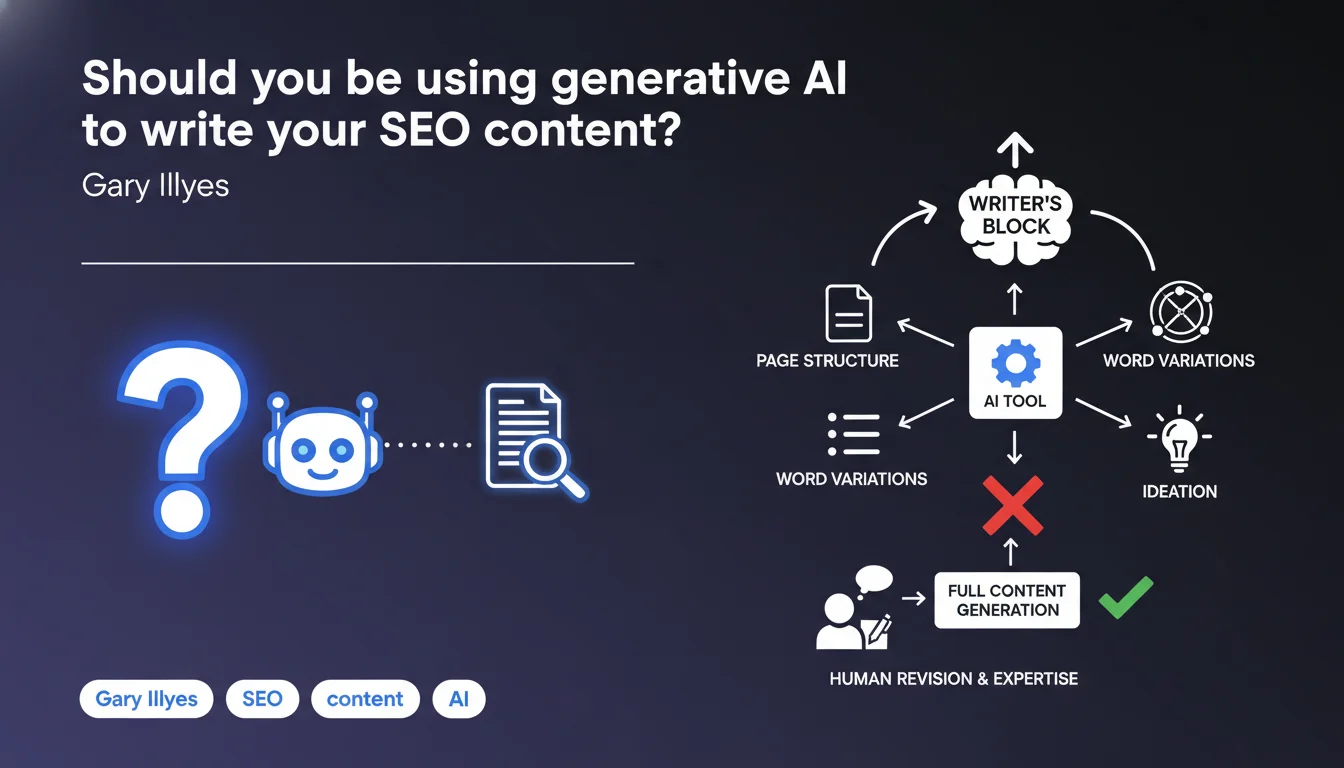
Google validates the use of generative AI for structuring content and overcoming writer's block, but warns against usage that neglects quality. The real issue isn't the tool itself, but how you use it — and that's rarely clearly specified.
What you need to understand
What exactly does Google say about generative AI?
Gary Illyes officially validates three specific uses of generative AI: overcoming writer's block, quickly creating a page structure, and suggesting lexical variations. Nothing more.
The underlying message? Google doesn't penalize the tool, but rather the way it's exploited. Which immediately raises the question: where exactly is the line between acceptable use and punishable abuse?
Why does this statement deliberately remain vague?
This position suits Google: it avoids alienating content creators while reserving the right to punish automated content farms. The problem? No objective criteria are provided to distinguish good use from bad.
Concretely, Google doesn't say how many AI-generated paragraphs are acceptable, nor what level of human revision is expected. This ambiguity leaves SEO practitioners in an uncomfortable gray zone.
What are the uses validated by this statement?
- Brainstorming and creative breakthrough — AI as an assistant to overcome writer's block
- Rapid structuring — Generate a page outline or content architecture
- Lexical enrichment — Suggest synonyms and semantic variations
- What is NOT validated — Publishing AI-generated content directly without significant human intervention
SEO Expert opinion
Is this statement consistent with real-world observations?
Yes and no. Across thousands of analyzed websites, 100% AI-generated content only ranks well if it perfectly matches search intent. Which rarely happens without human intervention.
The sites that perform best use AI exactly as Illyes describes: initial structure + substantial human rewriting. Those publishing raw ChatGPT see their traffic stagnate or drop after a few months. [To verify]: Does Google actually have detection mechanisms reliable enough to distinguish these nuances?
What are the unspoken limits of this position?
Illyes doesn't mention a crucial aspect: the difference between small and large volumes. Generating 10 articles per month with AI assistance is one thing. Producing 1,000 is another — and Google's algorithms detect it.
Second point: the statement doesn't address content homogenization. When everyone uses the same models (ChatGPT, Claude, Gemini), stylistic variations collapse. Google values originality — difficult to maintain when tools converge toward the same formulations.
In which cases does this rule probably not apply?
YMYL sectors (health, finance, legal) are treated differently. Demonstrated expertise and author authority weigh more heavily than simple semantic optimization. In these domains, AI-generated content — even well-revised — will often lack E-E-A-T signals.
Similarly, queries where Google explicitly prioritizes personal experience content (product reviews, comparisons) cannot be satisfied by pure AI. Machine learning detects the absence of real-world experience.
Practical impact and recommendations
What should you concretely do with generative AI?
Use AI as an accelerator, not as your final writer. Start by having it generate a page structure with main sections. Then, write or rewrite each section manually, bringing your own expertise.
For lexical variations, AI is genuinely useful — but always verify contextual relevance. A technically correct synonym can be inappropriate in a specific industry context.
What mistakes must you absolutely avoid?
- Never publish AI-generated content without review and substantial enrichment
- Avoid producing massive volumes (50+ articles/month) with high AI component — it gets detected
- Don't use AI for YMYL topics without validation by a recognized expert
- Eliminate generic formulations typical of AI ("in today's dynamic world...", "it's important to note that...")
- Never copy-paste AI-generated headline structures — they're too predictable
How do you verify that AI usage remains acceptable?
Ask yourself this question: if Google could compare your content to that of 100 competitors using AI, would yours stand out? If not, you're in danger zone.
Also test your audience's reaction. Engagement metrics (time on page, scroll depth, shares) reveal whether content truly delivers value or is perceived as generic.
❓ Frequently Asked Questions
Google pénalise-t-il le contenu écrit avec ChatGPT ou d'autres IA ?
Peut-on utiliser l'IA pour rédiger l'intégralité d'un article de blog ?
Comment Google détecte-t-il le contenu généré par IA ?
L'IA générative peut-elle aider au SEO technique ?
Faut-il mentionner qu'un contenu a été assisté par IA ?
🎥 From the same video 13
Other SEO insights extracted from this same Google Search Central video · published on 21/11/2023
🎥 Watch the full video on YouTube →
💬 Comments (0)
Be the first to comment.