
Official statement
What you need to understand
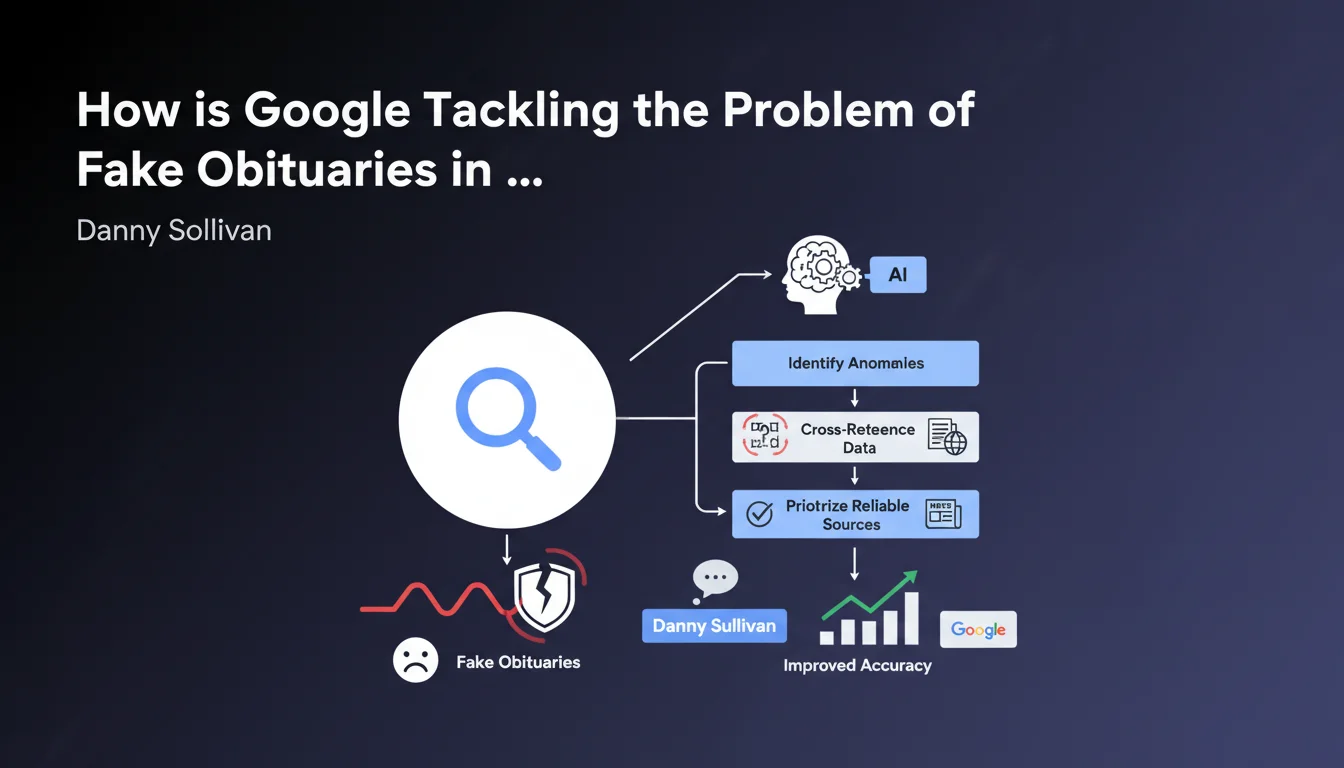
Google is facing a major algorithmic challenge regarding the appearance of fake obituaries in its search results. These misleading contents about people who are still alive not only create a disastrous user experience, but also raise important ethical questions.
Danny Sullivan, Google's Search Liaison, has publicly acknowledged that the company is actively working on this problem. This transparent admission reveals that even the most sophisticated algorithms can be fooled by certain types of manipulative content.
For SEO professionals, this statement highlights several critical issues:
- The importance of source reliability and E-E-A-T signals (Experience, Expertise, Authoritativeness, Trustworthiness)
- The difficulty for Google to quickly distinguish factual content from false content
- The potential for exploitation of this flaw by unscrupulous sites seeking sensationalist traffic
- The impact on informational queries concerning public figures
This issue reflects the growing complexity of filtering misinformation at scale. It also shows that certain thematic niches remain particularly vulnerable to manipulation, despite Google's AI constant progress.
SEO Expert opinion
This statement is consistent with several recent field observations. We are indeed seeing that sensationalist or misleading content still regularly manages to rank temporarily, particularly on queries related to news or celebrities.
The fact that Google openly acknowledges this difficulty reveals a shift in communication strategy. The company is adopting a more transparent stance on its limitations, which is preferable to a silence that would fuel conspiracy theories. Nevertheless, this vulnerability raises questions about the real effectiveness of harmful content detection systems.
An important nuance: this problem primarily affects recent news queries where search history is limited. Google's algorithms generally excel on established queries with a rich history, but struggle with emerging events where reliable signals are scarce.
Practical impact and recommendations
Facing this issue acknowledged by Google, here are concrete recommendations for SEO practitioners:
- Strengthen your E-E-A-T signals: clearly identify your authors, their qualifications, and add detailed "About" sections
- Absolutely avoid sensationalist or misleading headlines, even to generate temporary traffic – the reputational risk is too high
- Implement Schema.org markup for articles (Article, NewsArticle) with author information, publication date and modification date
- Prioritize verifiable sources: cite your sources, link to reliable references, document your factual claims
- Monitor your reputation: use Google Alerts and monitoring tools to quickly detect any negative association with your brand
- For news sites: consider joining fact-checking initiatives like the Trust Project or the Google News Initiative program
- Regularly audit your existing content to identify and correct any outdated or potentially misleading information
In summary: This statement confirms that Google increasingly values content reliability and authenticity. Sites that invest in credibility and transparency will be better protected against future algorithmic fluctuations.
Implementing these trust optimizations often requires a sophisticated technical and editorial approach. Correct implementation of structured markup, thorough online reputation auditing, and establishment of rigorous editorial processes represent complex projects. To maximize the impact of these changes and avoid costly mistakes, support from a specialized SEO agency can prove valuable, particularly for sites dealing with sensitive topics or news.
💬 Comments (0)
Be the first to comment.