
Official statement
Other statements from this video 13 ▾
- □ Is technical SEO really still essential for search rankings?
- □ Are You Wasting Time on Obscure Technical SEO Details Instead of Mastering the Basics?
- □ Is Search Console really the solution to fix all your SEO problems?
- □ Does Google really prioritize your homepage first when it comes to crawling and indexing?
- □ Does duplicate content really always come from exact copy-paste?
- □ Should you really sacrifice traffic volume for relevance?
- □ Are user feedback signals more revealing than traffic metrics when assessing page quality?
- □ Does SEO quality really come down to helping users accomplish what they came to do?
- □ Does a truly unique perspective really hold the key to ranking in saturated niches?
- □ Should you really delete low-traffic pages from your website?
- □ Should you really treat all crawl errors the same way?
- □ Do you really need to match your title tag and H1 for SEO success?
- □ Should you be using generative AI to write your SEO content?
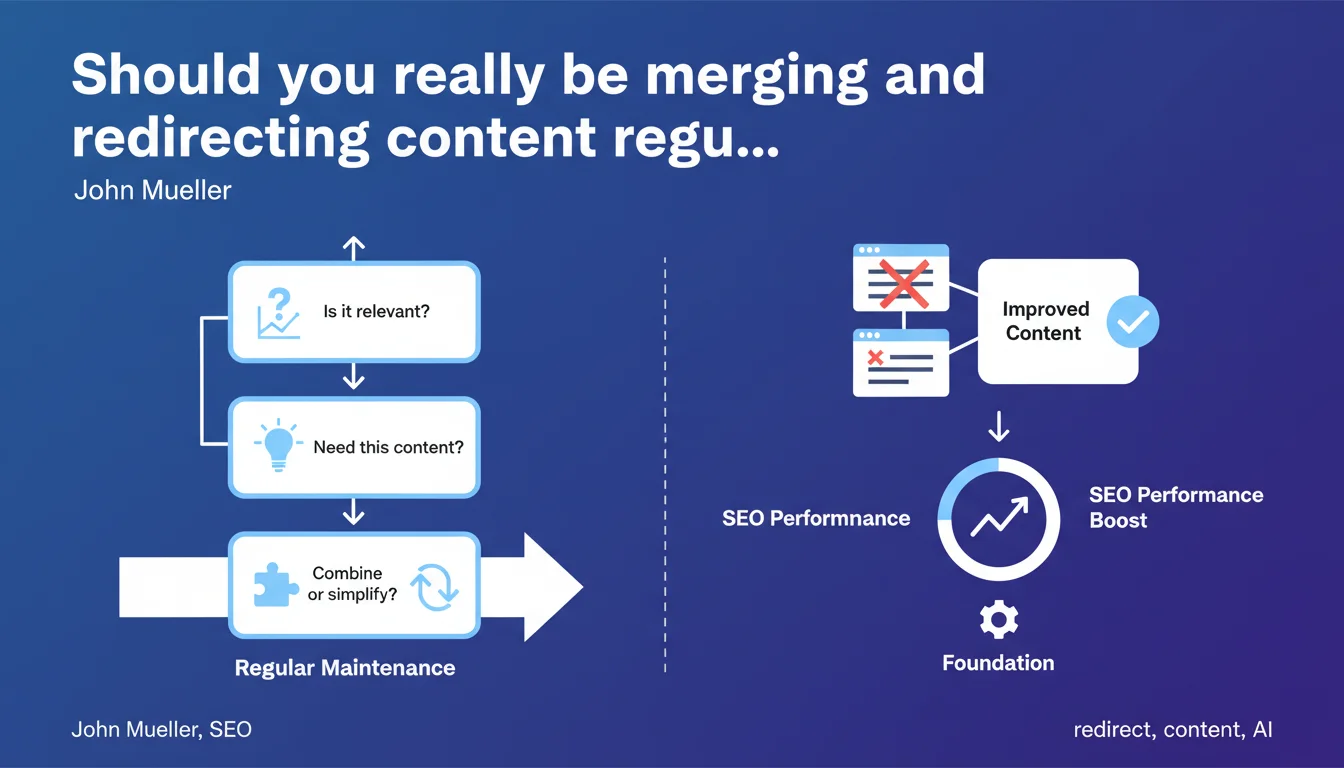
Mueller emphasizes that page merging and redirects are not exceptional operations but basic maintenance tasks that should be integrated into your site's ongoing management. The key issue: continuously evaluate the relevance of each piece of content, merge what overlaps, simplify what's overly complex, and keep only what truly adds value.
What you need to understand
Why does Google emphasize the concept of regular maintenance?
Too many websites accumulate content without ever sorting through it. Obsolete pages, self-cannibalizing content, topics covered multiple times across different URLs — all of this dilutes the site's overall relevance in Google's eyes.
Mueller uses the term "basic maintenance" deliberately. He's not talking about an annual overhaul or a one-time cleanup, but rather an ongoing routine. A living website needs to be tended: you prune, you trim, you consolidate.
What exactly do content merging and redirects involve?
Merging consists of combining multiple pages covering the same topic into a single, more comprehensive resource. The old URLs are redirected via 301 to the new consolidated page. The goal: concentrate authority, avoid keyword cannibalization, and deliver a better user experience.
Simple redirects, on the other hand, apply to pages that no longer serve a purpose but still receive traffic or backlinks. Rather than leaving these URLs as 404s, you redirect them to the most relevant available resource.
What's the real intention behind this statement?
Google wants to discourage compulsive content accumulation. Many sites still believe that a site with 10,000 pages will mechanically rank better than one with 1,000 pages. That's wrong.
The algorithm values relevance and depth, not raw volume. A merged page that fully satisfies a search intent will always outperform five shallow pages on the same topic.
- Regular maintenance: integrate content review into recurring processes, not just during annual audits
- Page merging: consolidate overlapping content to prevent cannibalization and concentrate authority
- 301 redirects: preserve SEO equity from old URLs while cleaning up site architecture
- Continuous evaluation: regularly ask yourself whether each piece of content is truly relevant and useful
SEO Expert opinion
Is this approach actually being followed in practice?
Let's be honest: very few websites practice this discipline. Most accumulate content without ever removing or merging anything, for fear of losing traffic. The result: bloated architectures where Google struggles to identify truly important pages.
The rare sites that do practice regular cleanup often see improvements in overall performance — not immediately, but noticeably within 3 to 6 months. Concentrating internal PageRank on fewer pages strengthens their individual authority.
What are the limitations of this recommendation?
Mueller remains intentionally vague about the frequency of this maintenance. Every three months? Every year? It depends on site size, publishing pace, and industry. [To verify]: Google provides no metrics to determine whether you're doing too much or too little.
Another point: content merging can be tricky. If two pages target slightly different search intents, merging them risks losing relevance for one of the two queries. You need to analyze SERPs, positioned keywords, and user behavior before deciding.
In which cases does this rule not apply?
Some sites need to maintain fine granularity for business or user experience reasons. For example, an e-commerce site with specific product sheets, or a media outlet that archives historical articles even if they no longer generate traffic.
The question is never binary — "merge or don't merge." It should always be asked in light of each page's strategic value, not solely based on its isolated SEO performance.
Practical impact and recommendations
How do you identify content to merge or redirect?
Start with a cannibalization audit: find groups of pages ranking on identical or very similar keywords. Tools like Ahrefs, Semrush, or Search Console help identify these friction zones.
Next, analyze user behavior: bounce rate, time spent, pages per session. A page with good traffic but poor engagement metrics is a candidate for merging with a more comprehensive resource.
What process should you follow to merge content safely?
Never merge blindly. Start by documenting the current rankings of each candidate page, the backlinks they receive, and their respective traffic volumes. Keep a record: you'll be able to measure the real impact post-merge.
Once the merge is complete, set up a clean 301 redirect from the old URLs to the new one. Verify that all internal links now point to the new consolidated page — not to the redirects.
What mistakes should you absolutely avoid?
First mistake: merging pages that target different intents. Even if keywords look similar, if the SERPs differ, keep the pages separate.
Second mistake: forgetting to update your internal linking. If dozens of internal links still point to the old redirected URLs, you create unnecessary redirect chains that dilute PageRank.
- Regularly audit content with poor performance or cannibalization issues
- Document rankings and traffic before any merge
- Verify that search intents are identical before merging
- Implement clean, tested 301 redirects
- Update all internal links to point to the new URLs
- Monitor rankings and traffic for 3 to 6 months post-merge
- Don't hesitate to undo a merge if results are negative
❓ Frequently Asked Questions
À quelle fréquence faut-il fusionner ou rediriger du contenu ?
Fusionner du contenu fait-il perdre du trafic à court terme ?
Peut-on rediriger une page vers une page qui traite un sujet différent ?
Faut-il supprimer les pages peu performantes ou les rediriger ?
Comment mesurer le succès d'une fusion de contenu ?
🎥 From the same video 13
Other SEO insights extracted from this same Google Search Central video · published on 21/11/2023
🎥 Watch the full video on YouTube →
💬 Comments (0)
Be the first to comment.