
Official statement
Other statements from this video 13 ▾
- □ Is technical SEO really still essential for search rankings?
- □ Are You Wasting Time on Obscure Technical SEO Details Instead of Mastering the Basics?
- □ Does Google really prioritize your homepage first when it comes to crawling and indexing?
- □ Does duplicate content really always come from exact copy-paste?
- □ Should you really sacrifice traffic volume for relevance?
- □ Are user feedback signals more revealing than traffic metrics when assessing page quality?
- □ Does SEO quality really come down to helping users accomplish what they came to do?
- □ Does a truly unique perspective really hold the key to ranking in saturated niches?
- □ Should you really delete low-traffic pages from your website?
- □ Should you really be merging and redirecting content regularly to boost your SEO performance?
- □ Should you really treat all crawl errors the same way?
- □ Do you really need to match your title tag and H1 for SEO success?
- □ Should you be using generative AI to write your SEO content?
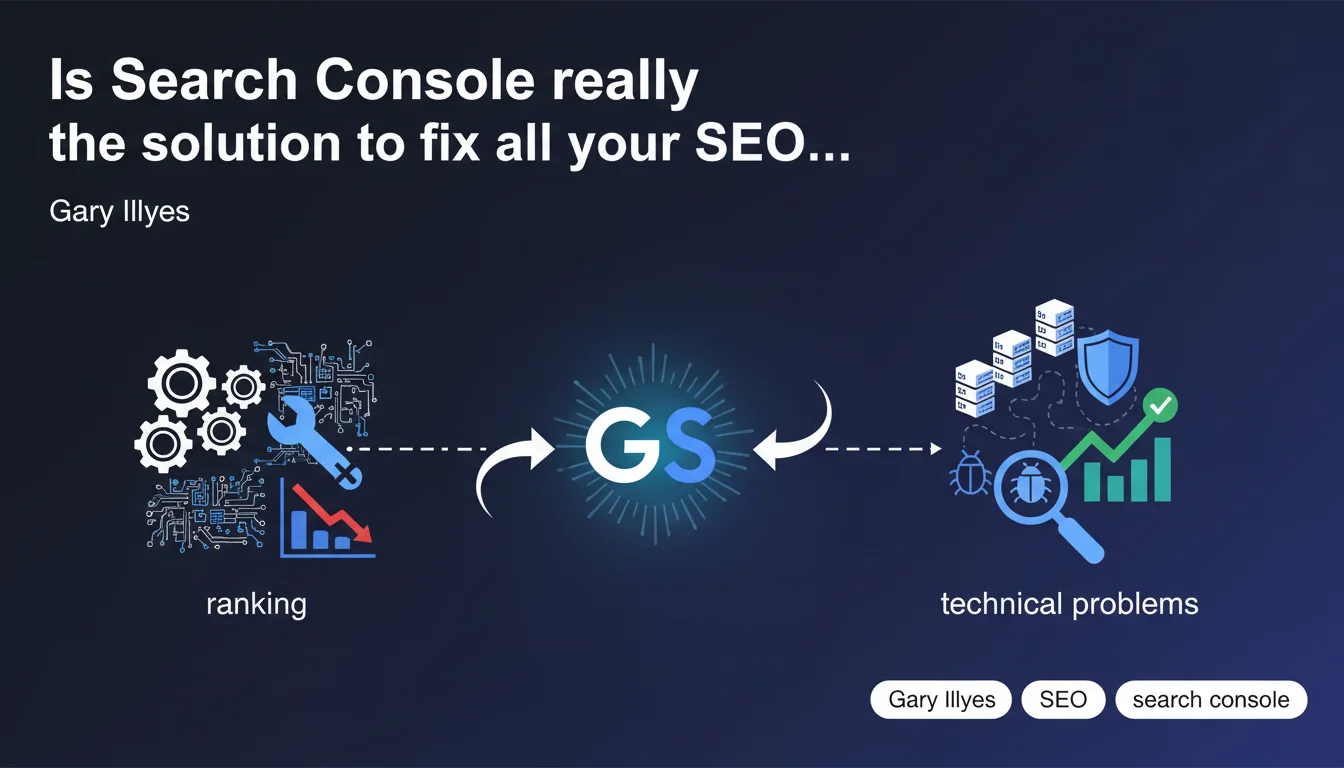
Gary Illyes confirms that Search Console excels at diagnosing technical issues, but its usefulness for ranking questions remains limited. The tool is designed first and foremost as an infrastructure error detector, not as a strategic organic performance dashboard.
What you need to understand
Why does Google emphasize the "technical" dimension of Search Console?
This statement reframes the scope of Search Console's intervention. Google wants to prevent webmasters from using it as a ranking oracle — which it isn't. The tool detects structural malfunctions: 404 errors, indexation issues, misconfigured robots.txt files, failing Core Web Vitals.
On the other hand, if your page is technically flawless but stagnates at position 15, Search Console won't tell you why. Positioning relies on hundreds of signals — many of which are opaque, qualitative, and impossible to synthesize in a dashboard.
What does "can help with ranking issues" mean?
The wording is deliberately vague. Concretely, Search Console can reveal indirect ranking obstacles: an orphaned page, catastrophic loading time, a misoriented canonical tag. Fixing these points can unlock a situation.
But Google doesn't say the tool explains ranking. It can point to a technical obstacle, rarely an editorial or competitive weakness.
- Search Console detects: 404 errors, indexation problems, coverage, sitemaps, mobile-usability, Core Web Vitals
- It does not detect: content quality, semantic relevance, thematic authority, backlink strategy
- Its SEO usefulness: purge errors that sabotage crawlability and UX, not optimize editorial strategy
SEO Expert opinion
Is this statement consistent with practices observed in the field?
Yes, absolutely. In practice, Search Console is a firefighting tool: it alerts when something is burning. It excels at diagnosing sudden traffic collapse linked to a massive indexation issue, a manual penalty, or a technical bug.
On the other hand, it's almost useless for understanding why a competitor is overtaking you on a competitive query. Performance reports show impressions, clicks, average positions — but no insight into the comparative quality of your content against the SERP.
What nuances should be added to this statement?
Gary Illyes doesn't say Search Console is useless for ranking, but that it's "particularly useful" for technical matters. It's a polite way of saying: don't expect strategic miracles.
In some cases, fixing a technical issue revealed by Search Console can have a spectacular ranking impact — if that issue was a blocker. Example: a key page not indexed because of a forgotten noindex tag. But these cases are rare. [To verify]: Google provides no statistics on the proportion of ranking issues caused by purely technical errors versus weaknesses in content or authority.
In what cases does this rule not apply?
If your site suffers from an algorithmic penalty (Helpful Content Update, for example), Search Console will tell you nothing concrete. You'll see a traffic drop, but no precise diagnosis, no actionable metrics. It does not replace an in-depth qualitative analysis of your editorial strategy.
Practical impact and recommendations
What should you concretely do with Search Console?
Use it as routine maintenance, not as a substitute for strategy. Set up weekly alerts on coverage errors, monitor Core Web Vitals, verify that your priority pages are indexed. It's a health dashboard, not a strategic GPS.
For ranking issues, cross-reference Search Console with third-party tools (Ahrefs, Semrush, Screaming Frog) and especially with human analysis: SERP, search intent, content gaps, competitors' backlinks.
What mistakes should you avoid with Search Console?
Don't overestimate average position data. It's aggregated, often misleading, and doesn't reflect intra-day variations or personalizations. A "12" average position can hide a position 3 for certain queries and 40 for others.
Also avoid panicking at every 404 error. If it concerns obsolete URLs without backlinks, without historical traffic, it deserves no action. Prioritize errors that block access to strategic pages.
- Set up email alerts for critical errors (coverage, indexation, security)
- Audit monthly pages excluded from the index to detect involuntary blockages
- Monitor Core Web Vitals and fix pages below thresholds (LCP > 2.5s, CLS > 0.1)
- Verify that your strategic pages appear in the "Pages" section of the performance report
- Cross-reference Search Console data with a crawl tool to detect inconsistencies (crawled but not indexed pages, etc.)
❓ Frequently Asked Questions
Search Console peut-elle m'expliquer pourquoi je perds des positions ?
Quels problèmes techniques Search Console détecte-t-elle le mieux ?
Dois-je corriger toutes les erreurs 404 remontées par Search Console ?
Search Console remplace-t-elle les outils SEO tiers ?
Pourquoi mes positions moyennes dans Search Console sont-elles trompeuses ?
🎥 From the same video 13
Other SEO insights extracted from this same Google Search Central video · published on 21/11/2023
🎥 Watch the full video on YouTube →
💬 Comments (0)
Be the first to comment.