
Official statement
Other statements from this video 13 ▾
- □ Is technical SEO really still essential for search rankings?
- □ Are You Wasting Time on Obscure Technical SEO Details Instead of Mastering the Basics?
- □ Is Search Console really the solution to fix all your SEO problems?
- □ Does Google really prioritize your homepage first when it comes to crawling and indexing?
- □ Does duplicate content really always come from exact copy-paste?
- □ Should you really sacrifice traffic volume for relevance?
- □ Does SEO quality really come down to helping users accomplish what they came to do?
- □ Does a truly unique perspective really hold the key to ranking in saturated niches?
- □ Should you really delete low-traffic pages from your website?
- □ Should you really be merging and redirecting content regularly to boost your SEO performance?
- □ Should you really treat all crawl errors the same way?
- □ Do you really need to match your title tag and H1 for SEO success?
- □ Should you be using generative AI to write your SEO content?
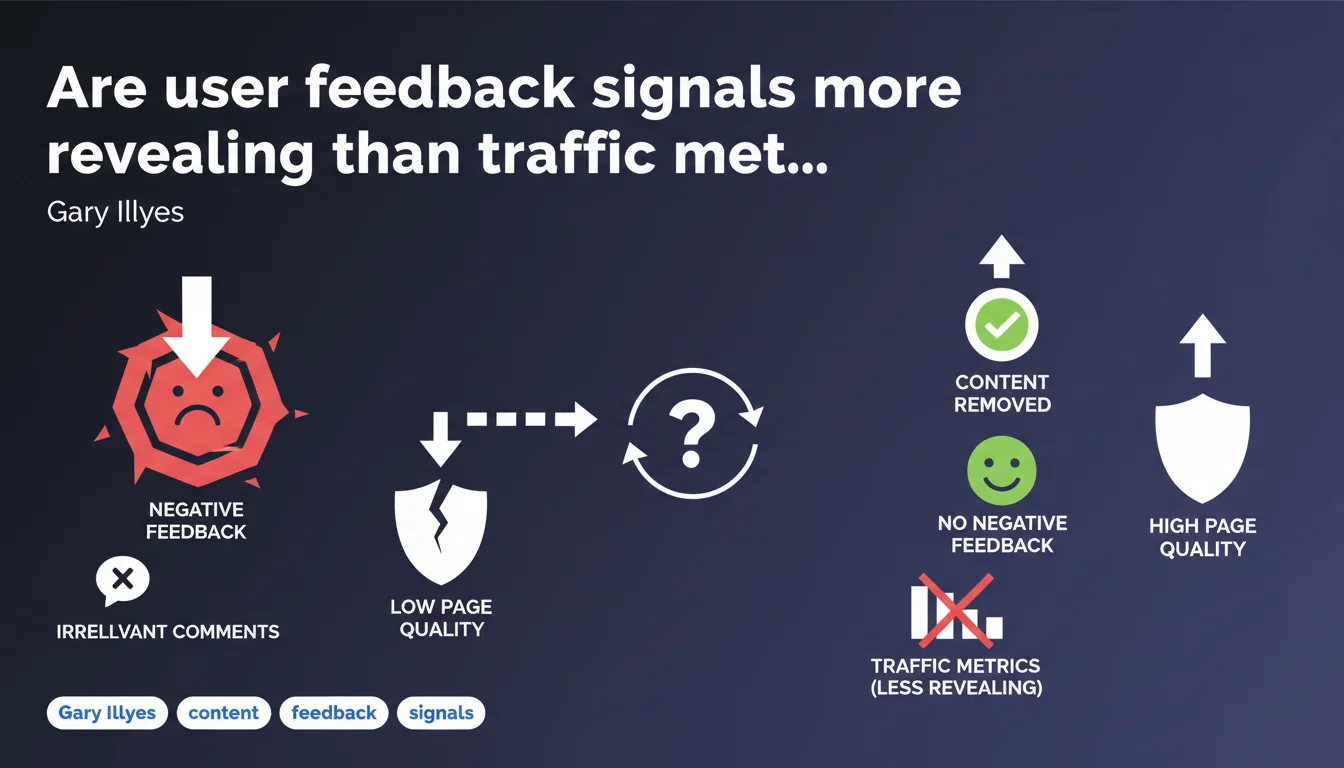
Gary Illyes states that negative feedback and irrelevant comments reveal page quality issues faster than traffic metrics alone. When irrelevant content is removed, negative feedback disappears—a clear signal that Google values alignment between user intent and served content.
What you need to understand
Why does Google emphasize user feedback over traffic metrics?
Traffic is a lagging indicator: a page can attract thousands of visitors before you realize it's generating frustration. Conversely, negative feedback—disappointed comments, reports, immediate bounce rates—emerges right from the first interactions. It reveals a gap between what the user expected and what they found.
Gary Illyes isn't talking here about technical metrics (Core Web Vitals, load time), but about qualitative behavioral signals. If content is technically sound but conceptually off-topic, users will let you know—and quickly.
What does "irrelevant content" actually mean in practice?
Content is irrelevant when it fails to answer the real search intent, even if it targets the right keyword. Classic example: a "best CRM" page listing 20 tools without ever explaining which to choose based on context. It drives traffic but disappoints.
Illyes emphasizes that removing this content also eliminates negative feedback. In other words: it's better to publish nothing than to publish noise. This aligns with Google's stance against content at scale lacking added value.
How does this approach fit into the Helpful Content philosophy?
This statement is a direct extension of the Helpful Content Update. Google no longer measures just thematic relevance, but post-click satisfaction. Negative feedback is a proxy for this dissatisfaction.
This means the algorithm could cross multiple signals: bounce rate, session duration, rapid SERP returns, but also—and this is more opaque—explicit feedback collected via Google tools (Search Console, Chrome, user surveys).
- Negative feedback appears faster than traffic drops in analytics
- Removing irrelevant content can improve the site's overall perception
- User intent trumps exhaustive keyword coverage
- Google likely has feedback channels we don't see (Chrome, Android, surveys)
SEO Expert opinion
Is this statement consistent with real-world observations?
Yes, partially. We regularly observe that pages that are technically flawless but conceptually flawed stagnate or drop after a Core Update. Traffic arrives, but users don't convert, don't stay, don't return. Weak engagement signals eventually take their toll.
But—and here's where it gets tricky—Google provides no access to these feedbacks. Unlike an e-commerce platform with customer reviews, we don't see what users really think about our pages. Illyes speaks of a signal he can measure, but that we must infer indirectly through third-party metrics (Hotjar, behavioral analytics, surveys). [To verify]: how much does Google actually leverage explicit feedback in rankings, and which types?
What nuances should be added?
The concept of "irrelevant content" remains fuzzy. For the same keyword, multiple intents can coexist. Take "python": programming language or snake? A page about the reptile isn't "irrelevant"—it's irrelevant for part of the audience only.
Furthermore, removing content isn't always the right answer. Sometimes, simply clarifying intent in the title and intro, or segmenting audiences with distinct pages, is enough. Illyes's advice is binary (keep/delete), but SEO reality is more granular.
In which cases does this rule not apply?
On highly technical or niche B2B sites, feedback is rare or nonexistent. An API documentation page might be read by 200 people/month, all satisfied, without ever generating a single comment. The absence of negative feedback proves nothing—nor does the absence of positive feedback.
Similarly, some content is intentionally broad (comprehensive guides, topic hubs). It might frustrate those seeking a precise 2-line answer, but satisfy those wanting to explore. Feedback will be mixed—should it be considered negative?
Practical impact and recommendations
What should you concretely do to identify and fix irrelevant content?
Start by auditing your existing content by cross-referencing quantitative and qualitative metrics. Pages with high traffic but low engagement (duration < 30s, bounce rate > 80%, zero conversions) are candidates. But don't rely on numbers alone: reread the content as if you were the user.
Next, collect explicit feedback where Google won't provide it. Install a satisfaction widget at the end of articles ("Did this page answer your question?"), analyze customer support verbatims, monitor comments if you have them. These signals will tell you if content disappoints—and why.
What mistakes should you avoid when optimizing or removing content?
Never delete without redirecting. Irrelevant pages may still have backlinks, internal juice, and contribute to overall topicality. Redirect to the closest semantically relevant page, or to a hub page if no match exists.
Another trap: confusing "irrelevant" with "underperforming". A page might rank in position 8 because it's under-optimized, not because it's conceptually flawed. Before deleting, verify if editorial refactoring (better angle, stronger title, added data) could save it.
How do you measure the impact of these optimizations?
Segment your interventions: delete or optimize in batches of 10-20 pages, wait 4-6 weeks, measure. Compare overall site traffic, crawl rate, engagement signals (average duration, pages/session). If negative feedback was real, its disappearance should translate to higher perceived quality—and possibly a boost at the next Core Update.
Document every decision: why was this page removed, what content replaced or absorbed it, which backlinks were preserved. This lets you roll back if impact is negative, and capitalize if it's a success.
- Audit pages with high traffic but low engagement (bounce, duration, conversions)
- Reread content from the user's perspective: does it truly answer the intent?
- Collect explicit feedback via widgets, surveys, customer support
- Never delete without 301 redirect to a relevant page
- Test optimizations in batches and measure impact over 4-6 weeks
- Document each intervention to trace site evolution
- Analyze user verbatims to detect intent misalignment
❓ Frequently Asked Questions
Google utilise-t-il vraiment les feedbacks utilisateurs pour classer les pages ?
Comment collecter des feedbacks utilisateurs si je n'ai pas de système de commentaires ?
Faut-il supprimer toutes les pages avec un taux de rebond élevé ?
Quel délai pour voir l'impact d'une suppression de contenu non pertinent ?
Peut-on restaurer une page supprimée si l'impact est négatif ?
🎥 From the same video 13
Other SEO insights extracted from this same Google Search Central video · published on 21/11/2023
🎥 Watch the full video on YouTube →
💬 Comments (0)
Be the first to comment.