
Official statement
Other statements from this video 13 ▾
- □ Are You Wasting Time on Obscure Technical SEO Details Instead of Mastering the Basics?
- □ Is Search Console really the solution to fix all your SEO problems?
- □ Does Google really prioritize your homepage first when it comes to crawling and indexing?
- □ Does duplicate content really always come from exact copy-paste?
- □ Should you really sacrifice traffic volume for relevance?
- □ Are user feedback signals more revealing than traffic metrics when assessing page quality?
- □ Does SEO quality really come down to helping users accomplish what they came to do?
- □ Does a truly unique perspective really hold the key to ranking in saturated niches?
- □ Should you really delete low-traffic pages from your website?
- □ Should you really be merging and redirecting content regularly to boost your SEO performance?
- □ Should you really treat all crawl errors the same way?
- □ Do you really need to match your title tag and H1 for SEO success?
- □ Should you be using generative AI to write your SEO content?
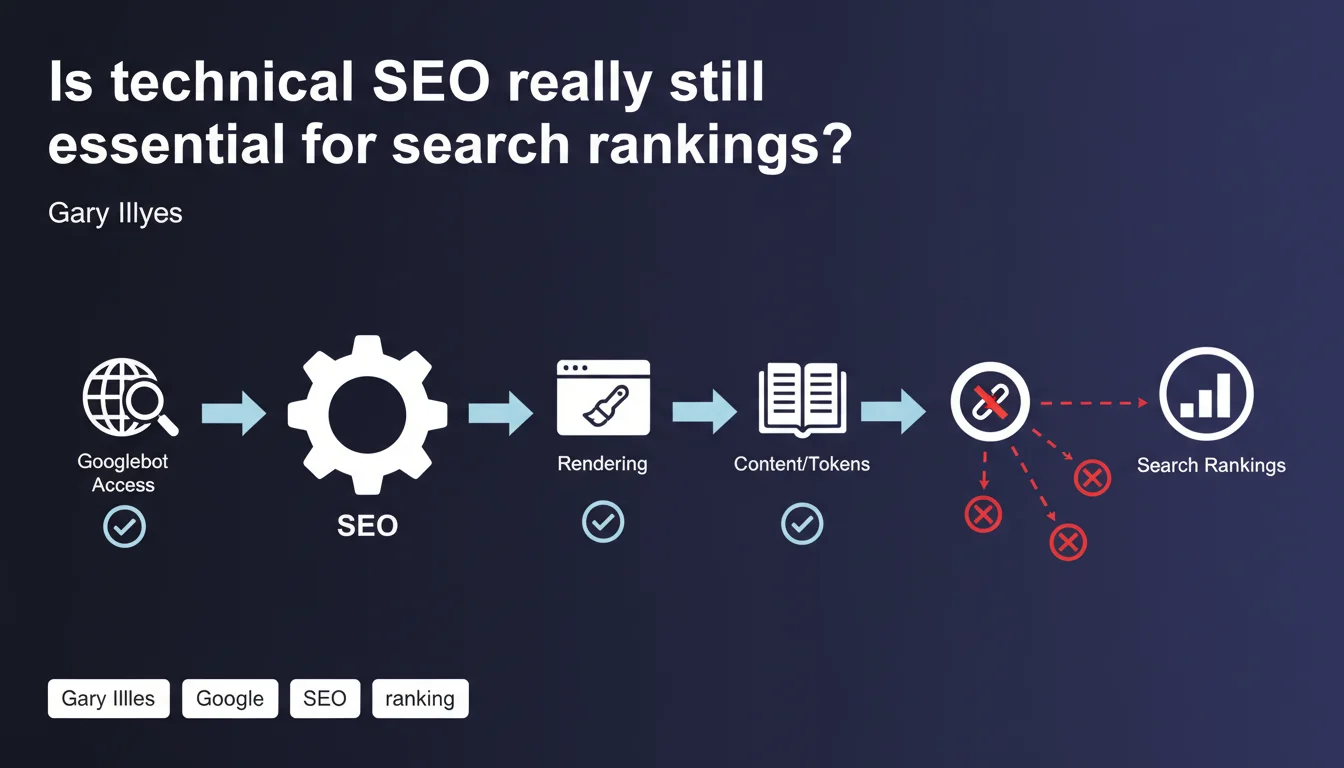
Google makes it crystal clear: without solid technical foundations, even the best content remains invisible. If Googlebot can't crawl your site, if JavaScript rendering fails, or if your pages lack exploitable text, you simply don't exist in the index. Technical SEO isn't an option — it's the absolute prerequisite for any visibility strategy.
What you need to understand
Why does Google keep hammering home the importance of technical foundations?
Because accessibility remains the first bottleneck. Googlebot must be able to access your site, load critical resources, execute JavaScript, and extract exploitable text. If any one of these steps fails, everything else — content, authority, user experience — becomes completely worthless.
This statement reinforces an often-overlooked truth: Google cannot guess what's on a page it can't reach. A misconfigured robots.txt file, JavaScript rendering that crashes, a page with zero text content — these are all insurmountable barriers to indexation.
What does it concretely mean when "rendering fails severely"?
Google executes JavaScript to access dynamic content. If this process fails — critical JS errors, blocked resources, timeouts — the bot sees nothing but an empty shell.
Single Page Applications (SPAs) that are poorly configured are especially vulnerable. Without server-side pre-rendering or HTML fallback, a single JavaScript error can render your entire content invisible. And Google won't wait forever: if rendering takes too long or crashes, it indexes what it managed to load — which is often very little.
What do we mean by "no words/tokens on the page"?
Google needs exploitable text to understand and rank a page. Images without alt text, content only in video format without transcription, purely graphic pages — all of this is virtually invisible to the search engine.
Even with successful crawling and rendering, if Google can't extract any relevant tokens, it cannot determine the page's topic or relevance. Textual content remains the foundation of semantic indexation.
- Technical accessibility comes before everything else: crawling, rendering, and content extraction are the three non-negotiable pillars.
- JavaScript must be robust: a critical error can destroy all organic visibility.
- Exploitable textual content remains essential for Google to understand and rank a page.
- Technical foundations determine the effectiveness of all other SEO optimizations.
SEO Expert opinion
Is this statement consistent with what we observe in real-world practice?
Absolutely. SEO audits regularly reveal sites with excellent content but deficient technical architecture — and their organic visibility is catastrophic. Conversely, mediocre sites that are technically flawless often outperform what you'd expect.
What Google doesn't say here is that these technical issues are often invisible to non-technical teams. A site can seem perfectly functional from a user perspective while being partially inaccessible to Googlebot. JavaScript rendering errors, for instance, only show up when you run specific tests with tools like the Mobile-Friendly Test or the URL Inspection tool in Search Console.
What nuances should we add to this statement?
Google doesn't specify exactly how "severe" a rendering failure needs to be. [To verify]: does a minor JS error affecting only a secondary module block the indexation of main content? Field feedback suggests Google is relatively tolerant of peripheral errors, but no official documentation specifies the exact thresholds.
Another point: Google doesn't mention processing delays. A technically flawless site but with insufficient crawl budget can also remain invisible. Technical accessibility is necessary but not sufficient — Google still needs to prioritize crawling and indexing your pages.
In what cases doesn't this rule apply completely?
For ultra-dominant brands with massive brand recognition, Google can compensate for certain technical weaknesses through other signals. But that's the exception, not the rule. For 99% of sites, technical foundations are non-negotiable.
Another special case: content embedded via iframes or blocked external resources can be partially indexed if Google manages to extract enough context from the parent page. But that's far from optimal.
Practical impact and recommendations
What should you check first on your site?
Start by validating that Googlebot can access all your critical pages. Test your robots.txt file, check for unintentional noindex directives, control redirect chains. An error at this level nullifies everything else.
Next, test JavaScript rendering on a representative sample of pages. Use the URL Inspection tool in Search Console and compare the source HTML to the final rendering. If entire content blocks only appear on the client side, you have a problem.
What errors must you absolutely avoid?
Never block critical resources (CSS, JS) needed to render main content. Google needs to execute JavaScript to see what users see. A robots.txt that's too restrictive can prevent essential scripts from loading and cause rendering failures.
Avoid purely client-side architectures without fallback. If your SPA provides no HTML content before JavaScript execution, you're playing with fire. Server-Side Rendering (SSR) or pre-rendering remain the most reliable solutions to guarantee content accessibility.
How can you ensure Google extracts exploitable content?
Inspect the rendered HTML version in Search Console. Textual content must be present and structured. If you rely only on images, videos, or HTML5 Canvas without alternative text, Google has nothing to work with.
Also verify that your main content isn't buried in complex JavaScript structures that delay its display. Content above the fold must be accessible quickly, without waiting for full resource loading from third parties.
- Test complete site accessibility via robots.txt and meta directives
- Verify JavaScript rendering with the URL Inspection tool (Search Console)
- Ensure main content is present in rendered HTML
- Check that critical resources (CSS, JS) aren't blocked
- Implement SSR or pre-rendering for SPAs
- Add alternative text (alt, transcriptions) for all non-textual content
- Monitor crawl errors and rendering warnings in Search Console
- Regularly test with third-party tools (Screaming Frog, Sitebulb) in JavaScript mode
❓ Frequently Asked Questions
Le SEO technique est-il plus important que le contenu ou les backlinks ?
Quels outils utiliser pour verifier que Googlebot voit bien mon contenu ?
Un site en React ou Vue.js peut-il etre correctement indexe par Google ?
Google peut-il indexer du contenu uniquement present dans des images ou des videos ?
Comment savoir si mon JavaScript bloque l'indexation de mon contenu ?
🎥 From the same video 13
Other SEO insights extracted from this same Google Search Central video · published on 21/11/2023
🎥 Watch the full video on YouTube →
💬 Comments (0)
Be the first to comment.