
Official statement
Other statements from this video 13 ▾
- □ Does content quality really impact every single Google ranking system?
- □ Does Google really give preferential treatment to new homepages?
- □ Does Google really prioritize high-quality pages when deciding what to crawl?
- □ Is Googlebot really that dumb, or is Google hiding something about how crawling actually works?
- □ Does page quality really determine how deeply Google crawls your website?
- □ Is Google really penalizing entire sections of your site based on quality patterns?
- □ Does moving low-quality UGC content really unlock your site's crawl potential?
- □ Does update frequency really affect how often Google crawls your pages?
- □ Does Google really filter certain topics during crawling and indexing?
- □ Can Google really crawl a page without indexing it if the content doesn't make sense?
- □ Is duplicate content really safe for your SEO?
- □ Can affiliate links coexist with a high-quality SEO strategy?
- □ Should you really have humans review your machine-translated content before publishing?
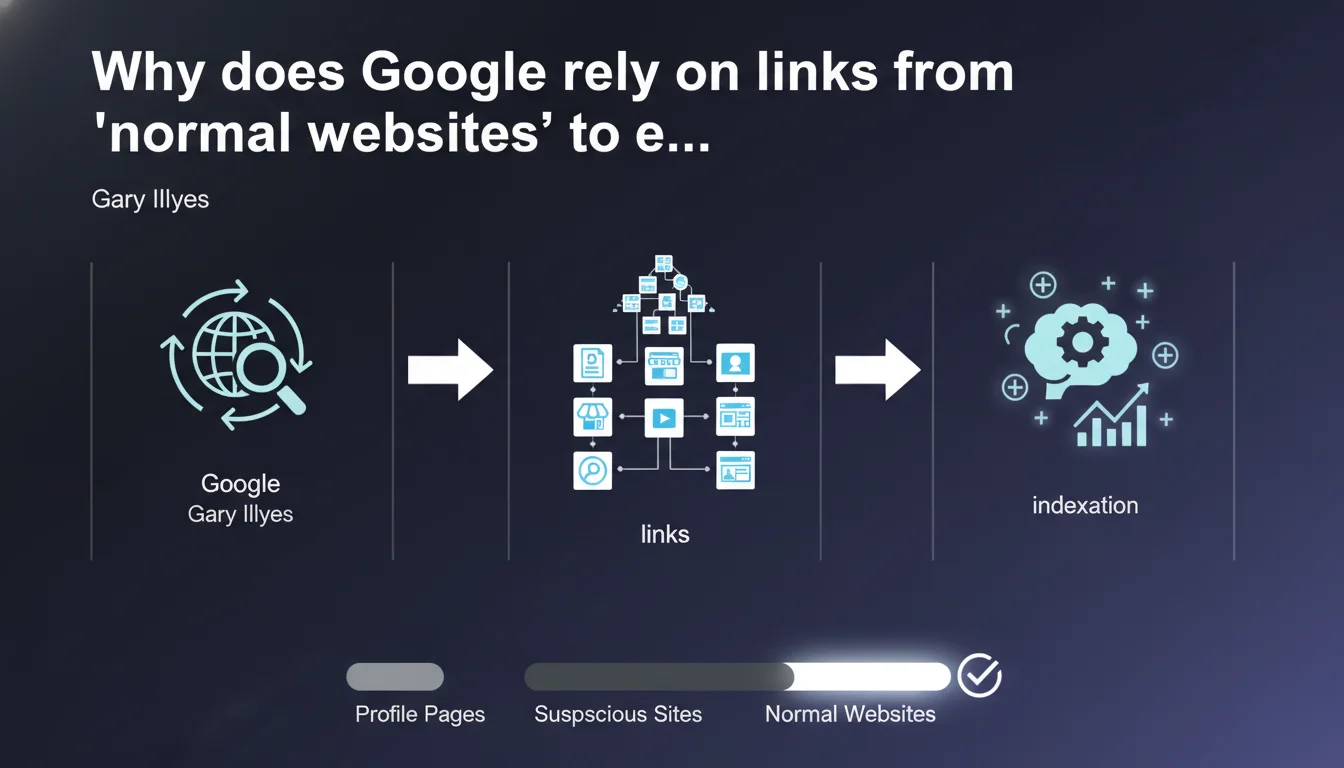
Google uses links from 'normal websites' — meaning legitimate sources, not social media profiles or suspicious directories — as a key signal to estimate a site's importance during indexation. The more natural backlinks you receive from reliable sources, the more Google prioritizes your content for crawling and indexation.
What you need to understand
What does Google actually mean by 'normal websites'?
Gary Illyes's wording is deliberately vague. A normal website is essentially a classic editorial site: media outlets, niche blogs, institutional websites, moderated forums. In short, destinations that publish original content and attract organic traffic.
Conversely, Google explicitly excludes profile pages (social networks, low-grade directories) and suspicious websites (link farms, low-quality PBNs). What matters is the editorial legitimacy and thematic relevance of the source site.
What's the connection between these backlinks and indexation?
Google doesn't say that links directly improve rankings — it's talking about importance estimation for indexation. Crucial distinction: a site with few quality backlinks risks having its pages crawled less frequently, or even ignored if crawl budget is tight.
Links from legitimate sites serve as a discovery signal and relevance validation. The more you obtain, the more Googlebot estimates that your pages deserve regular crawling and quick indexation.
How does Google distinguish between a 'natural' link and a manipulated one?
No technical details in this statement — that's precisely the problem. We know Google analyzes editorial context (is the link integrated into real content?), thematic consistency (does the source site cover the same topic?), and domain history (does it link to dozens of unrelated sites?).
But beyond these generalities, the line between 'natural' and 'manipulated' remains a gray area that only the algorithm knows.
- Indexation signal: links from legitimate sites accelerate crawling and indexation of your pages.
- Normal websites: classic editorial sites with organic traffic and original content — not profiles or directories.
- Vague criterion: Google doesn't detail its methods for distinguishing a natural backlink from a manipulated one.
- Crawl budget: a site without quality backlinks risks having its pages crawled less frequently.
SEO Expert opinion
Is this statement consistent with real-world observations?
Yes, overall. We've observed for years that sites well-connected within legitimate editorial ecosystems see their new pages indexed within hours, while isolated sites — even with decent content — may wait days or weeks.
The problem is that Gary Illyes provides no concrete metrics: how many links? From how many referring domains? How frequently? Everything remains vague, making the statement difficult to use operationally. [To verify] in your own data.
Why emphasize 'normal websites' rather than simply 'quality backlinks'?
Because Google wants to discourage artificial linking practices. By specifying 'not profile pages or suspicious sites,' Illyes is clearly targeting automated social media networks, low-cost directories, and poorly constructed PBNs.
Let's be honest: this wording is also a way to avoid giving precise criteria. If Google said 'you need X links from sites with Y domain rating,' half the SEO world would spend its time gaming the system. The vagueness is strategic.
What are the limitations of this statement?
First limitation: it says nothing about rankings. A site can be perfectly indexed and remain invisible on page 10. Indexation is a necessary condition, not a sufficient one.
Second limitation: the notion of a site's 'normalcy' is subjective. Is a WordPress blog hosted by an individual 'normal'? A niche forum with 500 active members? Google gives no threshold, no objective criteria.
Practical impact and recommendations
What should you do concretely to obtain these 'normal' links?
The soundest approach remains classic digital PR: identify relevant thematic media and blogs, propose them exclusive content or original data, obtain natural mentions. It takes time, but that's what Google values.
Guest posting strategies remain effective if conducted intelligently — that is, targeting sites with a real readership, not platforms open to everyone. Prioritize editorial quality over sheer number of referring domains.
What mistakes must you absolutely avoid?
Don't waste time on generic directories, low-cost press releases distributed across 200 cloned sites, or social media profiles created solely to place a link. Google ignores them at best, penalizes them at worst.
Another trap: buying backlinks from 'premium' PBNs marketed as 'normal websites.' If the network is detected — and they often are — you risk manual or algorithmic devaluation of all related links.
How do you verify that your strategy is working?
Monitor the indexation speed of your new pages in Search Console. If they're discovered and indexed within 48 hours of publication, that's a good sign. If they languish in 'Discovered, currently not indexed' for weeks, you likely lack quality inbound backlinks.
Also analyze crawl frequency: a well-linked site sees Googlebot visit its strategic pages several times daily. An isolated site may only be visited once per week.
- Identify 10 to 20 relevant editorial sites in your niche and propose them exclusive content.
- Avoid generic directories, cloned press releases, and social media profiles without editorial value.
- Monitor indexation speed of your new pages in Search Console.
- Analyze crawl frequency of your strategic pages to detect potential crawl budget issues.
- Always prioritize editorial quality of source sites over raw quantity of referring domains.
❓ Frequently Asked Questions
Un lien depuis un réseau social comme LinkedIn ou Twitter compte-t-il pour l'indexation ?
Combien de backlinks faut-il pour qu'un site soit jugé « important » par Google ?
Un site sans aucun backlink peut-il être correctement indexé ?
Les liens internes suffisent-ils pour améliorer l'indexation de mes pages profondes ?
Google considère-t-il les forums et communautés en ligne comme des « sites normaux » ?
🎥 From the same video 13
Other SEO insights extracted from this same Google Search Central video · published on 19/09/2023
🎥 Watch the full video on YouTube →
💬 Comments (0)
Be the first to comment.