
Official statement
Other statements from this video 13 ▾
- □ La qualité du contenu influence-t-elle vraiment tous les systèmes de classement Google ?
- □ Google accorde-t-il vraiment un traitement de faveur aux nouvelles pages d'accueil ?
- □ Google privilégie-t-il vraiment les pages de qualité dans son crawl ?
- □ Googlebot est-il vraiment stupide ou Google cache-t-il quelque chose ?
- □ La qualité d'une page détermine-t-elle vraiment le crawl des pages suivantes ?
- □ Google peut-il vraiment pénaliser certaines sections de votre site en fonction de leur qualité ?
- □ Faut-il vraiment déplacer le contenu UGC de faible qualité pour améliorer le crawl ?
- □ La fréquence de mise à jour influence-t-elle vraiment le crawl de vos pages ?
- □ Pourquoi Google refuse-t-il d'indexer un contenu qu'il a pourtant crawlé ?
- □ Le contenu dupliqué est-il vraiment sans danger pour votre SEO ?
- □ Les liens d'affiliation peuvent-ils coexister avec une stratégie SEO de qualité ?
- □ Faut-il vraiment faire relire vos traductions automatiques par des humains ?
- □ Pourquoi Google privilégie-t-il les liens depuis des « sites normaux » pour évaluer votre importance ?
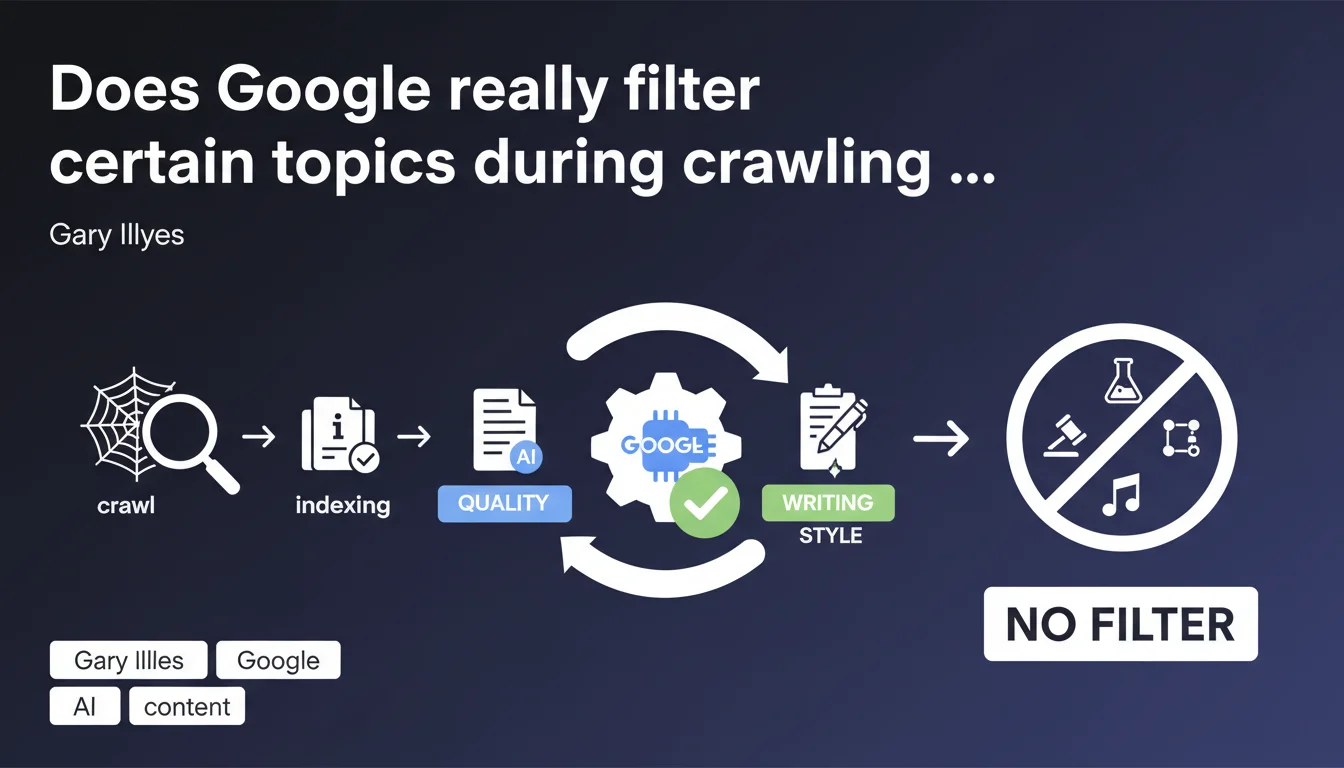
Google claims it does not discriminate against pages based on their subject matter at the crawling and indexing stage. Whether you're discussing plumbing, tax law, or cryptocurrency, the search engine applies the same criteria: content quality and how it is written. The topic itself is not a filter for entry into the index.
What you need to understand
Does Google really make a difference between a page about cooking and a page about blockchain?
The statement is clear: no, the subject matter does not influence the decision to crawl or index. Google does not have a whitelist or blacklist of prioritized or penalized topics from the outset. Whether your content covers organic gardening or decentralized finance, robots will pass through and evaluate according to the same technical and qualitative criteria.
What really matters? Editorial quality, content structure, relevance of information, and how it is presented. A mediocre article on a popular topic will have no better chance than a mediocre article on an ultra-specialized niche.
Why this clarification from Google now?
This clarification likely comes in response to a persistent misconception: some SEO professionals believe that Google structurally favors certain sectors (health, finance) or penalizes others (online betting, CBD, adult content).
In reality, these sectors are subject to reinforced quality filters (YMYL for example), but not thematic blocking at the crawling stage. The nuance is critical: it's not the topic that's problematic, it's how you treat it and whether you meet expected quality standards.
What does this change concretely for crawling and indexing?
Nothing — or almost nothing. If your page respects technical standards (robots.txt, sitemap, meta tags), it will be crawled. If it offers unique and well-structured content, it will be indexed. The topic only comes into play later, at the ranking stage, where competition and E-E-A-T requirements enter the picture.
- Crawling and indexing: neutral on topic, focused on technical aspects and editorial quality.
- Ranking: here, yes, certain topics (YMYL) require reinforced authority and expertise signals.
- Content filters: certain sensitive topics (health, finance) trigger specific algorithms, but after indexing.
- No "blacklist": no sector is blacklisted by default at the crawling stage.
SEO Expert opinion
Is this statement consistent with what we observe in practice?
Yes and no. Yes, because we do see pages indexed on virtually every imaginable topic, including ultra-sensitive niches. No, because experience shows that certain sectors (health, finance, legal) undergo much stricter quality filters from the earliest processing phases.
Google is playing with words here: technically, crawling and indexing do not discriminate by topic. But the ranking algorithms applied almost simultaneously do so massively. For the practitioner, the distinction is almost academic — the net result is that a poorly executed YMYL page will never rank, even if it is indexed.
What nuances should be added to this statement?
The phrasing "Google is not selective about topics" masks a more complex reality. Certainly, no arbitrary thematic blocking. But certain topics trigger reinforced verification mechanisms: verification of authors, sources, update dates, scientific or legal consistency.
A concrete example: two articles of 1500 words, same editorial quality, same on-page optimization. One is about cooking recipes, the other about cancer treatments. The second will require explicit medical authority signals (MD author, citations from studies, institutional affiliations) to have a chance of ranking. The first, far less so.
[To verify]: Google publishes no exhaustive list of topics subject to reinforced YMYL filters. We work by inference, observing algorithm fluctuations and feedback from affected sites.
In what cases does this rule not apply fully?
Some content, even well-written, can be deindexed or penalized for legal or political reasons (DMCA, right to be forgotten, illegal content). But these are not thematic filters in the algorithmic sense, rather manual or semi-automatic interventions in response to legal obligations.
Furthermore, anti-spam filters can affect certain sectors more than others, not because of the topic, but because these niches attract massive amounts of spam (betting, pharma, adult). Correlation is not causation — the topic is not blacklisted, but the dominant practices in that sector are.
Practical impact and recommendations
What should you do concretely if working on a sensitive or YMYL topic?
First, accept that the level of expectation will be structurally higher. Not because Google discriminates against the topic, but because the quality bar is set much higher. Concretely, each page must display explicit expertise signals: identified authors with credentials, cited sources, visible revision dates.
Next, work on E-E-A-T signals extensively: verifiable experience, documented expertise, domain and author authority, and transparency about who publishes and why. These signals must be visible, not only in the content, but also in supporting pages (About, Legal, Author bios).
What mistakes should you absolutely avoid?
Don't fall into the trap of "more content = better". On a YMYL topic, a short but heavily sourced article written by a recognized expert will always crush a 5000-word generic piece signed "Admin". Length without substance is counterproductive.
Also avoid neglecting regular updates. Medical or financial content that is three years old without revision sends a strong negative signal, even if technically it remains indexed. Google values freshness on these topics because information evolves quickly.
- Clearly identify authors with their qualifications and biography.
- Systematically cite primary sources (studies, laws, official documents).
- Display publication and last update dates visibly.
- Structure content with clear headings and direct answers to questions posed.
- Integrate reassurance elements (legal mentions, privacy policy, accessible contact).
- Avoid sensationalist language or exaggerated promises ("guaranteed cure", "miracle solution").
- Update content at minimum every 6-12 months on evolving topics.
- Obtain backlinks from authority sites in the same sector (recognized media, institutions, universities).
How can you ensure your approach meets Google's expectation level?
Compare your pages to the currently top-3 results for your target keywords. Analyze: who are the authors? What sources are cited? What is the editorial structure? What level of technical detail? If you're below this standard, there's no point hoping to rank — you must first close the gap.
Implement a regular E-E-A-T audit: every quarter, review your YMYL content to verify they still meet standards observed in SERPs. Requirements are constantly rising; what sufficed a year ago may be insufficient today.
❓ Frequently Asked Questions
Google indexe-t-il vraiment tous les sujets de la même manière ?
Pourquoi mes pages YMYL ne rankent-elles pas malgré un bon contenu ?
Faut-il éviter certains sujets sensibles en SEO ?
Comment savoir si mon sujet est considéré comme YMYL par Google ?
Un site récent peut-il ranker sur des sujets YMYL ?
🎥 From the same video 13
Other SEO insights extracted from this same Google Search Central video · published on 19/09/2023
🎥 Watch the full video on YouTube →
💬 Comments (0)
Be the first to comment.