
Official statement
Other statements from this video 13 ▾
- □ La qualité du contenu influence-t-elle vraiment tous les systèmes de classement Google ?
- □ Google accorde-t-il vraiment un traitement de faveur aux nouvelles pages d'accueil ?
- □ Google privilégie-t-il vraiment les pages de qualité dans son crawl ?
- □ Googlebot est-il vraiment stupide ou Google cache-t-il quelque chose ?
- □ La qualité d'une page détermine-t-elle vraiment le crawl des pages suivantes ?
- □ Google peut-il vraiment pénaliser certaines sections de votre site en fonction de leur qualité ?
- □ La fréquence de mise à jour influence-t-elle vraiment le crawl de vos pages ?
- □ Google filtre-t-il vraiment certains sujets lors du crawl et de l'indexation ?
- □ Pourquoi Google refuse-t-il d'indexer un contenu qu'il a pourtant crawlé ?
- □ Le contenu dupliqué est-il vraiment sans danger pour votre SEO ?
- □ Les liens d'affiliation peuvent-ils coexister avec une stratégie SEO de qualité ?
- □ Faut-il vraiment faire relire vos traductions automatiques par des humains ?
- □ Pourquoi Google privilégie-t-il les liens depuis des « sites normaux » pour évaluer votre importance ?
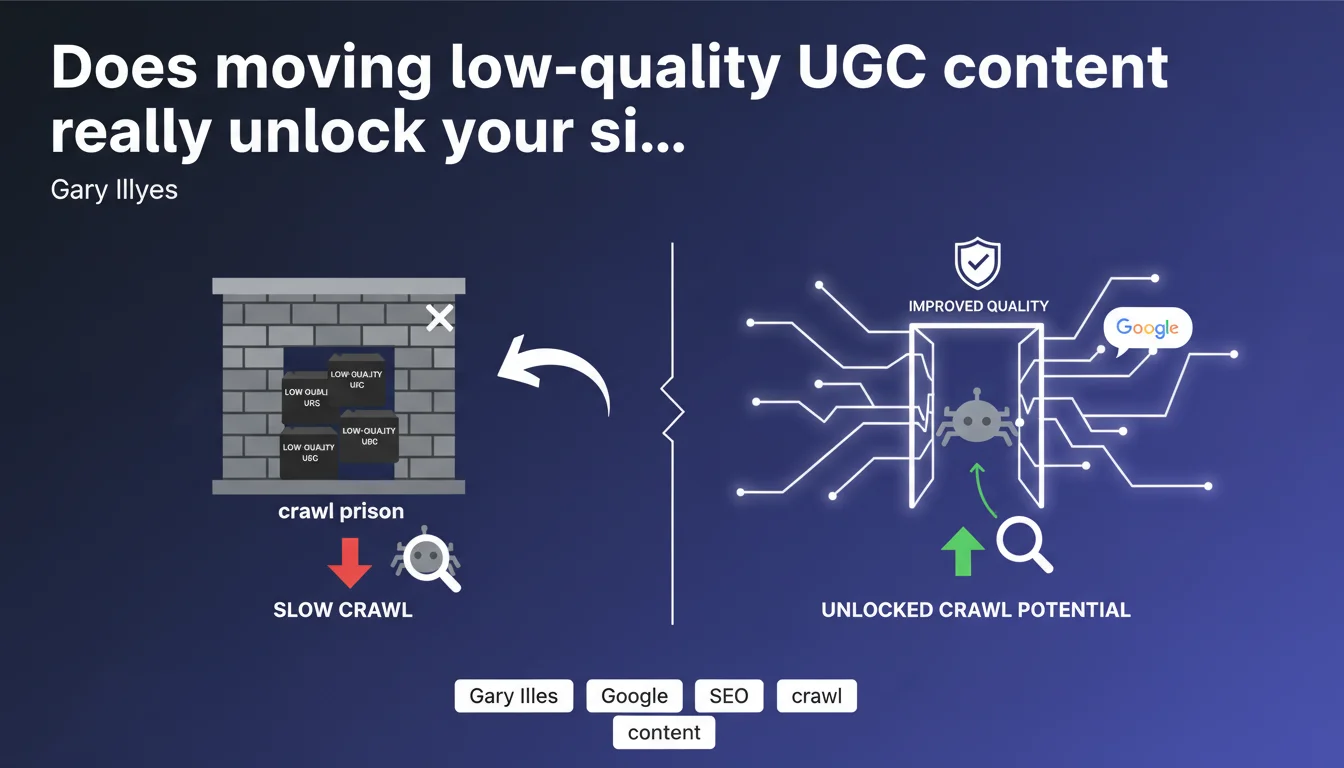
Google confirms that moving low-quality UGC content away from the main site improves how Googlebot crawls the remaining sections. This field observation validated by Gary Illyes suggests that a site's overall quality directly influences crawl budget allocation — what Google calls escaping 'crawl prisons'.
What you need to understand
What exactly is a 'crawl prison' according to Google?
The term "crawl prison" isn't officially documented in Google's guidelines, but Gary Illyes uses it here to describe a state where Googlebot drastically reduces its activity on certain site sections. In practical terms? The bot spends less time on areas it considers low-quality, creating a bottleneck.
This phenomenon isn't new — we've observed for years that Google adjusts its crawl budget based on quality signals. But this official statement formalizes that low-quality UGC (User Generated Content) can be a direct trigger for this restriction.
Why does UGC content pose a specific problem?
User-generated content — spam comments, polluted forums, empty product sheets — often represents a massive volume of low-value pages. Google must make a choice: crawl 10,000 mediocre comment pages or 500 solid editorial pages?
By moving this UGC content to a subdomain or separate domain, SEOs observe that Googlebot reallocates its budget toward critical sections. It's not magic: it's a matter of algorithmic efficiency. Google prioritizes areas where it detects positive quality signals.
What signals indicate a site is in 'crawl prison'?
Several indicators in Search Console should raise red flags: a progressive decrease in the number of pages crawled per day, an increase in 404 or soft-404 errors on specific sections, an abnormally long delay between publication and indexation.
Another signal: entire site sections aren't visited by Googlebot for several weeks, even though they contain fresh content. If you notice this pattern, Google has likely reduced crawl priority on these zones.
- Crawl budget is not uniform: Google allocates resources differently depending on site sections
- Overall quality impacts crawl: even good content can be penalized if buried in mediocre material
- Moving ≠ deleting: the goal is to isolate low-quality content, not necessarily to lose it
- 'Crawl prisons' are reversible: improving quality allows you to restore normal crawl activity
SEO Expert opinion
Is this statement consistent with field observations?
Yes — and it's rare for Google to be this explicit. For years, we've observed that sites with a high ratio of UGC to editorial content suffer from chronic indexing problems. phpBB forums, marketplaces with thousands of empty product sheets, review sites with massive spam: they all share this symptom.
What's different here is official validation. Gary Illyes isn't saying "theoretically this should work" — he's saying "SEOs have observed it." This is validated field experience from Google, not a hypothesis. It gives weight to a practice that remained in the empirical domain until now.
What nuances should we apply to this recommendation?
First nuance: [To verify] Google doesn't precisely define what it considers "low quality" for UGC. Is it based on engagement rate? Comment length? Detected spam ratio? We lack objective criteria to audit your own content.
Second point — moving UGC content isn't without technical or strategic implications. If this content generates organic traffic (even marginal), moving it to a subdomain can result in a direct loss. You need to measure ROI before acting.
Third nuance: not all sites need this manipulation. A blog with a few dozen moderated comments per article will never fall into 'crawl prison'. This strategy concerns platforms with high UGC volume — marketplaces, forums, review sites.
In what cases does this rule not apply?
If your site has fewer than 10,000 pages and moderate-quality UGC, you're probably not affected. Crawl budget is only a critical issue for large sites — Google repeats this regularly.
Another case: if your UGC is actively used by Google to enrich results (e.g., verified reviews displayed in rich snippets), moving it would be counterproductive. You must distinguish toxic UGC (spam, empty content) from strategic UGC (structured customer reviews, relevant Q&A).
Practical impact and recommendations
How do you identify UGC content to move?
Start with a crawl audit via Search Console. Export crawl data over 3 months and segment by page type. Identify sections that consume budget without generating organic traffic or conversions.
Next, analyze quality page by page. Use a scraper to extract the ratio of unique text to duplicate or generic content. Pages with less than 100 words of original content are prime candidates for moving.
- Audit crawl by section in Search Console (Crawl Statistics tab)
- Calculate ROI for each UGC page type: traffic vs crawl cost
- Identify UGC pages with bounce rate >90% and time on page <10s
- Verify if UGC generates backlinks or direct traffic (if not, move it)
- Test moving on a sample before full migration
What architecture should you adopt to isolate low-quality content?
Three main options: dedicated subdomain, separate domain, or noindex relocation. The subdomain (e.g., community.yoursite.com) is often the simplest technically — it maintains brand consistency while isolating crawl.
A separate domain (e.g., forum-yoursite.com) offers maximum isolation but complicates management. Massive noindex is a radical solution that works if the content has no SEO value — but be aware, you lose all ranking potential.
What mistakes should you avoid during this migration?
Classic mistake: moving without 301 redirects. Result? Thousands of 404s that damage user experience and generate noise in Search Console. If content has backlinks or traffic, systematically redirect.
Second mistake: neglecting user communication. If you move an active forum to a subdomain, notify the community. An abrupt URL change breaks habits and can kill engagement.
Moving low-quality UGC content can unlock stalled crawl situations — but it's a sensitive technical operation. Between the initial audit, architecture choice, redirect management, and post-migration monitoring, there are many steps and real risks. If your site handles tens of thousands of UGC pages and you lack internal resources to pilot this overhaul, bringing in a specialized SEO agency can be wise to avoid costly mistakes and maximize crawl impact.
❓ Frequently Asked Questions
Le déplacement d'UGC sur un sous-domaine affecte-t-il l'autorité du domaine principal ?
Faut-il conserver des redirections 301 vers le contenu UGC déplacé ?
Cette stratégie fonctionne-t-elle aussi avec du contenu éditorial de faible qualité ?
Combien de temps faut-il pour observer une amélioration du crawl après déplacement ?
Le noindex massif est-il une alternative viable au déplacement ?
🎥 From the same video 13
Other SEO insights extracted from this same Google Search Central video · published on 19/09/2023
🎥 Watch the full video on YouTube →
💬 Comments (0)
Be the first to comment.