
Official statement
Other statements from this video 13 ▾
- □ La qualité du contenu influence-t-elle vraiment tous les systèmes de classement Google ?
- □ Google accorde-t-il vraiment un traitement de faveur aux nouvelles pages d'accueil ?
- □ Google privilégie-t-il vraiment les pages de qualité dans son crawl ?
- □ Googlebot est-il vraiment stupide ou Google cache-t-il quelque chose ?
- □ La qualité d'une page détermine-t-elle vraiment le crawl des pages suivantes ?
- □ Google peut-il vraiment pénaliser certaines sections de votre site en fonction de leur qualité ?
- □ Faut-il vraiment déplacer le contenu UGC de faible qualité pour améliorer le crawl ?
- □ La fréquence de mise à jour influence-t-elle vraiment le crawl de vos pages ?
- □ Google filtre-t-il vraiment certains sujets lors du crawl et de l'indexation ?
- □ Pourquoi Google refuse-t-il d'indexer un contenu qu'il a pourtant crawlé ?
- □ Les liens d'affiliation peuvent-ils coexister avec une stratégie SEO de qualité ?
- □ Faut-il vraiment faire relire vos traductions automatiques par des humains ?
- □ Pourquoi Google privilégie-t-il les liens depuis des « sites normaux » pour évaluer votre importance ?
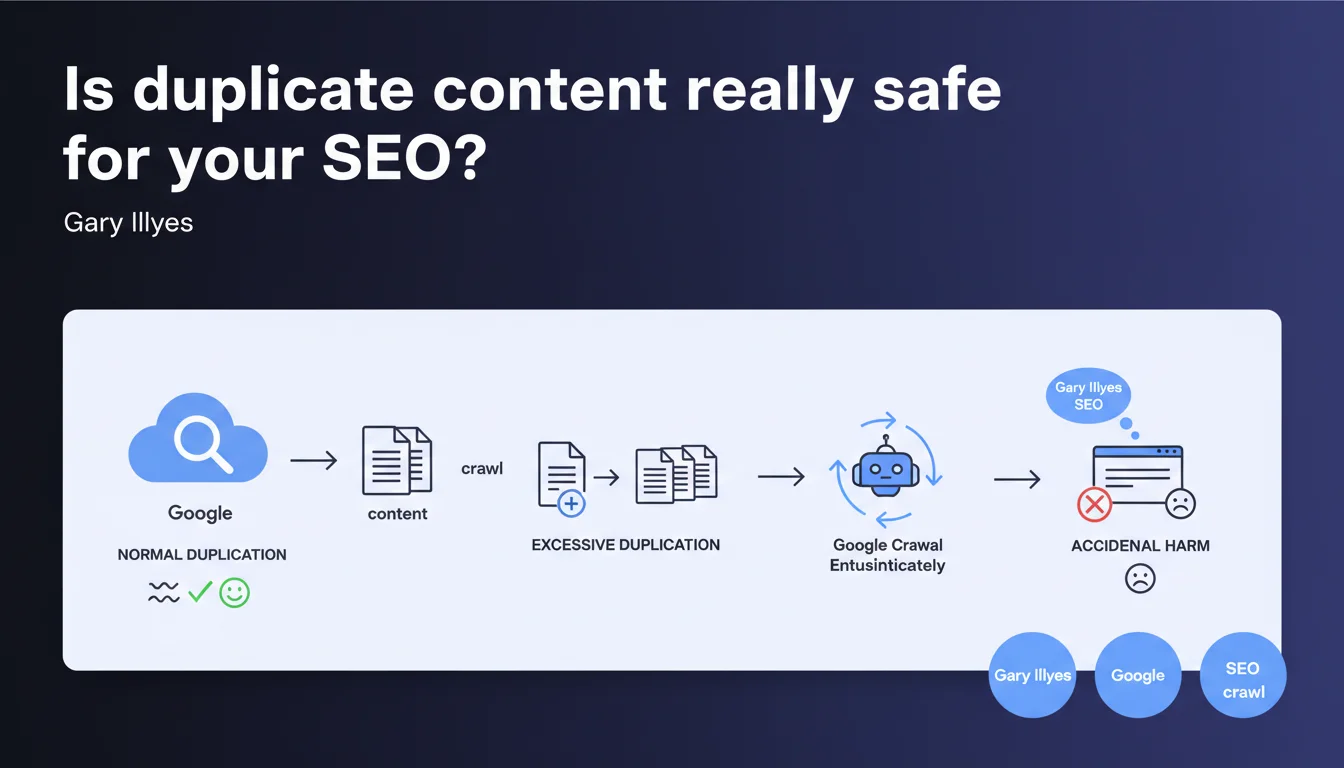
Google states that duplicate content is generally not a problem and is part of the normal functioning of a website. The real threat? An excessive multiplication of URLs that drains crawl budget and dilutes exploration efficiency. Nuance is essential: duplicate content is not directly penalized, but its collateral effects can sabotage your performance.
What you need to understand
Why does Google downplay duplicate content?
Gary Illyes states a clear position: duplicate content is part of the normal web ecosystem. E-commerce sites with product variants, multilingual sites, syndicated blogs — all naturally generate similar or identical content.
Google does not penalize this duplication. No manual action, no automatic demotion for having similar product pages. The search engine understands that the technical reality of the web imposes this redundancy.
Where is the line between normal and problematic?
The statement introduces a critical point: accidental excessive duplication. Google mentions an engine "very enthusiastic" about crawling newly discovered URLs. It's a euphemism for saying that Googlebot will waste time on variations without value.
Concretely? If your site generates 50,000 URLs through pagination, faceted filters, or user sessions, Google will attempt to crawl everything. Result: crawl budget evaporates on redundant content instead of focusing on your strategic pages.
What distinction should be made between internal and external duplication?
The statement does not explicitly clarify, but the context suggests it primarily refers to internal duplication — multiple URLs on the same site displaying identical or nearly identical content.
External duplication (scraping, syndication, plagiarism) is a different issue. Google attempts to identify the original source and prioritize it in the SERPs. But here, Illyes is clearly addressing webmasters worried about their own technical structure.
- Duplicate content does not trigger automatic algorithmic penalty
- Excessive URL multiplication dilutes crawl budget and reduces indexing efficiency
- Google differentiates normal duplicate content (legitimate technical variations) from manipulative spam
- The real risk is inefficiency: Google crawls your important pages less effectively
- Canonicals and robots.txt remain your primary tools for managing this duplication
SEO Expert opinion
Is Google's position consistent with what we observe in the field?
Yes, broadly speaking. Sites with moderate duplicate content do not suffer sudden SERP collapses. No Panda penalty has been documented solely on the basis of internal duplicate content for years.
However — and this is where the statement deserves additional perspective — we regularly observe sites where Google indexes the wrong page versions. Pagination URLs that cannibalize primary category pages, product variants competing against each other for the same keyword. No penalty, but structural inefficiency that undermines performance.
What does "very enthusiastic about crawling" really mean?
It's deliberately soft language to describe a concrete problem: Googlebot eagerly follows every discovered link, not always distinguishing a strategic URL from a parasitic variant. If you have 10 URLs displaying the same content, Google will spend crawl budget on all 10.
Let's be honest: this "enthusiasm" is not a bug, it's a feature. Google prioritizes discovery completeness. It's up to you to structure your site to guide this exploration toward what matters. [Verification needed]: the statement does not clarify whether Google has improved its ability to automatically detect duplication clusters without explicit tags.
In what cases does this rule not apply?
The statement mentions "normal" duplicate content. But what shifts to the abnormal side? Large-scale duplication spam — scraping 1,000 sites to republish their content — remains in the sights of manual actions.
Similarly, if your entire site is a mirror of another domain, Google will not technically penalize you, but it probably will not index you either. It will choose the source it deems original or authoritative. And that's where it gets sticky: Illyes says "no problem," but omits to clarify that not being penalized is not synonymous with ranking well.
Practical impact and recommendations
What should you concretely do to manage duplicate content?
First step: identify duplication clusters on your site. Use Screaming Frog or OnCrawl to spot URLs sharing identical or near-identical content. Focus first on strategic pages — categories, flagship product sheets, landing pages.
Next, prioritize. All duplications are not equal. User session URLs or sorting variations? Block them in robots.txt or via noindex. Legitimate product variants with minor differences? Implement canonicals pointing to the main version.
What critical mistakes must be avoided?
Do not use circular or contradictory canonicals. I've seen sites where page A points to B with a canonical, and B points to A. Google ignores these signals and chooses arbitrarily. Result: total unpredictability in indexation.
Another trap: blocking duplicate content in robots.txt AND adding a canonical. Google cannot crawl the blocked page to read the canonical tag — the signal is lost. If you want to consolidate, allow Google to access the page and guide with the canonical.
How do you verify that your duplicate content management is effective?
Monitor the indexation rate in Search Console. If Google indexes 80,000 pages when you only have 20,000 strategic ones, you have an uncontrolled duplication problem. Look at "Discovered - currently not indexed" — often, these are duplicates Google crawled then discarded.
Also analyze queries triggering unwanted page versions. If your pagination or filter URLs appear in the SERPs instead of main pages, your consolidation signals (canonical, noindex) are not working as intended.
- Audit duplication clusters with a technical crawler
- Implement coherent canonicals pointing to main versions
- Block in robots.txt session URLs, unnecessary parameters, sorting variations
- Verify that canonicals are not circular or contradictory
- Monitor actual indexation rate vs strategic URLs in Search Console
- Analyze server logs to detect excessive crawling on redundant content
- Regularly test SERPs to verify Google displays the correct versions
❓ Frequently Asked Questions
Le contenu dupliqué entraîne-t-il une pénalité Google ?
Quelle est la différence entre duplication interne et externe ?
Les balises canonical suffisent-elles pour gérer le contenu dupliqué ?
Comment savoir si mon contenu dupliqué affecte mes performances ?
Le contenu syndiqué compte-t-il comme duplication problématique ?
🎥 From the same video 13
Other SEO insights extracted from this same Google Search Central video · published on 19/09/2023
🎥 Watch the full video on YouTube →
💬 Comments (0)
Be the first to comment.