
Official statement
Other statements from this video 13 ▾
- □ La qualité du contenu influence-t-elle vraiment tous les systèmes de classement Google ?
- □ Google accorde-t-il vraiment un traitement de faveur aux nouvelles pages d'accueil ?
- □ Google privilégie-t-il vraiment les pages de qualité dans son crawl ?
- □ Googlebot est-il vraiment stupide ou Google cache-t-il quelque chose ?
- □ La qualité d'une page détermine-t-elle vraiment le crawl des pages suivantes ?
- □ Google peut-il vraiment pénaliser certaines sections de votre site en fonction de leur qualité ?
- □ Faut-il vraiment déplacer le contenu UGC de faible qualité pour améliorer le crawl ?
- □ La fréquence de mise à jour influence-t-elle vraiment le crawl de vos pages ?
- □ Google filtre-t-il vraiment certains sujets lors du crawl et de l'indexation ?
- □ Pourquoi Google refuse-t-il d'indexer un contenu qu'il a pourtant crawlé ?
- □ Le contenu dupliqué est-il vraiment sans danger pour votre SEO ?
- □ Faut-il vraiment faire relire vos traductions automatiques par des humains ?
- □ Pourquoi Google privilégie-t-il les liens depuis des « sites normaux » pour évaluer votre importance ?
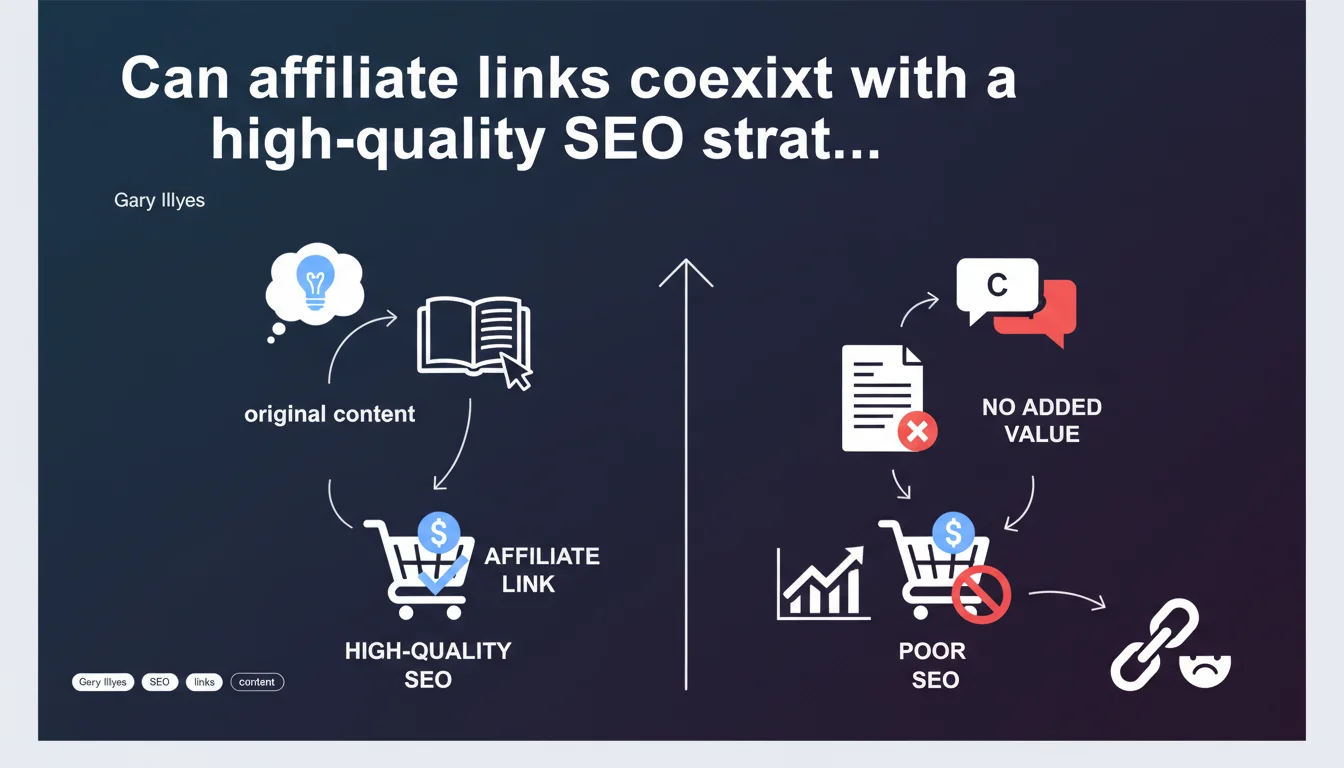
Google explicitly allows affiliate links provided they come with original and useful content. Simply copy-pasting merchant descriptions without added value remains penalizable. The red line: the absence of genuine expertise or personal analysis.
What you need to understand
Why does Google clarify its position on affiliate links?
Affiliation remains a massive economic model on the web. Thousands of sites live off these commissions, which inevitably generates variable quality content. Google has long fought against "thin content" affiliate sites — those copy-pasted soulless pages that polluted the SERPs.
This statement aims to clarify the boundary between legitimate affiliation and spam. It is in line with algorithmic updates targeting mass-generated content without real expertise.
What does Google consider as "useful and original content"?
Google explicitly mentions genuine product reviews — meaning: authentic tests, detailed comparisons, real-world feedback. Not AI-rewritten compilations of Amazon product sheets.
The nuance is crucial. Original content does not necessarily mean unprecedented in absolute terms, but bringing a unique perspective, analysis, lived experience. If 50 sites say the same thing with the same words, none are truly original.
What affiliate practices are explicitly rejected?
Pure copy-pasting of descriptions provided by affiliate programs is directly targeted. These standardized texts, often reproduced by hundreds of sites, provide no informational value.
Google considers these pages as spam — even if technically they contain text and links. The algorithm searches for expertise signals: real tests, personal photos, in-depth comparisons, reasoned viewpoints.
- Affiliate links are not penalizing in themselves — it is the quality of the content that matters
- Content must demonstrate genuine expertise or experience with the product/service
- Simply rewording merchant descriptions is not enough to create value
- Google values genuine product reviews with critical analysis and personal perspective
- Transparency about the affiliate nature of links remains recommended (rel="sponsored" or "nofollow")
SEO Expert opinion
Is Google's position consistent with field observations?
Yes, largely. Since the Product Reviews Updates (which became Reviews Updates), we observe a clear correlation between analytical depth and organic performance. Affiliate sites that rank sustainably are those investing in expert content.
But — and this is where it gets tricky — Google remains extremely vague on concrete evaluation criteria. What qualifies as a "genuine review"? How many words? What types of proof? Are photos sufficient? [To verify] because public guidelines lack granularity.
In what cases can this rule be circumvented or misinterpreted?
Some affiliate sites get by with medium-quality synthetic content — not pure copy-pasting, but barely enriched reworded content. They often benefit from strong history, high domain authority, or a niche topic with low competition.
Conversely, sites with genuine tests sometimes lose traffic. Why? Because Google also evaluates the credibility of the source, EEAT signals, content freshness. An excellent test published on a recent domain without backlinks can remain invisible. [To verify]: to what extent does domain authority compensate for average content?
What nuances should be made for large-scale affiliate sites?
Sites publishing thousands of product sheets face an economic dilemma. Impossible to physically test 10,000 references. Some bet on aggregating user reviews, others on sampling-based testing.
Google says nothing specific about these hybrid models. We observe that sites which clearly segment — basic product sheets on one side, in-depth comparative guides on the other — fare better. But no formal guarantee.
Practical impact and recommendations
What should you concretely do if you monetize with affiliate links?
First, audit existing content. Identify pages that merely compile product descriptions or technical specs without added value. These pages are direct candidates for rewriting or voluntary deindexing.
Next, build a premium content strategy. For each product category or segment, create at least one in-depth comparative guide, ideally based on real tests. These pillar pages will carry your organic visibility.
How do you prove originality and expertise in your content?
Google looks for tangible signals: original photos (EXIF metadata), unboxing videos, detailed comparison tables, mention of real usage over a given period. The more you document your experience, the better.
On the structure side, respect Google's Product Review Guidelines: include both strengths AND weaknesses, compare with alternatives, specify which type of user the product suits. The goal is to show critical analysis, not a sales pitch.
What mistakes should you absolutely avoid with affiliate links?
Do not drown content in links. An article packed with affiliate CTAs every two sentences sends an obvious spam signal. Favor natural, contextual placements that serve the information.
Another mistake: neglecting transparency. Even if Google does not formally require it for SEO, disclosing the affiliate nature of links (legal notices, rel attributes) strengthens EEAT credibility — and it is a legal obligation in many jurisdictions.
- Audit existing affiliate pages to identify "thin" or copied content
- Create at minimum one in-depth comparative guide per strategic product category
- Include proof of real usage: original photos, videos, dated experience reports
- Structure reviews according to Google's Product Review Guidelines: strengths, weaknesses, alternatives, target audience
- Use rel="sponsored" or rel="nofollow" attributes on affiliate links
- Balance the number of affiliate links to avoid the impression of commercial over-optimization
- Regularly update content to reflect product evolutions and maintain freshness
- Diversify formats: long-form articles, videos, infographics, interactive comparison tables
❓ Frequently Asked Questions
Dois-je supprimer tous mes liens d'affiliation pour éviter une pénalité Google ?
Quelle différence entre un contenu affilié acceptable et du spam selon Google ?
Faut-il utiliser l'attribut rel="sponsored" sur les liens d'affiliation ?
Les contenus affiliés générés par IA sont-ils considérés comme originaux par Google ?
Combien de mots doit faire une revue de produit pour être considérée comme approfondie ?
🎥 From the same video 13
Other SEO insights extracted from this same Google Search Central video · published on 19/09/2023
🎥 Watch the full video on YouTube →
💬 Comments (0)
Be the first to comment.