
Official statement
Other statements from this video 14 ▾
- □ What exactly is a web crawler and why does Google insist on this definition?
- □ Is Googlebot really just crawling without making any indexing decisions?
- □ How does Googlebot actually crawl your web pages?
- □ Does your crawl budget really depend on Search demand?
- □ Does crawl budget really exist at Google?
- □ Should you block certain pages from Google crawl to optimize your crawl budget?
- □ Is Google really running out of storage space to index your content?
- □ Are natural links really more important than sitemaps for URL discovery?
- □ Does linking from your homepage really accelerate the crawl of your new pages?
- □ Should you really restrict the Indexing API to only Google's recommended use cases?
- □ Why does Google restrict the Indexing API to specific use cases instead of making it universally available?
- □ Can the Indexing API Remove Your Content as Fast as It Indexes It?
- □ Does improving content quality really trigger Google to crawl your site more frequently?
- □ Can the URL inspection tool really speed up the indexing of your improvements?
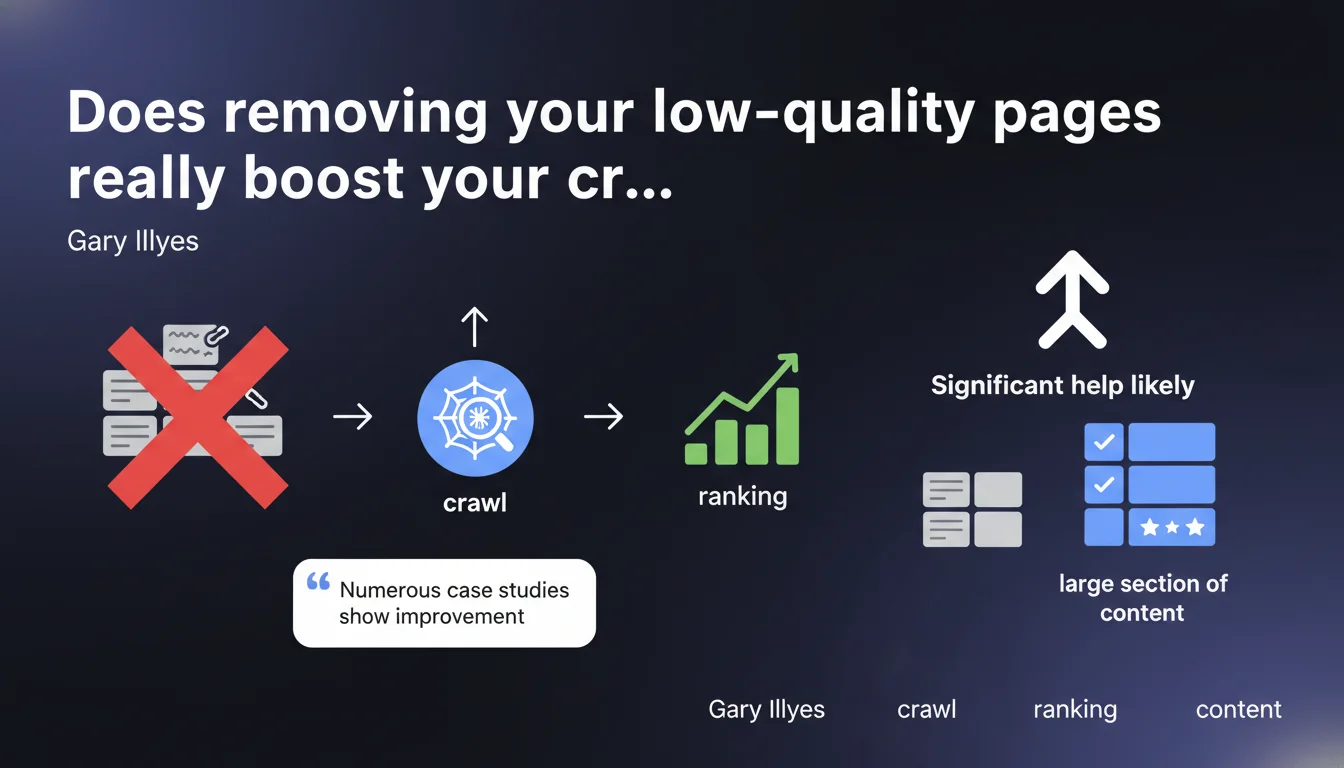
Gary Illyes confirms that removing entire sections of low-quality content significantly improves crawl efficiency. Case studies show tangible results when the proportion of affected pages is substantial. The message is clear: a smaller, cohesive site performs better than an artificially inflated catalog.
What you need to understand
Does Google really penalize sites with lots of mediocre content?
Illyes's statement doesn't directly address algorithmic penalties, but rather crawl optimization. The distinction matters. Google allocates a limited crawl budget to each site — if Googlebot wastes time on valueless pages, it explores fewer strategic pages.
The "numerous case studies" mentioned remain vague. No hard numbers, no concrete examples. The statement stays general, which is typical of Google declarations: just precise enough to guide, not enough to measure.
What exactly counts as a "relatively large" section of low quality?
Illyes provides no threshold. 10% of the site? 30%? 50%? This deliberate vagueness forces SEO professionals to analyze their own situations. A 10,000-page site with 3,000 empty or duplicated product sheets clearly falls into this category.
The term "section" suggests we're not talking about isolated pages. These are entire zones: abandoned legacy categories, untouched blog archives, automatically generated product variants with no unique content.
What signals indicate crawl improvements?
Crawl improvements are measured through Google Search Console: increased daily page exploration, reduced average download time, better indexation freshness of strategic content.
- Crawl budget is finite — Google optimizes its server resources
- Removing low-quality content frees budget for important pages
- Impact is most visible on large sites (10,000+ pages)
- The "case studies" mentioned lack publicly verifiable data
- The correlation between improved crawl = better rankings remains unproven
SEO Expert opinion
Does this statement align with real-world observations?
Absolutely. I've seen sites double their crawl frequency after removing 40% of their URLs — mainly auto-generated tag pages and product filters with no added value. But beware: improved crawl hasn't always produced immediate traffic gains.
The link between better crawl and better rankings isn't automatic. Google explores more thoroughly, yes, but if your strategic pages remain mediocre, nothing changes. Removing low-quality content is a necessary condition but not sufficient.
When does this strategy backfire?
When you confuse "low quality" with "low current traffic." I've seen clients obliterate entire sections of informative content because they received zero visits in three months — then lose overall traffic because those pages strengthened internal linking and thematic coherence.
Another trap: removing content without a redirect strategy. Backlinks pointing to deleted pages result in 404 errors, you lose link authority. [To verify]: Illyes doesn't clarify whether improved crawl systematically compensates for this potential authority loss.
What are the limits of this approach?
Google never defines what "low quality" objectively means. Zero traffic? Thin content? Duplication? High bounce rate? Everyone interprets using their own criteria, making comparisons impossible.
Practical impact and recommendations
How do you identify which content to remove first?
Start by exporting all indexed URLs via Google Search Console and cross-reference with analytics. Pages with zero clicks over 12 months AND zero external backlinks are obvious candidates. But dig deeper.
Use Screaming Frog or Oncrawl to detect pages with shallow crawl depth (10+ clicks from homepage), low word count (< 150), or high duplication rates. These technical signals often reveal zones Googlebot skims without genuine interest.
What removal strategy should you use?
Three options depending on context: permanent deletion with 410 Gone status if content won't return, 301 redirect to a parent page if the topic remains relevant, or consolidation of multiple weak pages into a single strong pillar page.
Avoid mass noindex as a lazy solution. It keeps URLs in your architecture, still consumes crawl budget via internal links, and creates confusion. If it's useless, delete it outright.
How do you measure impact after removal?
Track Search Console metrics: pages crawled per day, kilobytes downloaded, server response time. Compare across 30 days before/after. If crawl improves but traffic stalls, your strategic pages have other structural issues.
- Export all indexed URLs and cross-reference with GA4/Search Console data
- Prioritize entire sections, not isolated pages (archives, old categories, valueless filters)
- Implement a 301 redirect plan to preserve existing backlinks
- Only use permanent deletion (410) if there's no historical value or external links
- Monitor crawl budget for 60 days post-removal in GSC
- Verify removal doesn't break internal linking coherence on strategic pages
❓ Frequently Asked Questions
Supprimer des pages nuit-il toujours au trafic à court terme ?
Combien de pages faut-il supprimer pour voir un effet sur le crawl ?
Faut-il utiliser le noindex ou supprimer définitivement ?
Cette stratégie fonctionne-t-elle sur tous types de sites ?
Comment définir objectivement la faible qualité ?
🎥 From the same video 14
Other SEO insights extracted from this same Google Search Central video · published on 14/03/2024
🎥 Watch the full video on YouTube →
💬 Comments (0)
Be the first to comment.