
Official statement
Other statements from this video 14 ▾
- □ What exactly is a web crawler and why does Google insist on this definition?
- □ How does Googlebot actually crawl your web pages?
- □ Does your crawl budget really depend on Search demand?
- □ Does crawl budget really exist at Google?
- □ Should you block certain pages from Google crawl to optimize your crawl budget?
- □ Is Google really running out of storage space to index your content?
- □ Are natural links really more important than sitemaps for URL discovery?
- □ Does linking from your homepage really accelerate the crawl of your new pages?
- □ Should you really restrict the Indexing API to only Google's recommended use cases?
- □ Why does Google restrict the Indexing API to specific use cases instead of making it universally available?
- □ Can the Indexing API Remove Your Content as Fast as It Indexes It?
- □ Does improving content quality really trigger Google to crawl your site more frequently?
- □ Does removing your low-quality pages really boost your crawl budget and rankings?
- □ Can the URL inspection tool really speed up the indexing of your improvements?
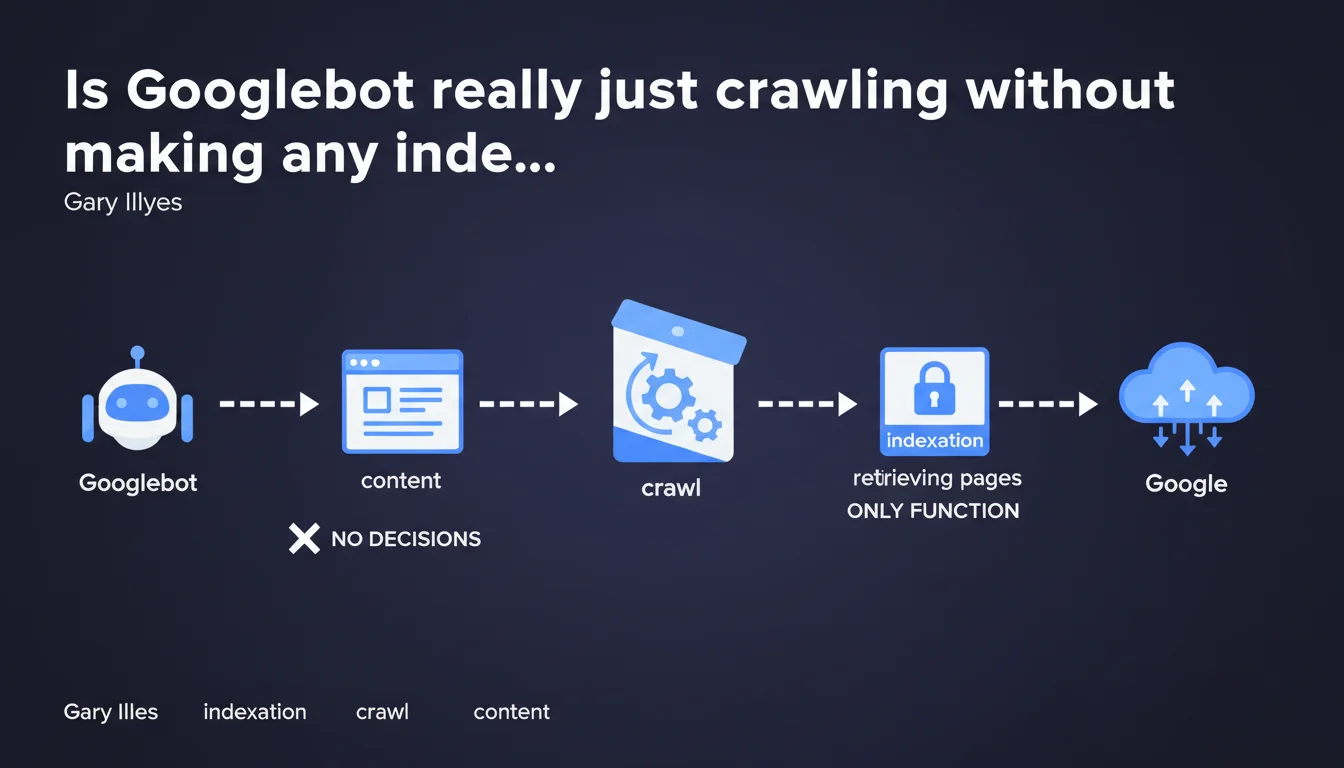
Gary Illyes states that Googlebot simply retrieves pages without making any indexing decisions whatsoever. This strict separation between crawling and indexing means that optimizing crawl efficiency provides no guarantee that a page will be indexed. You need to understand that other systems take over after Googlebot.
What you need to understand
Gary Illyes's statement formally separates two stages of Google's pipeline: crawling and indexing. Googlebot retrieves content, period. Indexing decisions fall to other components of the infrastructure.
This distinction overturns certain conventional wisdom — namely the illusion that optimizing crawl is enough to guarantee indexing. Let's be honest: many well-crawled sites simply aren't indexed regardless.
What is the concrete difference between crawling and indexing?
Crawling is the simple retrieval of content by Googlebot. It traverses URLs, fetches HTML, retrieves resources, executes JavaScript if needed. Nothing more.
Indexing is the analysis of retrieved content, its processing, storage in the index, and the decision to make it accessible or not in search results. This stage depends on many criteria: quality, duplication, relevance, canonicalization, robots directives, and more.
Why does Google insist so much on this separation?
Because too many SEO professionals still confuse crawlability with indexability. A site can be perfectly crawlable — clean robots.txt file, impeccable sitemap, flawless internal linking — yet still have its pages rejected from indexing.
Google wants to clarify that indexing problems do not stem from Googlebot. If your pages aren't indexed, look toward quality criteria, canonicalization, E-E-A-T signals, duplication, and similar factors.
Which systems decide on indexing after Googlebot?
Google deliberately remains vague about technical details. We know that components like Caffeine (indexing infrastructure), quality algorithms, spam filters, deduplication and canonicalization systems all play a role.
In practice, once Googlebot has passed, content goes through multiple layers of analysis before landing in the index. And that's where everything is really decided.
- Googlebot retrieves, it does not judge
- Indexing falls to other systems after crawling
- Optimizing crawl never guarantees indexing
- Indexing problems don't come from Googlebot but from quality and relevance criteria
SEO Expert opinion
Does this statement really change anything in practice?
Not really — for those already following Google's logic. The crawl/indexing separation has been known for a long time, but this official confirmation allows us to put an end to recurring confusion.
The problem is that many sites frantically optimize their crawl budget thinking it will solve their indexing problems. Spoiler: it won't. A site can be crawled 10,000 times a day and only index 10% of its pages.
What nuances should be applied to this statement?
Gary Illyes simplifies deliberately to clarify, but reality is more intertwined. Googlebot reports signals that indirectly influence indexing: load time, HTTP errors, redirects, availability of critical resources.
Saying that Googlebot makes no decisions is technically true, but it collects data that feeds downstream decision-making systems. An important distinction.
Why are some well-crawled sites never indexed?
Because quality trumps everything else. A site can be technically flawless — fast, well-structured, accessible — and still be denied indexing if the content is deemed weak, duplicated, or poorly relevant.
E-E-A-T criteria, spam signals, internal cannibalization, canonicalization issues, all of this happens after Googlebot's visit. And that's where it often gets stuck.
Practical impact and recommendations
What should you concretely do following this statement?
Stop obsessing solely over crawl. Yes, you need efficient crawling, but it's only one step. Focus on indexing criteria: content quality, originality, thematic authority, E-E-A-T signals, absence of duplication.
Check Google Search Console, Coverage section (or Pages in the new interface). Pages that are crawled but not indexed appear clearly — that's where you need to investigate.
What mistakes should you absolutely avoid?
Don't bet everything on robots.txt optimization or XML sitemap refinement thinking it will solve your indexing problems. These files facilitate crawling, not indexing.
Also avoid confusing discovered pages with indexed pages. Google can discover a URL without ever indexing it — it's actually common on large sites with weak or duplicate content.
How do you verify your site complies with this logic?
Audit crawlability and indexability separately. On the crawl side: check server logs, robots.txt file, sitemaps, internal linking. On the indexing side: analyze content quality, canonical tags, meta robots, relevance and authority signals.
Use tools like Screaming Frog for crawling and Google Search Console for indexing. Cross-reference the data to identify pages that are crawled but excluded from the index.
- Audit server logs to understand Googlebot's actual behavior
- Fix crawl errors (4xx, 5xx, redirect chains, timeouts)
- Analyze the quality of non-indexed pages
- Verify canonical and meta robots tags
- Eliminate duplications and weak content
- Strengthen E-E-A-T signals on strategic pages
- Monitor Google Search Console regularly, Coverage/Pages section
❓ Frequently Asked Questions
Si Googlebot ne décide pas de l'indexation, qui décide alors ?
Un site bien crawlé est-il forcément bien indexé ?
Comment savoir si mes problèmes viennent du crawl ou de l'indexation ?
Optimiser le crawl budget améliore-t-il l'indexation ?
Quels signaux Googlebot transmet-il aux systèmes d'indexation ?
🎥 From the same video 14
Other SEO insights extracted from this same Google Search Central video · published on 14/03/2024
🎥 Watch the full video on YouTube →
💬 Comments (0)
Be the first to comment.