
Official statement
Other statements from this video 14 ▾
- □ Qu'est-ce qu'un crawler web et pourquoi Google insiste-t-il sur cette définition ?
- □ Googlebot ne fait-il vraiment que crawler sans décider de l'indexation ?
- □ Comment Googlebot crawle-t-il réellement vos pages web ?
- □ Le crawl budget dépend-il vraiment de la demande de Search ?
- □ Le crawl budget existe-t-il vraiment chez Google ?
- □ Faut-il bloquer certaines pages du crawl Google pour optimiser son budget ?
- □ Google manque-t-il vraiment d'espace de stockage pour indexer votre contenu ?
- □ Les liens naturels sont-ils vraiment plus importants que les sitemaps pour la découverte ?
- □ Faut-il vraiment limiter l'usage de l'Indexing API aux seuls cas d'usage recommandés par Google ?
- □ Pourquoi Google limite-t-il l'usage de l'Indexing API à certains contenus ?
- □ L'Indexing API peut-elle faire retirer votre contenu aussi vite qu'elle l'indexe ?
- □ Comment l'amélioration de la qualité du contenu accélère-t-elle le crawl de Google ?
- □ Faut-il supprimer vos pages de faible qualité pour améliorer votre crawl budget ?
- □ L'outil d'inspection d'URL peut-il vraiment accélérer l'indexation de vos améliorations ?
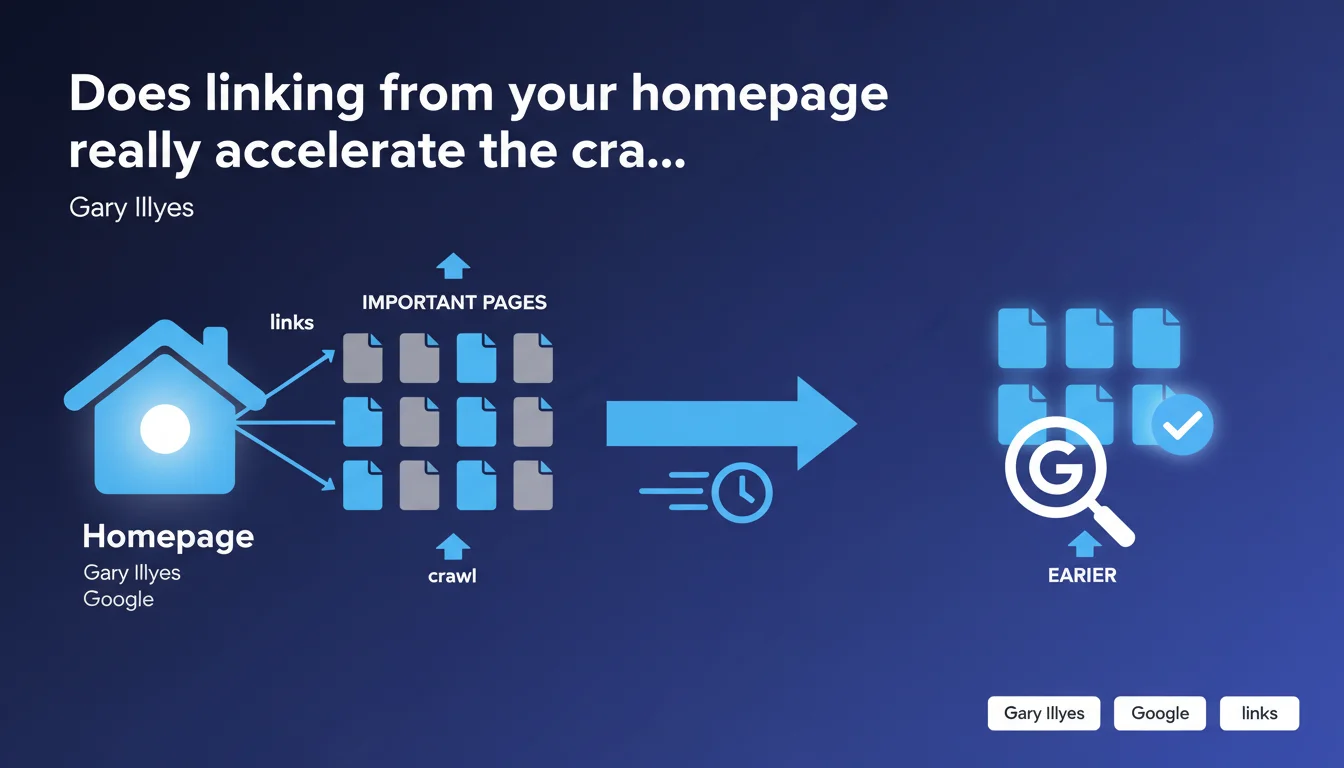
Gary Illyes confirms that the homepage remains the most important page of a site for Google. Placing links from this page to new strategic pages accelerates their discovery and crawl by Googlebot. It's a direct priority signal you send to the search engine.
What you need to understand
This statement from Gary Illyes is based on a fundamental principle of how Google works: the homepage generally concentrates the most authority signals (backlinks, traffic, frequent crawl). It's the main entry point, the one Googlebot visits most often.
By creating a link from this page to a new URL, you leverage this existing crawl flow. You tell Google: "This page deserves rapid attention." This is a form of crawl budget prioritization through internal architecture.
Why is the homepage so important for Googlebot?
The homepage naturally accumulates more internal and external PageRank than any other page. It often receives the majority of backlinks and concentrates a large portion of direct traffic.
Googlebot allocates its crawl budget based on these signals. The more "important" a page is according to these criteria, the more frequently it's crawled. The homepage is therefore revisited daily, sometimes several times a day on high-authority sites.
How does a link from the homepage accelerate crawling?
When Googlebot visits your homepage, it follows the links present on that page. If a link points to a new or recently modified URL, the bot discovers it immediately or almost immediately.
Without this link, the URL could remain invisible for days, especially if it's buried in a deep directory structure or absent from the recently submitted sitemap. The homepage link acts as a discovery accelerator.
Does this mean you should saturate the homepage with links?
No. Gary Illyes is talking about "important new pages," not all pages. The idea is to strategically select priority content: product launches, strategic articles, new categories.
Overloading the homepage dilutes the effect. Too many links spread the PageRank and reduce the individual impact of each link. You need to balance it carefully.
- The homepage is the page with the highest crawl budget on your site
- A link from this page is a priority signal for Googlebot
- This accelerates the discovery and crawl of new strategic URLs
- Don't confuse crawl speed with indexation guarantee — these are two distinct mechanisms
- Reserve this space for truly priority content, not your entire catalog
SEO Expert opinion
Is this statement consistent with field observations?
Absolutely. It's actually one of the best-documented practices in technical SEO. Tests show that a URL linked from the homepage is crawled significantly faster than a URL buried 4 clicks deep.
On tested e-commerce sites, product pages temporarily linked from the homepage were crawled within 24 hours, compared to 5 to 7 days for equivalent products relegated to subcategories without direct links.
What nuances should be applied to this statement?
The homepage link accelerates crawling, not indexation. Googlebot may crawl a page quickly and decide not to index it if it doesn't meet quality criteria, contains duplicate content, or lacks added value.
Furthermore, this technique works mainly on sites with a homepage that's already well-crawled. If your homepage itself is being ignored by Googlebot (very new site, no backlinks, low crawl budget), the benefit will be marginal. [To verify]: how long must this link remain in place to guarantee lasting impact? Google doesn't give exact figures.
Another point: the effect is temporary if the link disappears after a few days. For lasting SEO impact, the page must remain accessible through the main internal linking structure, even if it leaves the homepage after the initial crawl phase.
In which cases does this rule not apply?
On sites with already saturated crawl budgets, adding homepage links can create more problems than solutions. If Googlebot is already struggling to crawl all of your strategic pages, multiplying homepage links dilutes resources even further.
Similarly, on sites where the homepage isn't the most-crawled page (certain media outlets, blogs where older articles attract more backlinks), linking from this homepage won't have the expected effect. It's better to identify the true high-crawl page (via Search Console, Crawl Statistics section) and link from that instead.
Practical impact and recommendations
What should you concretely do to leverage this channel?
Identify your new or recently updated strategic pages: product launches, pillar content, new categories. Add a link from your homepage to these URLs for at least a few weeks.
Use visible and logical placements: promotional banner, "What's New" block, "Featured" section. The link should seem natural to the user, not solely intended for Googlebot.
Monitor in Google Search Console > Crawl Statistics whether these pages are actually crawled faster after the link is added. Compare with equivalent pages not linked from the homepage.
What mistakes should you absolutely avoid?
Don't saturate your homepage with dozens of internal links. Beyond 10-15 non-navigation links, you dilute the effect and degrade UX. Choose your priorities.
Don't leave these links in place indefinitely without rotation. A static homepage loses effectiveness over time. Replace old links with new priority content over the weeks.
Avoid linking to low-quality pages or those at high risk of deindexation. A homepage link isn't a guarantee of indexation — if the page is mediocre, you're wasting crawl budget.
- Identify 3 to 5 new or recently updated strategic pages each month
- Add a visible and logical link from the homepage (banner, news block, product feature)
- Verify in Search Console that these pages are crawled within 48-72 hours of the link being added
- Remove the link after 2-4 weeks and replace it with a new priority
- Ensure the page remains accessible through permanent internal linking after the homepage link is removed
- Never exceed 10-15 non-navigation internal links on the homepage
- Monitor global crawl budget evolution to detect any side effects
Linking from the homepage is a powerful lever but requires rigor and method. Balancing editorial priorities, UX, and technical SEO can quickly become complex, especially on sites with high content volume.
If you manage a catalog of thousands of pages or if your teams struggle to coordinate these optimizations, working with a specialized SEO agency can save you valuable time and help avoid costly crawl budget mistakes.
❓ Frequently Asked Questions
Combien de temps un lien homepage doit-il rester en place pour que la page soit crawlée ?
Est-ce que lier depuis la homepage garantit l'indexation de la page ?
Peut-on utiliser des liens en nofollow depuis la homepage pour accélérer le crawl ?
Faut-il retirer le lien homepage après que la page a été crawlée ?
Cette technique fonctionne-t-elle aussi pour des pages mises à jour, pas seulement nouvelles ?
🎥 From the same video 14
Other SEO insights extracted from this same Google Search Central video · published on 14/03/2024
🎥 Watch the full video on YouTube →
💬 Comments (0)
Be the first to comment.