
Official statement
Other statements from this video 14 ▾
- □ What exactly is a web crawler and why does Google insist on this definition?
- □ Is Googlebot really just crawling without making any indexing decisions?
- □ How does Googlebot actually crawl your web pages?
- □ Does your crawl budget really depend on Search demand?
- □ Does crawl budget really exist at Google?
- □ Should you block certain pages from Google crawl to optimize your crawl budget?
- □ Is Google really running out of storage space to index your content?
- □ Are natural links really more important than sitemaps for URL discovery?
- □ Does linking from your homepage really accelerate the crawl of your new pages?
- □ Should you really restrict the Indexing API to only Google's recommended use cases?
- □ Why does Google restrict the Indexing API to specific use cases instead of making it universally available?
- □ Does improving content quality really trigger Google to crawl your site more frequently?
- □ Does removing your low-quality pages really boost your crawl budget and rankings?
- □ Can the URL inspection tool really speed up the indexing of your improvements?
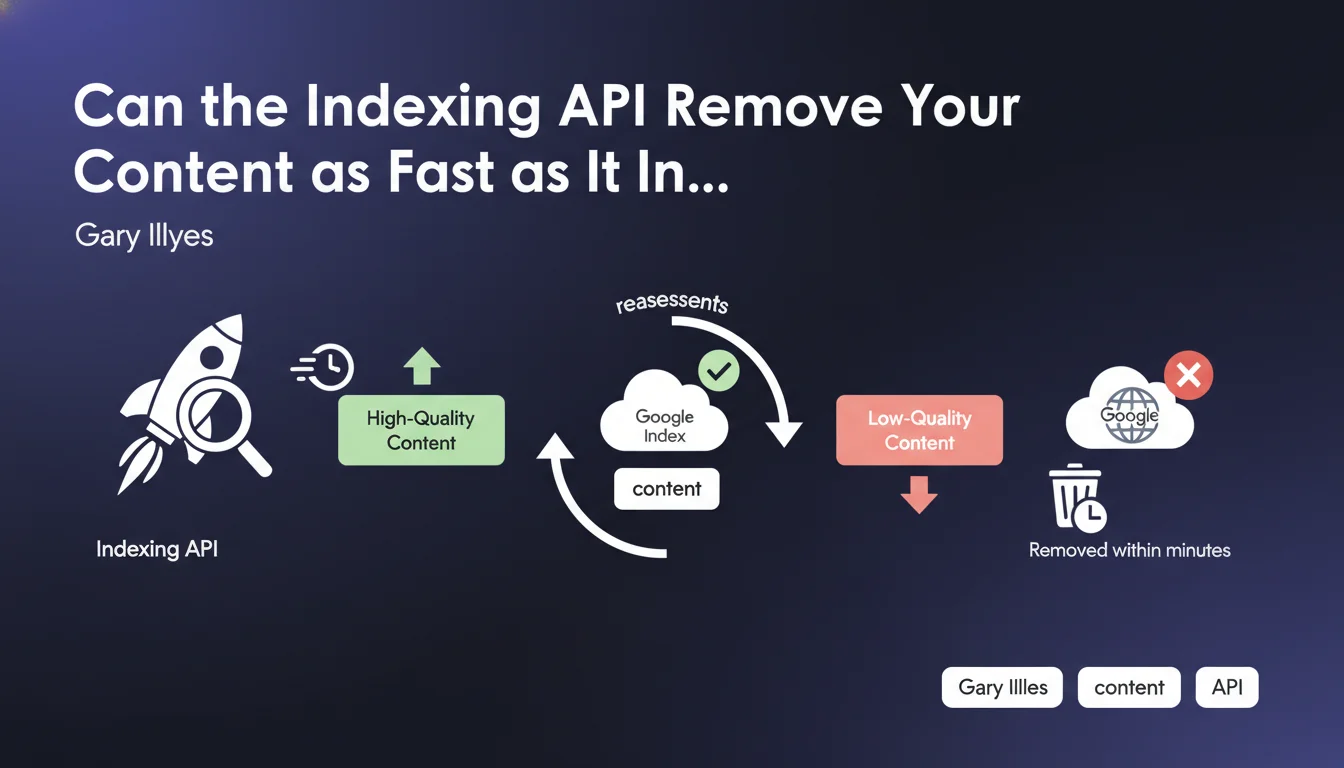
Gary Illyes confirms that the Indexing API accelerates indexation but Google constantly reassesses the quality of indexed content. Poor-quality content pushed via this API can be deindexed within minutes, making the tool a double-edged sword for those who neglect quality.
What you need to understand
Is the Indexing API Just a Shortcut to the Index?
The Indexing API does allow content to enter Google's index much faster than through traditional crawling. It's a powerful lever for sites publishing time-sensitive content — job postings, livestreams, events.
But here's the catch: Google doesn't just index what you send it. It continuously reassesses what deserves to stay in the index. If your content doesn't hold up on quality grounds, it can disappear as fast as it appeared.
What Does This Rapid Reassessment Mean in Concrete Terms?
According to Illyes, we're talking about minutes between indexation and potential deindexation. It's not a grace period of hours or days — it's nearly instantaneous.
This means Google applies quality filters as soon as content enters the index. If signals are poor (thin content, duplication, lack of relevance), removal is automated and swift.
Which Types of Content Are Subject to This Express Removal?
Google refers to low-quality content, without elaborating further. We can reasonably assume this includes thin pages, nearly identical variations, spam, or mass-generated content with no added value.
The Indexing API isn't designed to index an entire site — it targets specific use cases. Using it inappropriately amounts to highlighting your own editorial weaknesses.
- The Indexing API accelerates indexation but offers no quality immunity
- Google continuously reassesses indexed content, sometimes within minutes
- Rapid removal concerns content deemed low-quality or irrelevant
- This API is not a substitute for natural crawling across an entire site
- Forcing indexation of mediocre pages can accelerate their deindexation
SEO Expert opinion
Is This Statement Consistent with What We Observe in Practice?
Yes, and it's even a point rarely articulated this clearly by Google. We've long known that the index is not a vault — it's a constrained space where Google constantly arbitrates between what deserves to be kept and what can be removed.
Cases of indexed pages then quickly removed are not uncommon, especially on sites with lots of automatically generated or low-value content. What Illyes reveals is that the Indexing API also accelerates this eviction process.
What Nuances Should We Add to This Statement?
First point: Google isn't saying that all content pushed via the API will be reassessed within minutes. It specifically mentions low-quality content. But who decides this threshold? The exact criteria remain opaque. [To verify]
Second nuance: this rapid reassessment doesn't mean quality content is guaranteed to stay indexed indefinitely. Signals can evolve — competition intensifies, content ages, user expectations change.
Finally, this statement implies that the Indexing API is a signal amplifier, for both positive and negative signals. If your content is solid, you gain in responsiveness. If it's weak, you're exposed faster.
In Which Cases Doesn't This Rule Necessarily Apply?
If you use the Indexing API within its intended scope — job postings via JobPosting, livestreams via BroadcastEvent — and your content respects the guidelines, there's no reason to fear express removal.
The problem arises when you misuse the tool to force indexation of standard pages or borderline content. Google has already penalized sites that abused the API to index content outside its scope.
Practical impact and recommendations
What Should You Concretely Do If You Use the Indexing API?
First step: audit the quality of content you push via the API. If you're using it for job postings, ensure they're unique, up-to-date, and properly structured with JobPosting markup.
Second step: monitor your indexation logs in Search Console. If you notice spikes in rapid deindexation after using the API, it's a clear signal that Google is rejecting your content.
What Mistakes Should You Absolutely Avoid?
Don't use the Indexing API as a generalized indexation lever. It's not a tool to bypass crawling delays on product pages, blog articles, or standard landing pages.
Avoid pushing content in bulk without prior editorial validation. The API amplifies everything — including your mistakes. Duplicate, thin, or poorly optimized content will be deindexed even faster than it naturally would be.
How Can You Verify Your API Usage Is Compliant?
Consult the official Indexing API documentation and cross-reference it with your actual use cases. If you have any doubt, it's better to abandon the API and let natural crawling do its job.
Test on a reduced sample before deploying at scale. Push 10-20 URLs via the API and monitor their indexation status in the hours that follow. If they hold up, you can expand. If not, revise your content.
- Verify that your content fits within official API use cases (JobPosting, BroadcastEvent)
- Audit editorial and technical quality of pages before pushing them
- Monitor indexation logs in Search Console after using the API
- Avoid pushing content in bulk without human validation
- Test on a reduced sample before any large-scale deployment
- Never use the API to bypass crawl budget limits on standard content
❓ Frequently Asked Questions
L'Indexing API peut-elle être utilisée pour n'importe quel type de contenu ?
Combien de temps faut-il pour qu'un contenu soit retiré de l'index après avoir été poussé via l'API ?
Comment savoir si mon contenu a été retiré de l'index après utilisation de l'API ?
Est-ce que pousser du contenu via l'Indexing API améliore le classement ?
Peut-on perdre l'accès à l'Indexing API en cas d'abus ?
🎥 From the same video 14
Other SEO insights extracted from this same Google Search Central video · published on 14/03/2024
🎥 Watch the full video on YouTube →
💬 Comments (0)
Be the first to comment.