
Official statement
Other statements from this video 14 ▾
- □ Google choisit-il vraiment les titres de page indépendamment de la requête de l'utilisateur ?
- □ Changer un nom de ville suffit-il à créer des doorway pages condamnables par Google ?
- □ Faut-il vraiment centraliser son contenu compétitif plutôt que le dupliquer ?
- □ Découvert mais non indexé : Google n'a-t-il vraiment jamais crawlé ces pages ?
- □ Pourquoi Google refuse-t-il d'indexer un site techniquement parfait ?
- □ Faut-il vraiment faire confiance aux recommandations de vos outils SEO ?
- □ Passer d'un ccTLD à un gTLD suffit-il pour conquérir de nouveaux marchés internationaux ?
- □ Sous-domaine ou sous-répertoire : Google a-t-il vraiment une préférence ?
- □ Pourquoi les clics par page et par requête diffèrent-ils dans Search Console ?
- □ Les erreurs de données structurées bloquent-elles vraiment l'indexation de vos pages ?
- □ Le maillage interne révèle-t-il vraiment l'importance de vos pages à Google ?
- □ L'attribut target des liens a-t-il un impact sur le référencement Google ?
- □ Faut-il vraiment supprimer tous les breadcrumbs schema sauf un pour éviter la confusion ?
- □ Pourquoi vos images CSS background-image sont-elles invisibles pour Google Images ?
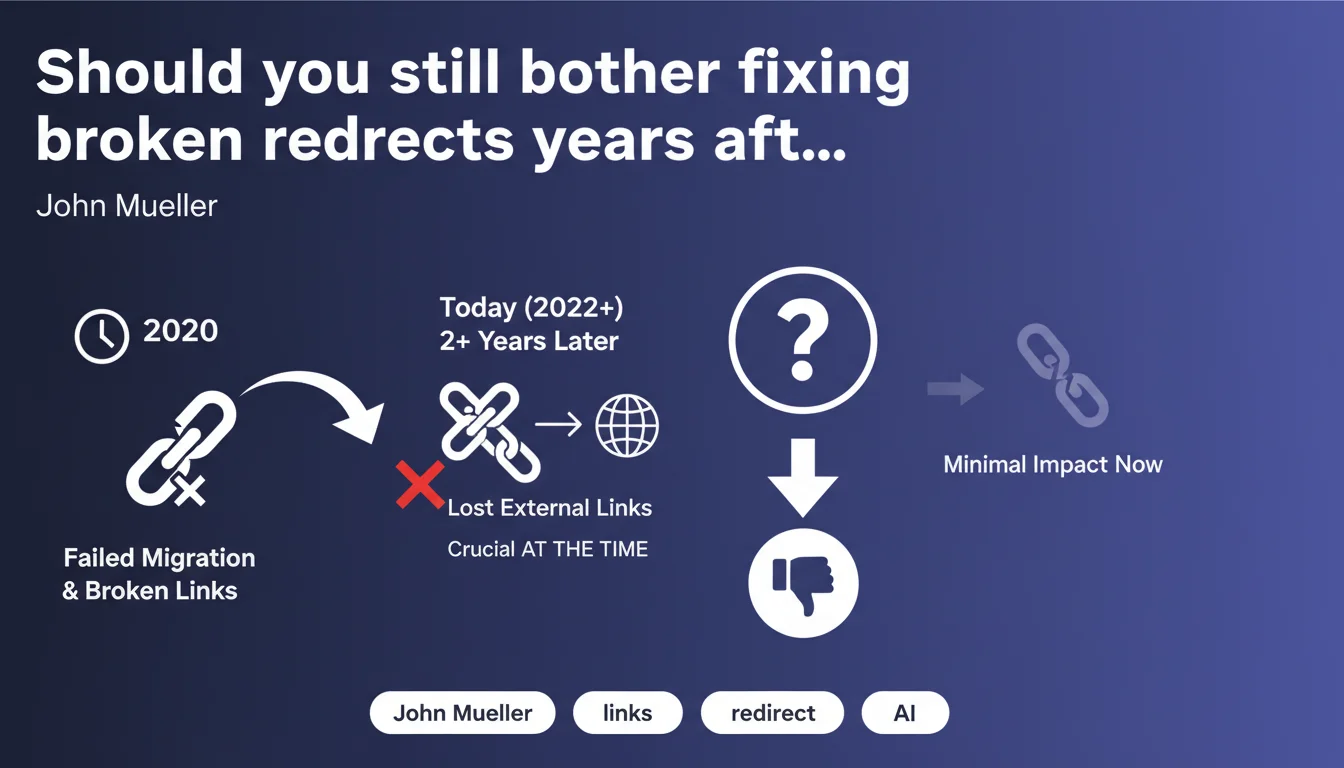
Google considers that after approximately two years, fixing failed redirects from a migration has minimal impact. Most of the value from external links is permanently lost if redirects aren't in place from the start. Beyond this timeframe, recovering lost PageRank becomes nearly impossible.
What you need to understand
Why is this two-year window so critical?
Google observes that the value of external links gradually dissipates when redirects are absent or misconfigured. During the first weeks following a migration, crawlers attempt to follow old URLs, but faced with repeated 404 errors, they eventually give up.
After two years without functioning redirects, the relevance signals associated with these pages disappear from the link graph. Sites that were pointing to you have often modified or removed their links entirely. Fixing things late won't bring back that lost trust capital.
Does this rule apply to all types of migrations?
Mueller is speaking of a failed migration with many broken links. The context is therefore a massive error, not just a handful of forgotten redirects. If you migrated 95% of your URLs correctly, the missing 5% can still benefit from a late fix.
However, if the migration broke hundreds of quality backlinks and you don't discover the problem until two years later, the effect will be negligible or nonexistent. Search engines have already recalculated their index without these signals.
What actually happens during these two years?
During the first few months, Googlebot regularly returns to check the old URLs. It temporarily stores the link signals hoping to find a redirect. But over time, crawl frequency drops drastically.
Third-party sites encountering 404s have often updated their links or removed them entirely. PageRank no longer flows to your new domain or new structure. Even if you finally install redirects, they point to nothing on the signals side.
- Redirects must be in place on day one of migration to capture backlink value.
- After approximately two years, the impact of a fix is marginal because link signals have evaporated.
- External sites have often modified or deleted the broken links in the meantime.
- Google drastically reduces crawling of old URLs that consistently return 404s.
SEO Expert opinion
Is this statement consistent with real-world observations?
Yes, in principle. Botched migrations do indeed show irreversible organic traffic loss when redirects aren't configured immediately. However, the "approximately two years" threshold remains fuzzy — typical of Google communications.
In reality, degradation begins within the first few weeks. Waiting six months is already too long for some competitive sectors. Mueller is probably referring to a statistical point of no return, not an absolute limit. [To verify]: are there documented cases where a late fix actually worked? Google provides no numerical data.
What nuances should we add to this rule?
The timeframe depends heavily on the initial crawl frequency of the site. A news outlet crawled daily will see its signals evaporate in months. A niche B2B site with stable backlinks might have a longer recovery window.
Another factor: the quality of lost backlinks. If you broke links from government or educational sites that are rarely updated, those links might still exist. Installing redirects could then have an effect, even if late. But that's the exception, not the rule.
Finally, Mueller mentions "many broken links." For a migration where only a few strategic URLs were missed, fixing after a year can still deliver measurable gains — especially if those pages had strong internal PageRank.
When does this rule not apply?
If old URLs continue to receive direct traffic (bookmarks, offline campaigns, links from static PDF documents), installing a redirect remains useful even after two years. You at least recover that user traffic, even if SEO is dead.
Similarly, for user experience or reputation reasons, fixing massive 404s makes sense — if only to avoid visitor frustration and negative signals sent to Google through user behavior.
Practical impact and recommendations
What should you do concretely before and during a migration?
Plan ahead. Establish a comprehensive URL mapping of all your pages before migrating. Use tools like Screaming Frog, Botify, or OnCrawl to identify every indexed page and every backlink pointing to your site.
Configure all 301 redirects on day one of the switchover. Test them in bulk via scripts or dedicated tools. Leave no strategic URL without a functioning redirect. Monitor server logs and Search Console within 48 hours of migration to catch errors.
How do you handle a migration gone wrong that's discovered late?
If you find broken redirects months later, fix them anyway. Even if SEO impact is limited after two years, you avoid 404 errors for users and potentially recover residual direct traffic.
Analyze your still-active backlinks via Ahrefs, Majestic, or SEMrush. If quality links still point to old URLs, contact webmasters to request direct updates to the new structure. This is more effective than hoping Google will follow a redirect installed late.
What mistakes must you absolutely avoid?
Never tell yourself "we'll fix it later." In SEO, later = too late. Migration is a critical moment where every hour counts. Delaying redirect configuration means accepting permanent loss of part of your SEO capital.
Avoid redirect chains (A → B → C). Google typically follows 5 hops maximum, but each hop dilutes transmitted PageRank. Always redirect directly to the final destination.
- Map all URLs and backlinks before migration
- Configure 301 redirects on day one, not after
- Perform thorough redirect testing before and after switchover
- Monitor Search Console and server logs for at least 3 months
- Audit for 404 errors monthly and fix immediately
- Contact webmasters to update broken backlinks if discovered late
- Keep old redirects active indefinitely — removing an old redirect just breaks the link again
❓ Frequently Asked Questions
Faut-il garder les redirections actives indéfiniment après une migration ?
Peut-on récupérer du PageRank perdu en corrigeant tardivement des redirections ?
Les redirections 302 perdent-elles leur valeur plus rapidement que les 301 ?
Comment prioriser les redirections à corriger si on découvre des erreurs après plusieurs mois ?
Une migration ratée peut-elle être totalement récupérée si on agit vite ?
🎥 From the same video 14
Other SEO insights extracted from this same Google Search Central video · published on 22/03/2022
🎥 Watch the full video on YouTube →
💬 Comments (0)
Be the first to comment.