
Official statement
Other statements from this video 14 ▾
- □ Google choisit-il vraiment les titres de page indépendamment de la requête de l'utilisateur ?
- □ Changer un nom de ville suffit-il à créer des doorway pages condamnables par Google ?
- □ Faut-il vraiment centraliser son contenu compétitif plutôt que le dupliquer ?
- □ Découvert mais non indexé : Google n'a-t-il vraiment jamais crawlé ces pages ?
- □ Pourquoi Google refuse-t-il d'indexer un site techniquement parfait ?
- □ Faut-il encore corriger les redirections cassées longtemps après une migration ?
- □ Passer d'un ccTLD à un gTLD suffit-il pour conquérir de nouveaux marchés internationaux ?
- □ Sous-domaine ou sous-répertoire : Google a-t-il vraiment une préférence ?
- □ Pourquoi les clics par page et par requête diffèrent-ils dans Search Console ?
- □ Les erreurs de données structurées bloquent-elles vraiment l'indexation de vos pages ?
- □ Le maillage interne révèle-t-il vraiment l'importance de vos pages à Google ?
- □ L'attribut target des liens a-t-il un impact sur le référencement Google ?
- □ Faut-il vraiment supprimer tous les breadcrumbs schema sauf un pour éviter la confusion ?
- □ Pourquoi vos images CSS background-image sont-elles invisibles pour Google Images ?
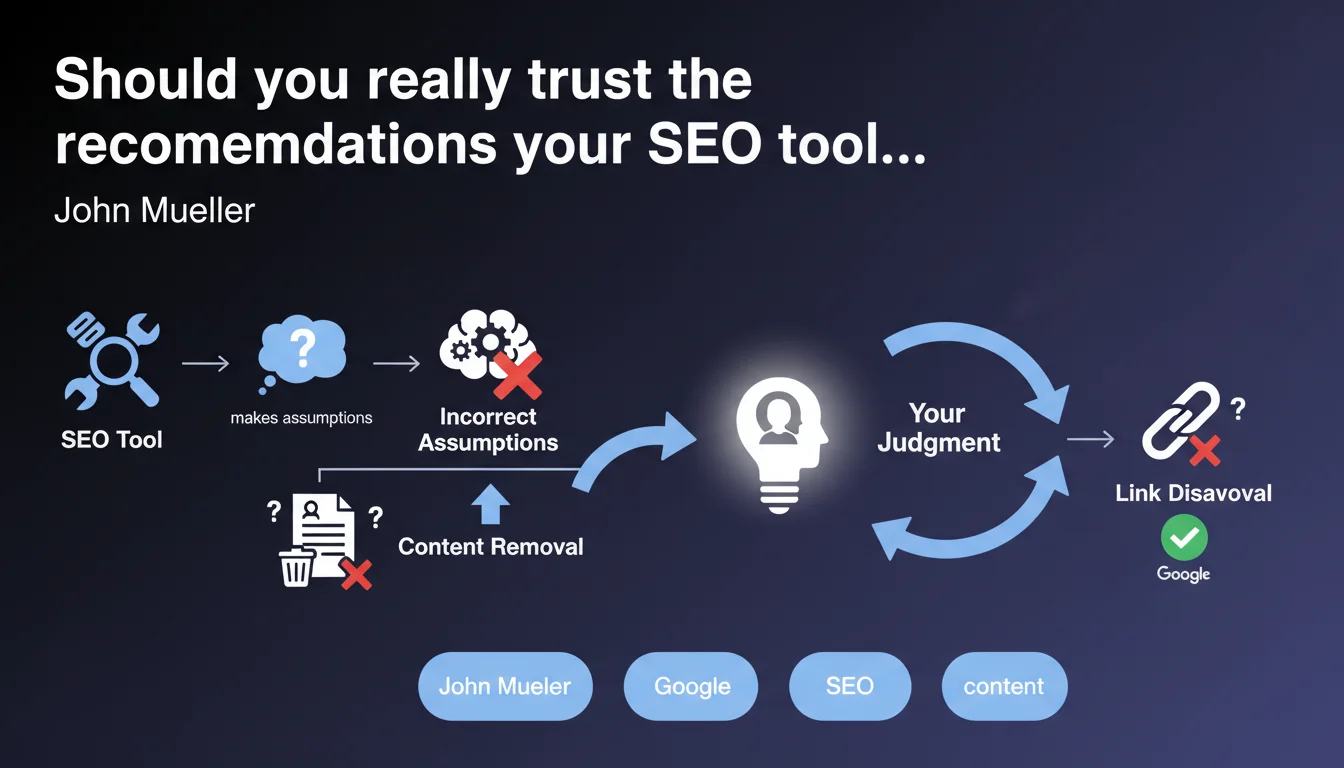
SEO tools operate on assumptions that may be wrong about how Google actually evaluates your site. Mueller warns against mechanically applying their recommendations, especially regarding content removal or link disavowal — two irreversible actions that can destroy your visibility if they're based on false premises.
What you need to understand
Why is Google questioning the reliability of SEO tools?
SEO tools — whether they're called Ahrefs, Semrush, Screaming Frog, or something else — rely on predictive models. They analyze correlations, extrapolate patterns, and attempt to guess what Google values or penalizes. The problem? These models don't reflect how the algorithm actually works internally. They observe results and infer causes from them.
A tool might claim that a link is toxic because it comes from a low-authority site. But Google has never confirmed using this metric. Worse: disavowing this link might actually remove a positive signal that the algorithm was taking into account through other dimensions (semantic context, thematic relevance, etc.).
Which actions are particularly risky according to Mueller?
Two recommendations appear repeatedly in automated audits: removing content deemed "weak" and disavowing "toxic" links. These two actions are irreversible in the short term and can destroy years of work if they're based on false assumptions.
Content removal can tank your rankings if Google was finding semantic value or authority context in it that the tool failed to detect. Link disavowal can cancel out positive signals that Google was using — but that the tool misinterpreted due to lack of access to the algorithm's actual criteria.
Are SEO tools useless then?
No. But they should be viewed as indicators, not as prescriptors. They detect anomalies, identify trends, highlight opportunities. But the final decision should be based on human analysis that takes into account business context, site history, and strategic objectives.
A tool might alert you to 500 duplicate pages. It's up to you to determine whether these pages actually serve users, whether they generate qualified traffic, or whether they're truly unnecessary noise. The tool can't make this distinction — it applies a generic rule to a particular context.
- SEO tools model Google, they don't reproduce it
- Removing content or disavowing links are irreversible high-risk actions
- Automated recommendations must be filtered through your judgment and knowledge of the site
- A tool detects patterns, but only a human can interpret their relevance in a given context
SEO Expert opinion
Is this warning consistent with practices observed in the field?
Absolutely. We regularly see sites that apply automated audit recommendations to the letter and lose 30 to 50% of their organic traffic within weeks. Typical case: mass removal of "weak content" detected by a tool that relies solely on word count or bounce rate.
Except Google doesn't think that way. A short page can be perfectly relevant if it precisely answers search intent. A high bounce rate can mean the user found their answer immediately — not that the page is bad. Tools can't capture these nuances.
In which cases do tools get it most wrong?
Atypical link profiles are the first pitfall. A niche site might have a "weird" backlink profile by generic standards (unusual follow/nofollow ratio, over-optimized anchors in a sector where this is the norm), but perfectly legitimate within its industry context.
Second classic case: low search volume content. A tool will flag that a page generates only 10 visits/month and recommend removing it. But if those 10 visits convert at 40% and generate high average cart value, that page has more business value than 100 pages generating 1,000 visits at 0.5% conversion.
[To be verified] Tools claiming to measure link "toxicity" base their assessments on proprietary metrics whose actual correlation with Google penalties has never been publicly demonstrated. No large-scale study validates that their scores actually predict a risk of sanctions.
When should you still follow a tool's recommendations?
When they address objective technical issues: duplicate title tags, pages linked from your site returning 404s, excessive load times, missing HTTPS, robots.txt blocking critical resources. These diagnostics are factual — either something is broken or it isn't.
However, as soon as you move into qualitative interpretation ("this content is too short", "this link is toxic", "this page lacks authority"), human judgment must take over. The tool alerts you, you decide.
Practical impact and recommendations
How do you evaluate whether a tool recommendation is relevant before applying it?
First step: cross-check sources. If three different tools flag the same technical issue (missing tag, broken link), it's probably sound. If only one tool alerts you to "weak content" that others don't detect, investigate before acting.
Second step: analyze real impact. Before removing a page or disavowing a link, look at Analytics and Search Console data. Does this page generate qualified traffic? Does this link send visitors who convert? If yes, why remove it just because an external algorithm deems it "weak"?
Third step: test at small scale. If you doubt a massive recommendation (delete 200 pages, disavow 1,000 links), start with a sample of 10 to 20 items and observe the effect over 4 to 6 weeks before scaling up.
What mistakes should you absolutely avoid with SEO tools?
Never apply in bulk an action suggested by an "Auto-fix" or "Apply recommendations" button. These features are designed for convenience, but they can't account for your business context, site history, and specific objectives.
Also avoid disavowing links without first manually verifying their nature. A tool might flag as toxic a link from a perfectly legitimate industry directory simply because that site also hosts other less-quality directories. Google knows how to distinguish — the tool doesn't.
- Cross-reference diagnostics from multiple tools before making a decision
- Check Analytics and Search Console to measure the real impact of the detected "problem"
- Test recommendations on a small sample before any large-scale action
- Never remove content or disavow links without prior human analysis
- Prioritize objective technical fixes (404s, redirects, speed) over subjective qualitative optimizations
- Document each change so you can revert if results decline
Who can help you correctly interpret this data?
Faced with increasingly complex algorithms and a multiplication of tools, correctly interpreting automated recommendations requires specialized expertise and continuous monitoring. Misdiagnosis can cost months of traffic and revenue.
If your internal team lacks the resources or experience to audit these recommendations thoroughly, engaging a specialized SEO agency can help you avoid costly mistakes. An experienced external perspective often identifies true priorities, filters the noise generated by tools, and builds an optimization strategy suited to your context — not generic rules.
❓ Frequently Asked Questions
Peut-on faire confiance aux scores d'autorité de domaine (DA, DR, etc.) ?
Combien d'outils SEO faut-il utiliser pour avoir une vision complète ?
Un audit automatique peut-il remplacer une analyse humaine ?
Faut-il désavouer tous les liens marqués comme toxiques par un outil ?
Les recommandations de contenu des outils sont-elles fiables ?
🎥 From the same video 14
Other SEO insights extracted from this same Google Search Central video · published on 22/03/2022
🎥 Watch the full video on YouTube →
💬 Comments (0)
Be the first to comment.