
Official statement
Other statements from this video 14 ▾
- □ Google choisit-il vraiment les titres de page indépendamment de la requête de l'utilisateur ?
- □ Changer un nom de ville suffit-il à créer des doorway pages condamnables par Google ?
- □ Faut-il vraiment centraliser son contenu compétitif plutôt que le dupliquer ?
- □ Découvert mais non indexé : Google n'a-t-il vraiment jamais crawlé ces pages ?
- □ Pourquoi Google refuse-t-il d'indexer un site techniquement parfait ?
- □ Faut-il vraiment faire confiance aux recommandations de vos outils SEO ?
- □ Faut-il encore corriger les redirections cassées longtemps après une migration ?
- □ Passer d'un ccTLD à un gTLD suffit-il pour conquérir de nouveaux marchés internationaux ?
- □ Sous-domaine ou sous-répertoire : Google a-t-il vraiment une préférence ?
- □ Pourquoi les clics par page et par requête diffèrent-ils dans Search Console ?
- □ Le maillage interne révèle-t-il vraiment l'importance de vos pages à Google ?
- □ L'attribut target des liens a-t-il un impact sur le référencement Google ?
- □ Faut-il vraiment supprimer tous les breadcrumbs schema sauf un pour éviter la confusion ?
- □ Pourquoi vos images CSS background-image sont-elles invisibles pour Google Images ?
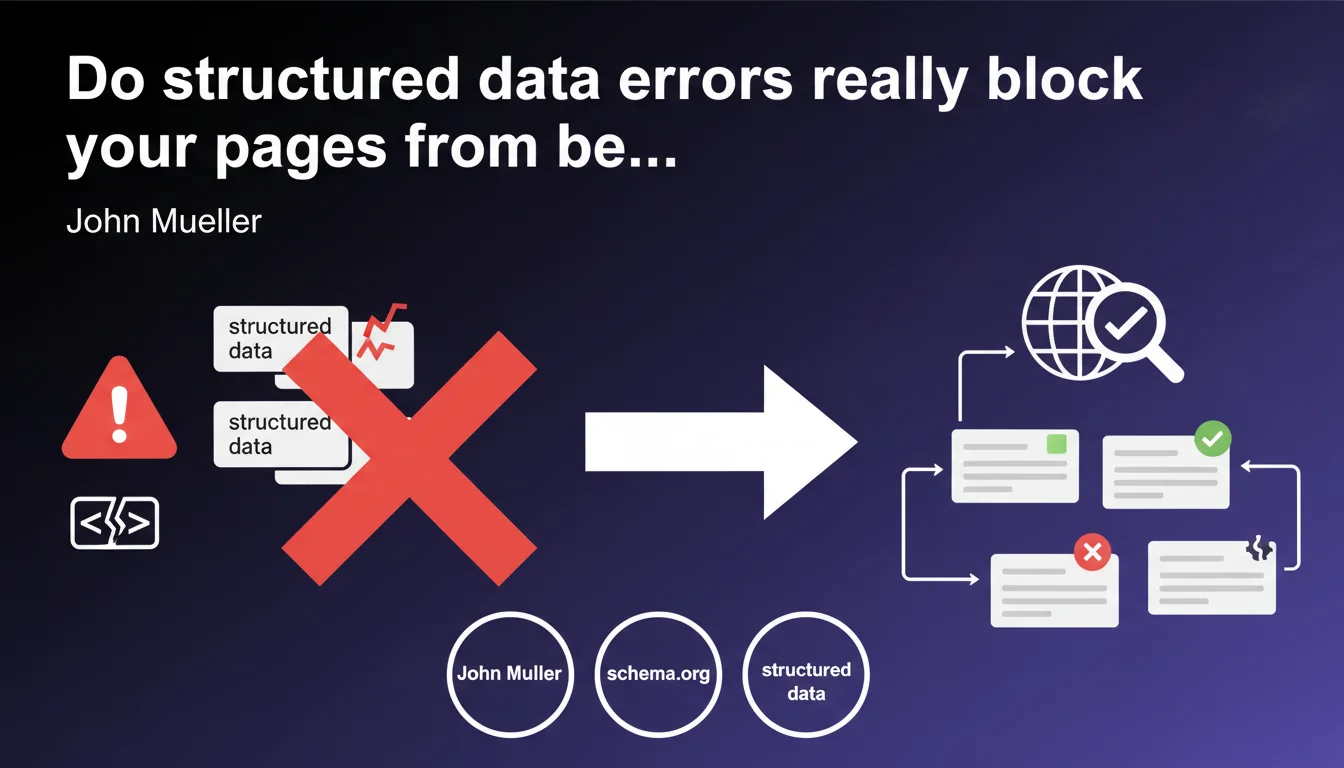
Google indexes your pages even if structured data is broken, incomplete, or absent. Even completely defective HTML doesn't prevent indexation. Schema.org errors have no impact on Googlebot's ability to crawl and index a URL.
What you need to understand
Why does this statement challenge certain SEO beliefs?
Many SEO professionals overestimate the role of structured data in the indexation process. Some believe that a page without schema.org or with critical errors risks not being indexed properly.
Mueller is clear: indexation does not depend on the validity of structured markup. Googlebot is capable of extracting content even from poorly formed HTML. Structured data serves to improve display in SERPs (rich snippets, FAQs, products), not to decide whether a page enters the index or not.
What is the distinction between indexation and eligibility for rich snippets?
Indexation is the fact that Google includes a page in its database. Eligibility for rich snippets is a subsequent step that depends on the quality of schema.org markup.
A page can be indexed and rank normally without ever generating an enriched result. Conversely, a page with perfect schema.org but weak content or a crawl issue will not be indexed, regardless of markup quality.
Do structured data errors have zero impact then?
Not quite. They don't prevent indexation, but they sabotage your chances of obtaining rich results. And these can significantly improve your organic CTR.
A critical error in your Product schema can make you lose the display of stars and price. A poorly marked FAQ will never appear in SERPs. Structured data remains a visibility lever — it's just not a prerequisite for indexation.
- Indexation works independently of the presence or validity of structured data
- Broken HTML does not prevent Googlebot from crawling and indexing a page
- Schema.org errors only impact the display of rich snippets
- A page without structured markup can rank normally in organic results
- Search Console flags structured data errors without blocking indexation
SEO Expert opinion
Is this statement consistent with real-world observations?
Yes, absolutely. We regularly see sites with catastrophic schema.org markup that index and rank without any issues. Sometimes even better than competitors with impeccable markup.
The real determinant of indexation remains the quality of text content, basic HTML structure (title tags, meta descriptions, headings), site architecture, and popularity signals. Structured data is an optional additional layer to enrich display.
Why does Google communicate so much about schema.org if it's not essential?
Because rich results improve user experience in SERPs. Google has every interest in sites implementing structured data correctly — it makes its search results pages more attractive.
But blocking indexation for a site that doesn't play along? That's never been Google's strategy. The search engine prioritizes inclusivity: index as much relevant content as possible, even if some sites don't get rich snippets.
In what cases might this rule have exceptions?
Technically, no known exceptions. Even a site with HTML so broken that it doesn't display correctly in a browser can be indexed if Googlebot manages to extract text. [To verify]: one could imagine extreme cases where a site entirely generated with client-side JavaScript without SSR and with critical errors poses problems, but that wouldn't be related to structured data.
The real limitation concerns specific enriched result types. Certain SERP features (event carousels, recipes with photos) require valid structured markup. No indexation blocked, but no premium display either.
Practical impact and recommendations
Should you stop correcting structured data errors?
Absolutely not. Just because they don't block indexation doesn't mean they're without consequences. Your competitors who display stars, expandable FAQs, or enriched breadcrumbs in SERPs capture more clicks.
Prioritize corrections based on business impact: broken Product schema on an e-commerce product page is urgent, a minor error on a blog post is less so. But keep in mind that even without rich snippets, your page can rank — it's just less visually appealing.
How do you manage Search Console alerts about structured data?
Don't panic if you receive notifications of critical errors. Your pages continue to be crawled and indexed. Treat these alerts as improvement opportunities, not blocking technical emergencies.
First verify whether the errors concern markup types that actually generate rich snippets on your target queries. If no one ever sees enriched FAQs on your keywords, fixing the FAQPage schema is less priority than optimizing your content.
What strategy should you adopt for new projects?
Implement structured data from the start, but don't delay a launch because of it. If your basic HTML is clean and your content solid, launch the site. You can add or fix schema.org in iteration.
Focus on markup types that have proven impact in your sector: Product for e-commerce, Article and Breadcrumb for media, LocalBusiness for local sites. Exotic schemas can wait.
- Regularly audit Search Console to identify structured data errors
- Prioritize corrections based on impact on rich snippets visible in your target SERPs
- Test your markup with Google's Rich Results Test before deployment
- Never block a site launch because of non-critical schema.org errors
- Document implemented markup types to facilitate future maintenance
- Monitor the evolution of competitor rich snippets to identify opportunities
❓ Frequently Asked Questions
Une page sans aucune donnée structurée peut-elle ranker en première position sur Google ?
Les erreurs critiques signalées dans la Search Console impactent-elles mon crawl budget ?
Dois-je corriger en priorité les erreurs de données structurées ou les problèmes de contenu dupliqué ?
Le temps de chargement est-il affecté par des données structurées mal implémentées ?
Google peut-il indexer une page avec un HTML complètement cassé mais du texte visible ?
🎥 From the same video 14
Other SEO insights extracted from this same Google Search Central video · published on 22/03/2022
🎥 Watch the full video on YouTube →
💬 Comments (0)
Be the first to comment.