
Official statement
Other statements from this video 14 ▾
- □ Google choisit-il vraiment les titres de page indépendamment de la requête de l'utilisateur ?
- □ Changer un nom de ville suffit-il à créer des doorway pages condamnables par Google ?
- □ Faut-il vraiment centraliser son contenu compétitif plutôt que le dupliquer ?
- □ Découvert mais non indexé : Google n'a-t-il vraiment jamais crawlé ces pages ?
- □ Pourquoi Google refuse-t-il d'indexer un site techniquement parfait ?
- □ Faut-il vraiment faire confiance aux recommandations de vos outils SEO ?
- □ Faut-il encore corriger les redirections cassées longtemps après une migration ?
- □ Sous-domaine ou sous-répertoire : Google a-t-il vraiment une préférence ?
- □ Pourquoi les clics par page et par requête diffèrent-ils dans Search Console ?
- □ Les erreurs de données structurées bloquent-elles vraiment l'indexation de vos pages ?
- □ Le maillage interne révèle-t-il vraiment l'importance de vos pages à Google ?
- □ L'attribut target des liens a-t-il un impact sur le référencement Google ?
- □ Faut-il vraiment supprimer tous les breadcrumbs schema sauf un pour éviter la confusion ?
- □ Pourquoi vos images CSS background-image sont-elles invisibles pour Google Images ?
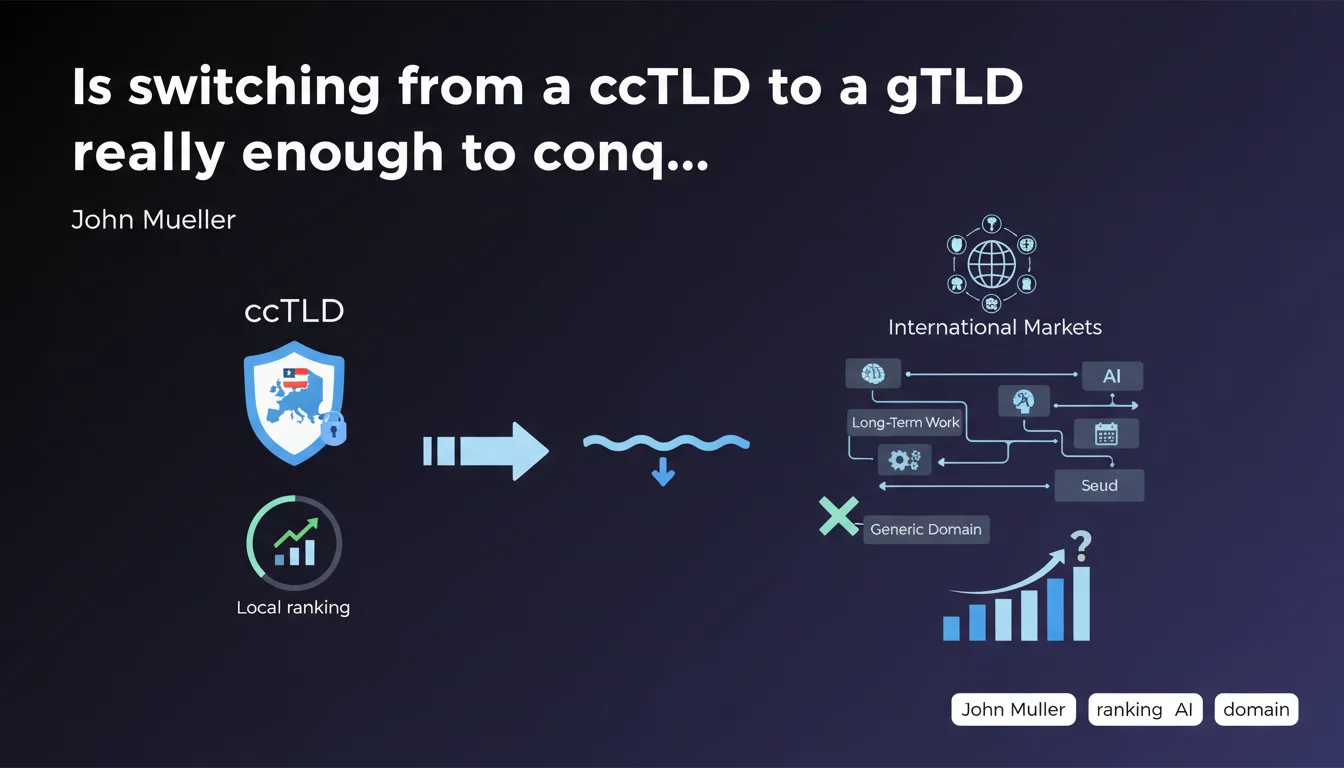
Migrating from a national domain (.fr, .de) to a generic domain (.com) guarantees no performance transfer. International competition forces you to rebuild everything: authority, backlinks, signals — technical adjustments are never enough. It's a long-term project, not a simple migration.
What you need to understand
Why does Google distinguish so clearly between ccTLD and gTLD?
The ccTLD (Country Code Top-Level Domains) like .fr or .de benefit from automatic geolocation treatment by Google. The search engine associates them by default with a specific market, which boosts their local visibility but penalizes them everywhere else.
A gTLD (.com, .net, .org) has no native geographic anchor. Google must deduce the geographic target through other signals: hreflang, Search Console, hosting, local backlinks. This neutrality opens up international opportunities, but implies head-to-head competition with already-established global players.
What actually changes at the competition level?
Ranking on a ccTLD means playing in a regional league. Migration to a gTLD propels you into the global first division — with competitors who sometimes have 10 years of advantage in domain authority, content depth, and international link architecture.
Google doesn't carry your local performance to the new domain. Each international market becomes a distinct battle, with its own SERPs, its own leaders, its own barriers to entry. The gTLD doesn't unlock anything automatically: it just removes the geographic restriction of the ccTLD.
Why are technical adjustments never enough?
Because international SEO relies on trust signals that accumulate slowly. Migrating technically (301s, hreflang, structure) preserves indexing, but creates no authority on the new target markets.
You need local backlinks, culturally adapted content, user engagement signals specific to each zone. Competitors already in place built these foundations over years. A freshly migrated domain starts with a major structural disadvantage.
- ccTLD = automatic local boost, but strict geographic ceiling
- gTLD = international freedom, but global competition without safety net
- Technical migration preserves indexing, not competitive performance
- Conquering new markets requires rebuilding authority and local signals
- Realistic timeframe: 12-24 months minimum per target market
SEO Expert opinion
Does this statement really reflect what we observe in the field?
Absolutely. Failed ccTLD → gTLD migrations all share the same flaw: underestimating the competitive reset. Clients see their local positions hold for a few months post-migration, then collapse once Google recalculates the new domain's authority against international competition.
Success cases consistently show massive investment before migration: multilingual content creation, market-targeted link building, local presence (press mentions, partnerships). Those who migrate thinking 301s will "transfer link juice" face a brutal reality — the juice was local, it doesn't travel.
What nuances should we add to this rule?
Not all ccTLDs start from the same point. A .de with strong authority can resist better than a weak .fr, but the principle remains: international competition eats your local advantage. [To verify] whether certain "premium" ccTLDs (UK, DE) benefit from differentiated treatment during migrations — Google releases no quantified data on this.
Another blind spot: highly vertical niches. In certain ultra-specialized B2B sectors, global competition remains limited. A locally dominant ccTLD can switch to gTLD and maintain dominance if international competitors are rare or weak. But that's the exception, not the rule.
In which cases does this migration remain relevant anyway?
When your local market is saturated and you have resources for a multi-year investment. ccTLD → gTLD migration is never a quick solution, but becomes unavoidable if your growth depends on going international.
Concretely: if you already dominate your ccTLD, if you have a real go-to-market strategy per country (not just translating the site), and a 18-24 month budget for link building and content is aligned, then yes. Otherwise, you'll just dilute your existing authority without compensatory ROI.
Practical impact and recommendations
What must you do before even considering migration?
Audit your real competitive potential on each target market. Analyze the top 10 results for your priority queries: domain authority, link profile, content depth. If the gap is abyssal, delay migration and invest first in strengthening your current domain.
Build an international link base before migrating. Secure mentions in local press on your target markets, create partnerships, generate geographic relevance signals. A freshly migrated gTLD without these foundations starts with a brutal handicap.
Which mistakes should you kill immediately?
Believing that a perfect technical migration (301s, hreflang, sitemap) will transfer your performance. No. It preserves indexing and prevents disasters, but creates no competitive advantage on new markets.
Thinking that translating content is enough. Google values cultural and behavioral signals: local engagement, target market backlinks, content structure adapted to local search intent. A translated site without these signals remains invisible against native competitors.
How do you orchestrate a migration that maximizes your chances?
Phase by priority market. Don't target 10 countries simultaneously — you'll dilute budget and attention. Select 1-2 markets with the best opportunity/competition ratio, invest heavily for 12-18 months, then replicate the validated playbook.
Track realistic KPIs: don't expect to recover your local positions in 6 months. Measure relative progress (position gains month-over-month), acquisition of local backlinks, engagement improvement per market. Continuously adjust rather than wait for a binary result.
- Audit international competition before any decision
- Build a local backlink base pre-migration
- Implement hreflang and geo-targeting in Search Console on day one
- Create native content per market, don't just translate
- Plan continuous link building budget for 18-24 months minimum
- Track progression metrics, not absolute results
- Phase by priority market rather than spread efforts
❓ Frequently Asked Questions
Un gTLD avec sous-répertoires par pays (/fr/, /de/) est-il aussi efficace que des ccTLD distincts ?
Combien de temps faut-il pour retrouver des positions équivalentes après migration ?
Peut-on conserver le ccTLD en parallèle du gTLD pendant la transition ?
Les redirections 301 du ccTLD vers le gTLD transfèrent-elles l'autorité internationale ?
Faut-il migrer si on vise seulement 2-3 pays supplémentaires ?
🎥 From the same video 14
Other SEO insights extracted from this same Google Search Central video · published on 22/03/2022
🎥 Watch the full video on YouTube →
💬 Comments (0)
Be the first to comment.