
Official statement
Other statements from this video 14 ▾
- □ Google choisit-il vraiment les titres de page indépendamment de la requête de l'utilisateur ?
- □ Changer un nom de ville suffit-il à créer des doorway pages condamnables par Google ?
- □ Faut-il vraiment centraliser son contenu compétitif plutôt que le dupliquer ?
- □ Découvert mais non indexé : Google n'a-t-il vraiment jamais crawlé ces pages ?
- □ Pourquoi Google refuse-t-il d'indexer un site techniquement parfait ?
- □ Faut-il vraiment faire confiance aux recommandations de vos outils SEO ?
- □ Faut-il encore corriger les redirections cassées longtemps après une migration ?
- □ Passer d'un ccTLD à un gTLD suffit-il pour conquérir de nouveaux marchés internationaux ?
- □ Pourquoi les clics par page et par requête diffèrent-ils dans Search Console ?
- □ Les erreurs de données structurées bloquent-elles vraiment l'indexation de vos pages ?
- □ Le maillage interne révèle-t-il vraiment l'importance de vos pages à Google ?
- □ L'attribut target des liens a-t-il un impact sur le référencement Google ?
- □ Faut-il vraiment supprimer tous les breadcrumbs schema sauf un pour éviter la confusion ?
- □ Pourquoi vos images CSS background-image sont-elles invisibles pour Google Images ?
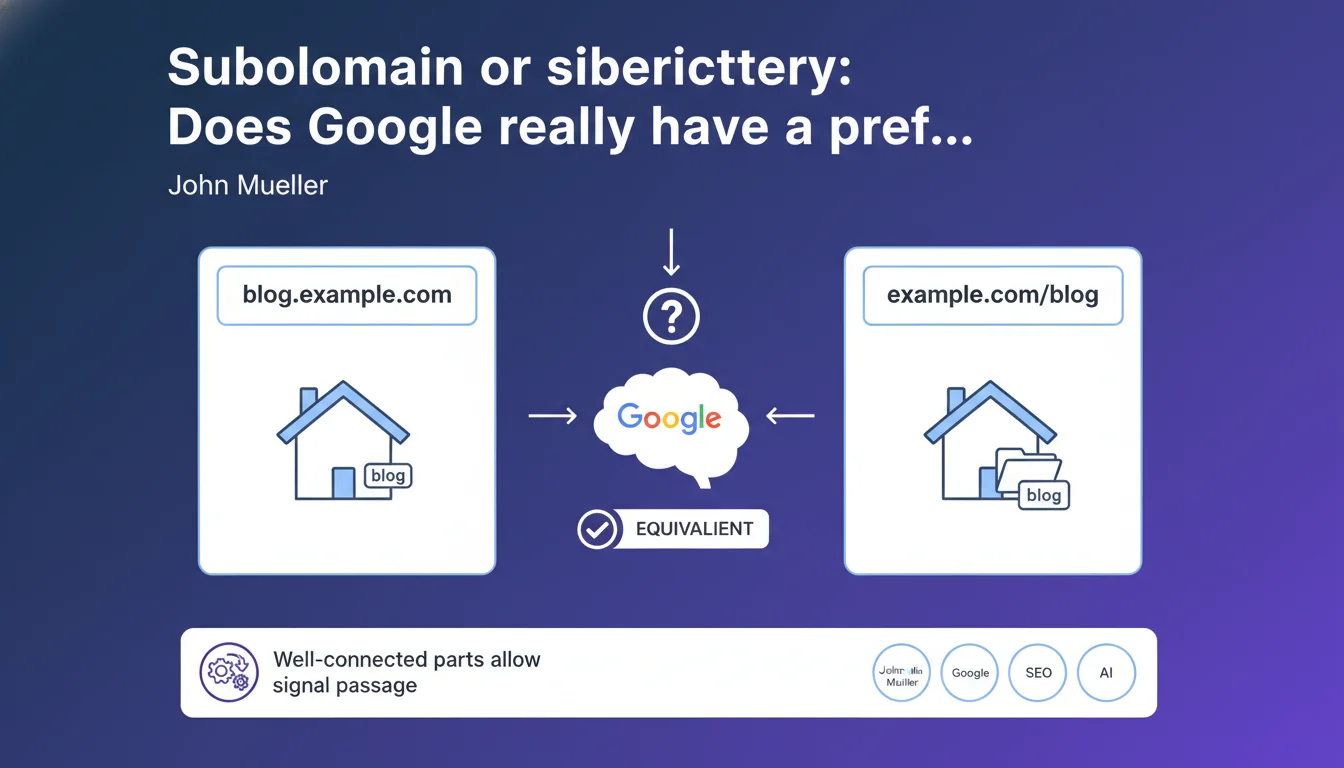
Google claims to treat subdomains and subdirectories equivalently. Whether you opt for blog.example.com or example.com/blog, there's no SEO difference according to Mueller — provided you ensure strong internal linking between the two parts of your site to facilitate signal flow.
What you need to understand
Why does this question come up so often?
URL structure is one of the first technical decisions a site must make, with heavy long-term consequences. Switching from a subdomain to a subdirectory (or vice versa) involves redirects, risks of traffic loss, and potentially months of fluctuation in the SERPs.
Historically, subdirectories have always been perceived as more effective for capitalizing on the main domain's authority. A subdomain, on the other hand, could be treated as a separate — even competing — entity by Google. This perception has been ingrained in SEO best practices for years.
What exactly does Mueller say?
John Mueller states that Google does not prefer one over the other. Subdomain or subdirectory, it's the same for the algorithm. The essential factor, according to him, lies in the connection between the two parts of your site: internal linking and semantic consistency must allow signals (authority, relevance, crawl) to flow freely.
Concretely? If your blog is on a subdomain, make sure it's well integrated into the main site through relevant links, and vice-versa. No siloed structure.
What does this mean for us, practitioners?
This statement aims to defuse a debate that is often futile from a technical standpoint. It refocuses the question: it's not the URL format that matters, but how you structure your content and your internal linking.
But — and here's where it gets tricky — Mueller provides no quantification. No data, no concrete examples of what "well-linked" means. We're left in the dark.
- Google treats subdomains and subdirectories equivalently (according to Mueller)
- The determining factor: quality of internal linking and signal flow
- No quantitative data provided to support this equivalence
- The choice should be made based on technical, organizational, and branding criteria — not pure SEO
SEO Expert opinion
Is this claim consistent with real-world observations?
Let's be honest: feedback from the field varies. Many SEO professionals have observed significant traffic gains after migrating from a subdomain to a subdirectory, particularly for blogs, e-commerce sections, or multilingual content. These cases suggest that in practice, the subdirectory benefits more from the main domain's authority.
So why this gap between Google's theory and real-world experience? Several hypotheses: insufficient internal linking on subdomains, signal dilution, or even a less favorable interpretation by the algorithm when content is perceived as "separate." [To verify]: Google provides no metric allowing validation that equivalence is real at equal authority and linking levels.
In what cases does this rule not fully apply?
There are situations where subdomain separation can be strategically justified, or even preferable. For example: a SaaS tool hosted on app.example.com with fundamentally different business logic from the main site, or a multilingual site with geolocalized versions (fr.example.com, de.example.com) where each subdomain benefits from local infrastructure.
But be careful: even in these cases, linking must be flawless. An orphaned subdomain, with no links from the main domain, starts with a structural disadvantage — regardless of what Mueller says.
Should we take this statement at face value?
No. Mueller speaks of "theoretical" equivalence in an ideal context where everything is done correctly. But in real life, nothing is ever done perfectly. Subdomains are more often neglected in terms of linking, content, and editorial strategy. Result: they perform worse, not because of the URL, but because of site governance.
Equivalence is only true if you have the resources, rigor, and architecture to make it true. Otherwise, the subdirectory remains the safest choice to capitalize on domain authority without extra effort.
Practical impact and recommendations
What should you do concretely?
If you're launching a new project (blog, shop, local section), favor the subdirectory by default. It's the simplest choice to manage, the most effective for inheriting the main domain's authority, and the least risky in terms of signal dilution.
If you already have a subdomain in place and it's performing well, don't migrate on a whim. First audit your internal linking, verify that both parts of your site communicate effectively, and analyze whether the subdomain is receiving backlinks and autonomous organic traffic.
What critical mistakes should you avoid?
Never create a subdomain thinking it will be "automatically" linked to the main site. Google won't do the work for you. A subdomain without linking is an orphaned site that starts from zero in terms of authority.
Another pitfall: multiplying subdomains without a clear strategy. Each fragmented subdomain dilutes your SEO efforts, complicates crawling, and makes technical governance unmanageable. If you have 5 different subdomains, ask yourself: is this really necessary, or is it just inherited technical debt?
- Favor the subdirectory for any new project unless there's a specific technical case for subdomains
- Audit the internal linking between main domain and subdomain if you use one
- Verify that the subdomain receives direct backlinks and autonomous organic traffic
- Never migrate without measuring potential impact through an A/B test or pilot phase
- Avoid multiplying subdomains without clear strategic justification
- Document any migration with an exhaustive 301 redirect plan
How do you verify that your current configuration is optimal?
Analyze the organic traffic distribution between main domain and subdomain. If the subdomain captures less than 10% of total traffic, question its relevance. Also check Google Search Console to see if both properties receive balanced impressions or if one dominates the other.
On the technical side, inspect your crawl budget: does Googlebot regularly explore both parts of your site? A subdomain that's rarely crawled is often a poorly integrated subdomain. Finally, scrutinize your internal link structure with a tool like Screaming Frog to identify orphaned areas.
❓ Frequently Asked Questions
Un sous-domaine peut-il hériter de l'autorité du domaine principal ?
Faut-il migrer un sous-domaine vers un sous-répertoire pour gagner en SEO ?
Les sous-domaines sont-ils pénalisés par Google ?
Quel impact sur les backlinks si je passe d'un sous-domaine à un sous-répertoire ?
Google traite-t-il les sous-domaines comme des sites séparés ?
🎥 From the same video 14
Other SEO insights extracted from this same Google Search Central video · published on 22/03/2022
🎥 Watch the full video on YouTube →
💬 Comments (0)
Be the first to comment.