
Official statement
Other statements from this video 14 ▾
- □ Google choisit-il vraiment les titres de page indépendamment de la requête de l'utilisateur ?
- □ Changer un nom de ville suffit-il à créer des doorway pages condamnables par Google ?
- □ Découvert mais non indexé : Google n'a-t-il vraiment jamais crawlé ces pages ?
- □ Pourquoi Google refuse-t-il d'indexer un site techniquement parfait ?
- □ Faut-il vraiment faire confiance aux recommandations de vos outils SEO ?
- □ Faut-il encore corriger les redirections cassées longtemps après une migration ?
- □ Passer d'un ccTLD à un gTLD suffit-il pour conquérir de nouveaux marchés internationaux ?
- □ Sous-domaine ou sous-répertoire : Google a-t-il vraiment une préférence ?
- □ Pourquoi les clics par page et par requête diffèrent-ils dans Search Console ?
- □ Les erreurs de données structurées bloquent-elles vraiment l'indexation de vos pages ?
- □ Le maillage interne révèle-t-il vraiment l'importance de vos pages à Google ?
- □ L'attribut target des liens a-t-il un impact sur le référencement Google ?
- □ Faut-il vraiment supprimer tous les breadcrumbs schema sauf un pour éviter la confusion ?
- □ Pourquoi vos images CSS background-image sont-elles invisibles pour Google Images ?
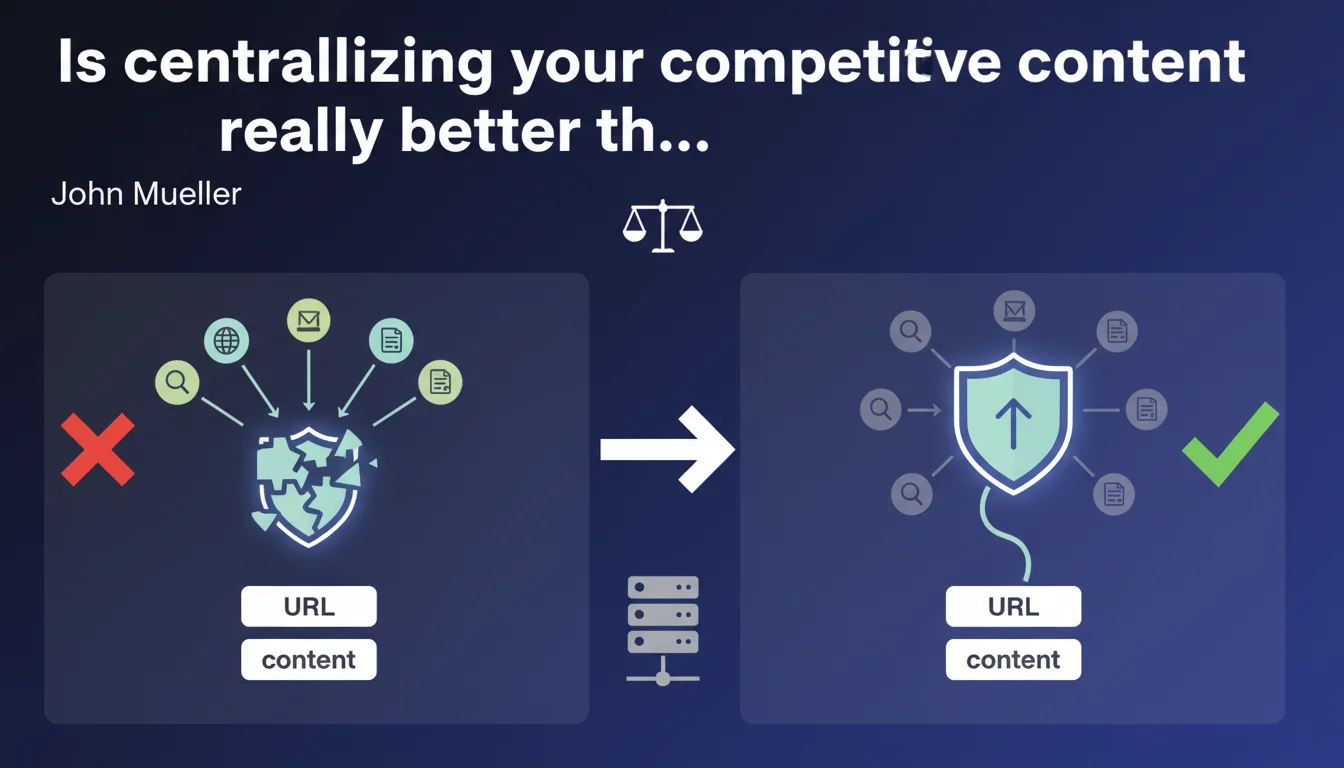
Duplicating strategic content across hundreds of local pages weakens its strength in search results. Google recommends concentrating high-potential competitive content on a single powerful central page, while reserving local variations for less critical elements. Balancing local visibility with centralized authority remains a delicate juggling act.
What you need to understand
Why does Google talk about "dilution" of value?
When the same content appears on dozens or hundreds of pages — typically local pages for franchises or multi-location businesses — Google must determine which one deserves to rank. None of them really stand out, because signals (links, authority, engagement) become dispersed instead of converging on a single source.
The search engine favors pages that concentrate relevance signals. If your strong content is duplicated everywhere, each URL becomes a weakened version of the original. Result: you're competing against yourself in the SERPs.
What counts as "competitive content" in this context?
Competitive content targets high-volume queries or high-intent keywords, often disputed by established competitors. Typically: main service pages, flagship product pages, strategic guides.
Google suggests keeping this type of content on a single, authoritative central page, even if it means sacrificing local granularity on these topics. Less competitive content (hours, contact info, minor local specifics) can be tailored locally without risk.
How do you balance local pages with centralized content?
The balance comes from a differentiation strategy. Local pages must deliver real local added value: regional customer testimonials, local team profiles, local partnerships, geo-targeted news.
If the only difference between your 200 pages is the city name, you're in the danger zone. Either centralize your strong content and redirect to a store locator, or invest in making each local page genuinely unique.
- Dilution = same strategic content across hundreds of weak URLs
- Centralization = concentrating competitive content on a single powerful page
- Local differentiation = essential condition to justify multiple local pages
- Non-competitive content can be tailored locally without risk
SEO Expert opinion
Does this actually reflect real-world practice?
Yes and no. We do see that sites with hundreds of nearly identical pages struggle to rank on competitive queries. But — and this is a big but — some local businesses do very well with duplicated local pages, largely thanks to Google Business Profile, local citations, and geo-targeted backlinks.
Mueller's statement doesn't say "never create local pages." It says "don't duplicate your best content everywhere." That's an important distinction. The problem is that the boundary between "competitive" and "local" is fuzzy. [Should be verified] on your own vertical: test, measure, adjust.
What situations escape this rule?
Franchises with strong local presence (McDonald's, Decathlon, banks) have local pages that rank excellently — but they invest heavily in differentiation: Google reviews, local events, dedicated teams, local backlinks. This isn't passive duplication.
Classified ad sites or marketplaces (like Craigslist, Airbnb) duplicate content infinitely, but their model relies on fresh inventory and the long tail, not the competitiveness of a single page. Different context entirely.
Where does this recommendation become a trap?
If you centralize too much, you lose the local granularity that ranks for "[service] + [city]". Google loves hyper-specialized pages. A law firm with one "labor law" page for the entire country will miss out on "labor lawyer in Lyon".
The real challenge: centralize without losing local long-tail visibility. This requires sophisticated architecture (intermediate regional pages, smart internal linking, differentiated satellite content). And this is where most fail.
Practical impact and recommendations
What should you do concretely with your existing local pages?
Audit your current local pages. Identify which ones target competitive national queries with duplicated content. If you have 150 "car insurance" pages that are identical except for the city, you're in trouble.
Two options: either consolidate on a powerful national page and redirect the others (301), or differentiate each local page with unique content, local data, geo-targeted testimonials. No middle ground.
How do you know if content is "too competitive" to duplicate?
Look at the SERPs. If the top 10 results are national or international players with high-authority pages (DR 60+, massive backlinks), your weak local page has no chance. Centralize.
If the SERPs show varied local results (Google Business profiles, competitors' local pages), then a differentiated local strategy can work. But only if you invest in quality.
- Identify local pages with duplicated content on competitive queries
- Analyze target SERPs: national dominance or local competition?
- Consolidate on a central page if national competition is strong
- Genuinely differentiate each local page (photos, reviews, team, events)
- Invest in smart internal linking between central and local pages
- Track performance by cluster (central vs local) over 3-6 months
What mistakes should you avoid during this transition?
Don't brutally delete 200 local pages without a plan. You risk losing long-tail traffic and existing local backlinks. Prioritize: start with pages that generate neither traffic nor conversions.
Also avoid the opposite trap: keeping local pages "just in case" when they rank nowhere and waste your crawl budget. Be surgical, not sentimental.
Intelligent centralization of competitive content is a powerful lever — but balancing central authority with local granularity requires careful analysis of your market, target SERPs, and editorial resources. If this optimization seems complex to manage alone (audit, prioritization, migration, monitoring), working with a specialized SEO agency can help you avoid costly mistakes and accelerate results.
❓ Frequently Asked Questions
Dois-je supprimer toutes mes pages locales si elles ont du contenu dupliqué ?
Comment différencier concrètement une page locale ?
Une page nationale peut-elle ranker sur des requêtes locales ?
Quel impact sur le référencement local (Google Business Profile) ?
Combien de temps pour voir les effets d'une consolidation de pages ?
🎥 From the same video 14
Other SEO insights extracted from this same Google Search Central video · published on 22/03/2022
🎥 Watch the full video on YouTube →
💬 Comments (0)
Be the first to comment.