
Official statement
Other statements from this video 7 ▾
- □ Does Google really keep Search and Ads completely separate, or is this just PR?
- □ Does Google really give large sites privileged SEO support while smaller sites are left behind?
- □ Are PBNs really all classified as spam by Google, or is there room for interpretation?
- □ Does Google really monitor help forums to detect spam?
- □ Where does Google really get all those spam reports from?
- □ Why does Google discourage the use of LLMs for answering in its support forums?
- □ Does Google Really Use Product Experts' Feedback to Improve Search Console and Documentation?
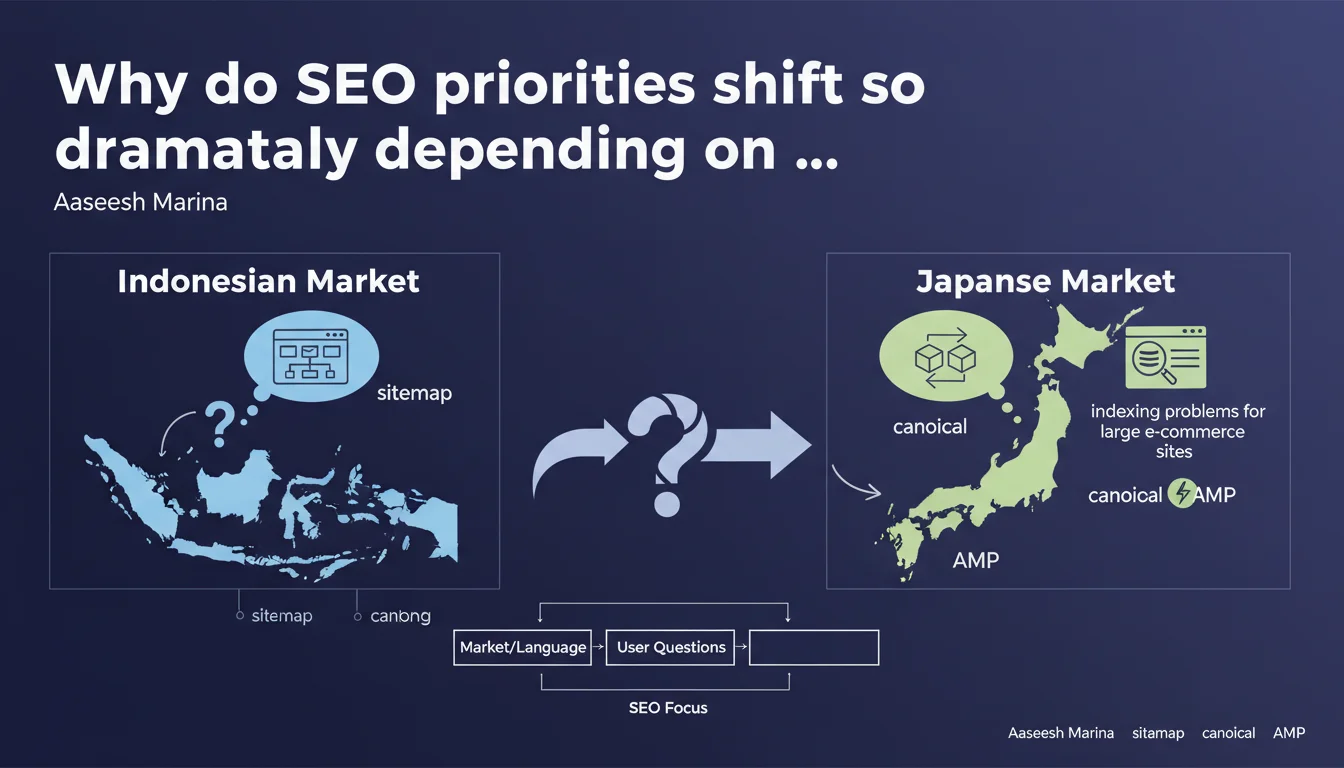
Google has observed that SEO challenges differ drastically across geographic regions and languages. Indonesia focuses heavily on sitemaps, Japan grapples with canonicalization and indexing issues for large product catalogs. This disparity reveals that technical SEO priorities aren't universal — they depend on market maturity, dominant CMS platforms, and local website typologies.
What you need to understand
Why do SEO concerns vary so much from one market to another?
Each digital ecosystem has its own structural peculiarities. In Indonesia, the recurring questions about sitemaps suggest widespread adoption of poorly configured CMS platforms or local e-commerce solutions that generate broken sitemaps by default.
In Japan, canonicalization and indexing dominate discussions — which makes sense given the density of e-commerce sites with massive catalogs (infinite product variants, multilingual content, duplicate product pages). Technical maturity differs there, but so do the actual problems.
Does this observation impact international SEO strategy?
Absolutely. If you manage a multilingual or multi-country site, don't assume your priorities from one market will translate to another. What works in France won't necessarily face the same obstacles in Southeast Asia.
SEO audits must incorporate this regional dimension — an international crawler can miss nuances tied to local infrastructure, CDNs, or indexation behaviors specific to Google's language-based algorithms.
Can we extrapolate these trends to other markets?
Google only provides two examples here. It's hard to draw universal conclusions without data from Europe, Latin America, or Africa. But the logic holds: each market has its own technical pathologies.
The questions people ask Google often reflect the systemic weaknesses of an ecosystem — dominant local CMS platforms, legacy development practices, regional hosting infrastructure. A savvy SEO professional needs to understand these patterns to diagnose problems effectively.
- Technical SEO issues are not uniform across countries
- The questions asked to Google reveal the structural weaknesses of a local digital ecosystem
- An international SEO audit must account for regional specificities in indexation and canonicalization
- Don't apply a French or American SEO strategy to Asian or African markets without prior analysis
SEO Expert opinion
Does this statement really reveal anything new?
Not particularly. Any SEO professional who's managed multi-regional sites has observed this firsthand: technical problems vary by geographic zone. What's interesting is that Google is finally saying it publicly.
But be cautious — this statement remains vague. Google provides no hard data, no methodology for identifying these differences. We don't know if these observations come from Search Console, help forums, or internal analysis. [Needs verification] — impossible to know whether these trends are statistically significant or just anecdotal.
Are the examples given (Indonesia, Japan) really representative?
Hard to say without more context. Indonesia definitely has a rapidly growing e-commerce ecosystem with local platforms like Tokopedia and Bukalapak that have their own technical standards — sometimes poorly implemented. Questions about sitemaps could reflect recurring bugs on these platforms.
For Japan, canonicalization is a logical topic given linguistic complexity (kanji, hiragana, katakana) and the density of product variants. But is this truly specific to Japan, or simply a symptom you'd find on any poorly architected large e-commerce site? Google doesn't clarify.
Should you adjust your SEO priorities based on target market?
Yes, but not solely based on this statement. What matters is auditing local technical specificities — dominant CMS platforms, regional hosting providers, Google indexation behavior by language.
In practice: if you're launching a site in Indonesia, verify from the start that your sitemap is clean and properly submitted. If you manage an e-commerce catalog in Japan, anticipate canonicalization issues before they tank your indexation. But don't rely on just these two examples — every market has its own pathologies.
Practical impact and recommendations
How do you identify SEO priorities specific to a market?
First step: analyze Search Console data by region and language. Look at indexation errors, canonicalization issues, crawl problems. If you spot recurring patterns on a specific market, dig deeper.
Second avenue: explore local Google Help forums and regional SEO communities. The questions people ask often reveal systemic flaws — exactly what Google observes in its statement. If everyone's struggling with sitemaps in Indonesia, that's a signal.
What mistakes should you avoid when rolling out an international site?
Don't transplant your technical infrastructure from one market to another. A fast CDN in Europe could be catastrophic in Southeast Asia. A solid CMS in France might generate broken sitemaps on an Indonesian instance.
Another common mistake: overlook linguistic specificities. URLs, hreflang tags, special character handling — all impact indexation differently depending on language. Japan and China present challenges you'll never encounter in Western Europe.
What concrete steps should you take for a multilingual or multi-country site?
- Audit Search Console errors by region and language, not just globally
- Test sitemap submission on each language version — verify they're being crawled
- Check canonicalization on markets with large catalogs (Japan, Korea, China)
- Identify dominant local CMS or e-commerce platforms and their known bugs
- Adapt technical audit priorities based on regional pathologies you observe
- Never assume a configuration that works in France will work in Asia without adjustment
❓ Frequently Asked Questions
Pourquoi les sitemaps posent-ils plus de problèmes en Indonésie qu'ailleurs ?
La canonicalisation est-elle vraiment spécifique au Japon ?
Faut-il auditer différemment un site selon son marché cible ?
Google fournit-il une liste des problèmes SEO par marché ?
Ces différences impactent-elles réellement le ranking ?
🎥 From the same video 7
Other SEO insights extracted from this same Google Search Central video · published on 21/02/2024
🎥 Watch the full video on YouTube →
💬 Comments (0)
Be the first to comment.