
Official statement
Other statements from this video 7 ▾
- □ Does Google really keep Search and Ads completely separate, or is this just PR?
- □ Does Google really give large sites privileged SEO support while smaller sites are left behind?
- □ Are PBNs really all classified as spam by Google, or is there room for interpretation?
- □ Where does Google really get all those spam reports from?
- □ Why does Google discourage the use of LLMs for answering in its support forums?
- □ Does Google Really Use Product Experts' Feedback to Improve Search Console and Documentation?
- □ Why do SEO priorities shift so dramatically depending on which market you're targeting?
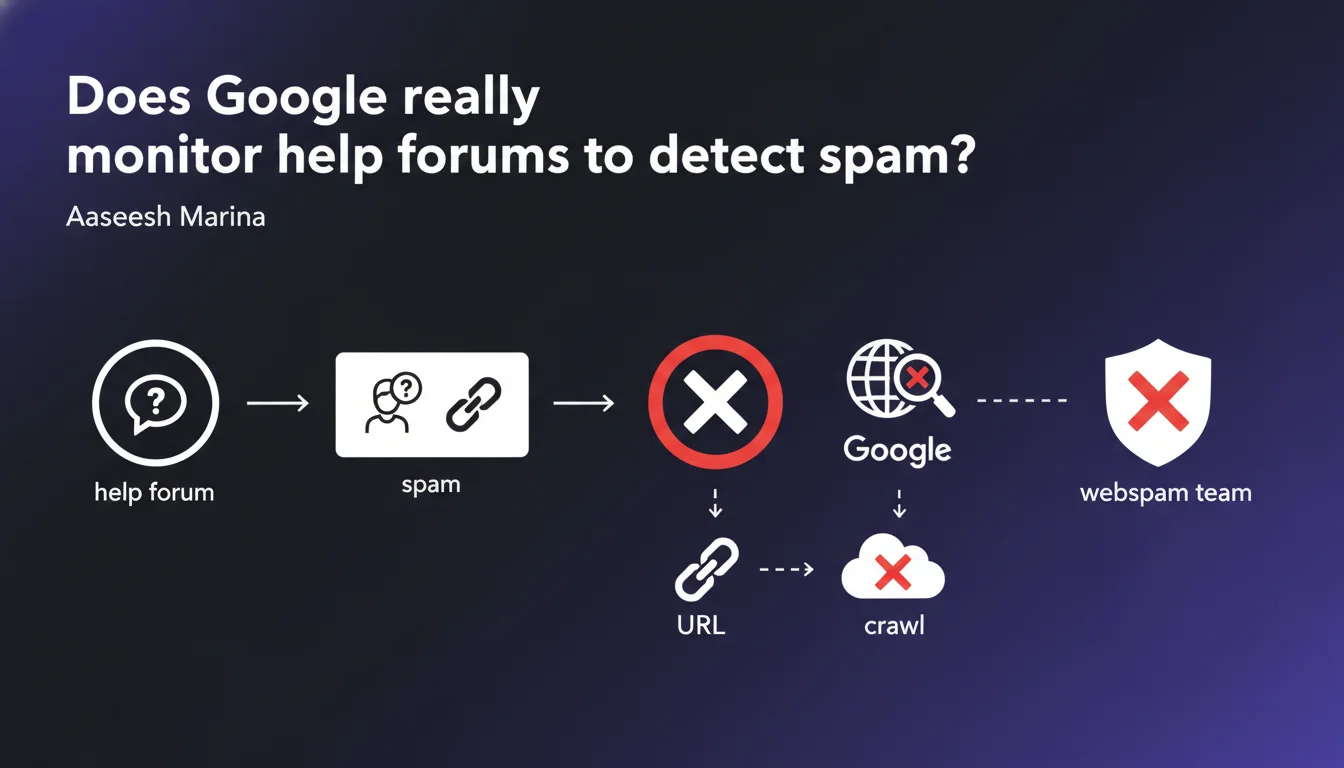
Google does not crawl help forums to identify spam websites. Webspam teams do not rely on these sources because users rarely share their URLs, and the method would be ineffective for detecting actual spam patterns.
What you need to understand
Why doesn't Google monitor help forums?
Help forums — whether it's Search Central Community or other public spaces — are not a reliable source for identifying spam. The main reason lies in user behavior: those who ask questions generally do not communicate their website URL.
Even when a URL appears, it often lacks technical context. A webmaster asking for help with a manual penalty doesn't necessarily provide enough information for the webspam team to draw actionable insights from.
What is Google's actual spam detection methodology?
Google relies on automated algorithms and large-scale analysis systems to detect spam patterns. Webspam teams use large-scale signals — artificial links, automatically generated content, cloaking — rather than individual reports.
Manual actions exist, but they result from proactive analysis or targeted spam reports through Search Console. Monitoring forums would be a manual approach incompatible with the volume processed daily.
Does this statement apply to all types of forums?
Marina speaks specifically about official help forums, but the principle logically extends to SEO communities, Facebook groups, or Reddit. Google does not deploy systematic monitoring of these spaces to feed its anti-spam filters.
This doesn't mean that no Googler ever visits them — some participate personally — but there is no formal process of monitoring to enrich detection databases.
- Google does not crawl help forums to identify spam
- Users rarely share their complete URLs in these spaces
- Detection relies on automated algorithms and large-scale signals
- Manual actions stem from proactive analysis, not community monitoring
- This approach also applies to third-party SEO forums and social networks
SEO Expert opinion
Is this statement consistent with observed practices?
Yes, and it's actually reassuring. If Google relied on forums to detect spam, it would create a huge bias: only sites whose owners ask questions would be scrutinized, ignoring spammers who never ask for anything.
Concretely? Webspam teams have far more effective methods: link graph analysis, anchor pattern detection, PBN network identification. Relying on forum posts would be like looking for a needle in a haystack when you have an industrial magnet.
Does this mean you can say anything in forums?
No, and that's where nuance is needed. Even if Google doesn't actively monitor, a Googler who stumbles upon a flagrant case can still pass it on to the relevant teams. It's not systematic, but possible.
Moreover, publicly exposing borderline techniques can have other consequences: competitors reporting your site through the spam form, or increased visibility that draws attention during random audits. In short, discretion is still the best policy.
What are the limits to this transparency?
Marina doesn't specify whether other channels — such as manual spam reports or certain signals from third-party platforms — are exploited differently. [To verify] the extent to which teams cross this data with other sources.
Similarly, nothing indicates whether conversational AI tools or automated monitoring systems could one day crawl these spaces. The statement addresses the current state, not a lasting guarantee.
Practical impact and recommendations
What should you do concretely if you need help with a penalty?
Nothing fundamentally changes. Continue to use official help forums to get advice, but don't count on priority treatment because you posted there.
If you want to expedite a reconsideration request after making corrections, use the official form in Search Console. This is the formal channel, the one that actually triggers manual action verification.
What mistakes should you avoid when participating in these forums?
Don't share sensitive information: detailed server logs, API tokens, confidential traffic data. These spaces are public and indexed — your competitors can benefit from them.
Also avoid precisely describing gray-hat techniques you may have tested. Even if Google doesn't actively monitor, others do. A careless post can backfire on you.
How can you verify that your site isn't penalized without relying on forums?
First check Search Console: Manual Actions section. This is the most reliable indicator. If nothing appears there, you probably don't have a manual penalty.
For algorithmic penalties (not displayed), analyze your traffic curves during major updates (Core Updates, Helpful Content). A sharp drop coinciding with a rollout suggests a quality issue, not necessarily spam.
- Use Search Console for any official reconsideration request
- Never share sensitive data in public forums
- Check the Manual Actions section regularly
- Document your fixes before submitting a reconsideration request
- Keep a record of algorithm updates to correlate traffic drops
- Avoid detailing your gray-hat or experimental SEO tactics publicly
Google doesn't monitor forums to identify spam, but that doesn't mean you should share anything there. Use these spaces to get advice, not as a reporting channel or to request priority treatment.
If your needs go beyond simple advice — in-depth penalty diagnosis, comprehensive technical audit, recovery strategy after manual action — these analyses often require specialized expertise and dedicated tools. In these cases, contacting a specialized SEO agency can save you valuable time and secure your approach with personalized support.
❓ Frequently Asked Questions
Google peut-il pénaliser un site mentionné dans un forum d'aide ?
Les Googlers lisent-ils les forums SEO pour détecter de nouvelles techniques ?
Faut-il éviter de partager son URL dans les forums d'aide ?
Comment signaler efficacement un site spam à Google ?
Cette déclaration vaut-elle aussi pour les réseaux sociaux ?
🎥 From the same video 7
Other SEO insights extracted from this same Google Search Central video · published on 21/02/2024
🎥 Watch the full video on YouTube →
💬 Comments (0)
Be the first to comment.