
Official statement
Other statements from this video 14 ▾
- □ Does Google really choose page titles independently of what users actually search for?
- □ Is centralizing your competitive content really better than spreading it across multiple pages?
- □ Discovered but not indexed: Has Google really never crawled these pages at all?
- □ Why Is Google Refusing to Index a Technically Perfect Website?
- □ Should you really trust the recommendations your SEO tools are giving you?
- □ Should you still bother fixing broken redirects years after a migration?
- □ Is switching from a ccTLD to a gTLD really enough to conquer new international markets?
- □ Subdomain or subdirectory: Does Google really have a preference?
- □ Why Do Click Counts Differ Between Page-Level and Query-Level Reports in Search Console?
- □ Do structured data errors really block your pages from being indexed?
- □ Does internal linking really show Google which pages matter most on your site?
- □ Does the target attribute in links really have an impact on Google SEO rankings?
- □ Should you really remove all breadcrumb schemas except one to avoid confusion?
- □ Why are your CSS background images invisible to Google Images?
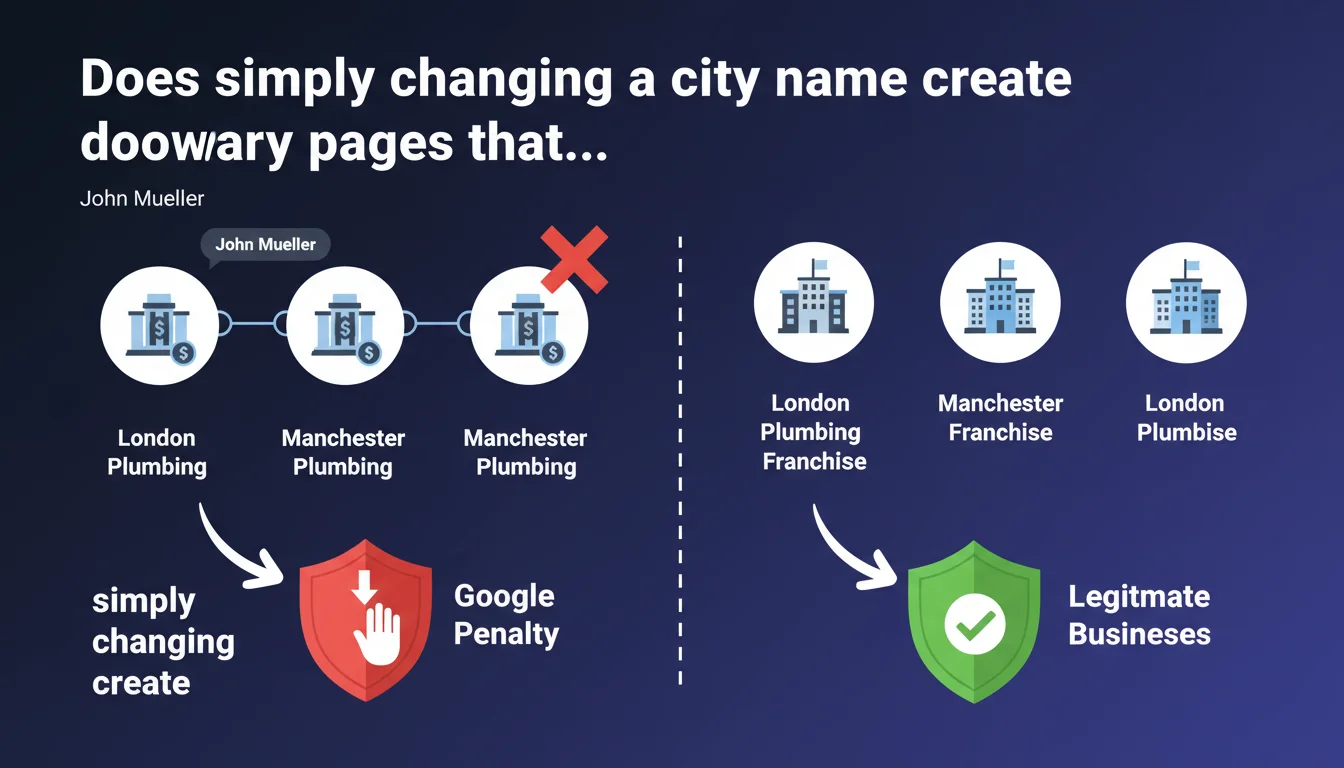
Google considers it doorway pages to create hundreds of near-identical pages by changing just one word (city, street, region) to capture traffic to the same business. Notable exception: franchises where each page represents a real distinct entity with its own premises and services.
What you need to understand
Where is the line between local optimization and spam?
Google draws a clear line: multiplying pages by modifying only a place name for a single business is spam. Intention matters — if the goal is to capture traffic on dozens of local searches without any real infrastructure justifying this geographic presence, it's penalizable.
The nuance lies in the reality of the offering. An agency with an office in Paris that creates 50 pages "plumber in Lille", "plumber in Lyon", "plumber in Marseille" without physically operating in these cities falls under this rule.
Are franchises exempt from this rule?
Yes, and this is a fundamental point. Mueller clarifies that each franchise represents a real distinct business — own premises, local team, dedicated number, services actually delivered on-site. In this case, creating one page per location is legitimate.
The difference from a site that artificially multiplies its pages comes down to the materiality of the point of sale. If behind each URL there is a physical location where a customer can go, Google tolerates the structural repetition inherent to networks.
What are the concrete criteria that distinguish these two situations?
- Real infrastructure: office, store, workshop with verifiable address
- Distinct local contact: dedicated phone number, geolocated form, specific opening hours
- Differentiated content: beyond the place name, local information (precise service areas, named team, customer testimonials from the sector)
- Service intent: the page answers a real customer need rather than serving a traffic capture strategy
SEO Expert opinion
Is this statement consistent with real-world observations?
Let's be honest: Google still tolerates many sites that play with this limit. Directories, comparison sites, aggregators create thousands of city-by-city pages without the penalty systematically falling. The consistency between the statement and real-world application leaves much to be desired.
The problem is that Mueller provides no quantitative threshold. "Hundreds of pages" — but is 50 already too much? 10 with real local content, does that pass? [To verify] on specific volumes, because without concrete numbers, everyone interprets differently.
What gray areas remain in this definition?
Online services without mandatory geographic anchoring blur the lines. An attorney who litigates across France but only has an office in Paris — can they create 20 regional pages if they actually operate in those jurisdictions? Technically no according to Mueller, but the service reality exists.
Another complex case: local search pages for national brands selling through independent resellers. The brand itself has no point of sale, but partners do locally. Creating one page per city becomes a gray area if the link to the reseller is tenuous.
In what cases could this rule be navigated without risk?
Navigated, no. Respected intelligently, yes. If you create local pages with truly differentiated content — local market research, named partnerships, documented case studies, regional events — you move beyond doorway logic even without physical offices.
But concretely? That requires significant editorial investment. Few sites are willing to produce 1500 unique words per city. Hence the temptation of template + city name, which remains a risky bet.
Practical impact and recommendations
How do I audit my local pages to detect doorway risk?
First question to ask yourself: if I hide the city name, are the pages identical? If yes, you're probably in the red zone. Next, verify the depth of local content — location-specific photos, geolocated testimonials, references to local elements.
Also check the conversion rate by page. If certain local pages never generate a contact or visit, that's a signal Google could interpret as a lure to capture traffic without real service intent.
What if my site already relies on this local pages model?
No need to panic immediately — Google doesn't penalize overnight. Start by identifying your highest-potential pages (search volume, conversion rate) and invest in their differentiation. Others, either enrich them progressively or noindex them.
For franchises or real points of sale, ensure each page displays verifiable contact information: clickable Google Maps address, working local phone number, precise opening hours. These signals reassure Google about materiality.
What alternatives if I want to rank across multiple cities without physical offices?
- Create a unique regional hub rather than 20 city pages — then work internal linking toward thematic subsections
- Publish geolocalized editorial content (guides, studies, interviews with local actors) that justifies the place name presence without simulating a point of sale
- Focus on event-based landing pages (trade show, presentation, partnership) that have limited lifespan but real anchoring
- Invest in local paid search to test demand before creating organic pages
- Use Google Business Profile pages if you really operate in these areas, even without an office
The line between local optimization and doorway hinges on the reality of the service behind each page. If the infrastructure, content, and commercial intent are authentic, Google tolerates structural repetition. Otherwise, you're playing with fire.
These strategic decisions — which pages to keep, how to differentiate them, where to invest editorial effort — require an overall vision of your site and its business model. Poorly calibrated, they can destabilize your entire domain. This is precisely the kind of project where the support of a specialized SEO agency can make the difference between a refresh that takes off and a migration that tanks your traffic.
❓ Frequently Asked Questions
Si je crée 10 pages locales avec du contenu unique de 500 mots chacune, suis-je à l'abri ?
Les pages de catégories e-commerce par ville (ex: 'chaussures Paris') sont-elles concernées ?
Combien de pages locales peut-on créer avant que Google considère ça comme du spam ?
Peut-on utiliser un template commun pour toutes les pages locales ?
Les pages locales en noindex échappent-elles à cette règle ?
🎥 From the same video 14
Other SEO insights extracted from this same Google Search Central video · published on 22/03/2022
🎥 Watch the full video on YouTube →
💬 Comments (0)
Be the first to comment.