
Official statement
Other statements from this video 16 ▾
- □ Are JavaScript Web Components really crawlable by Google's bots?
- □ Does Google really require FAQ Schema content to follow a strict presentation format?
- □ Does FAQ Schema Markup Really Guarantee That Your FAQ Snippets Will Show Up in Google?
- □ Should you really avoid duplicating your own content for SEO?
- □ Does Google really see your JavaScript content the way you do?
- □ Does your CMS really penalize your SEO compared to static HTML?
- □ Why aren't your pages getting indexed even though your site is technically flawless?
- □ Why have external user studies become essential for diagnosing quality issues that your team can no longer see?
- □ Should you really trust rel=canonical to control indexation?
- □ Are backlinks pointing to 404 pages really worthless for your SEO?
- □ Does the disavow tool really erase all traces of toxic links from Google's algorithms?
- □ Can an SSL certificate really penalize your search rankings?
- □ Does a progressive multi-domain ranking decline reveal a quality issue rather than a technical one?
- □ Do technical SEO issues really have an immediate impact on your rankings?
- □ Does blocking Google Translate really impact your search rankings?
- □ Can the meta notranslate tag really remove the 'Translate this page' link from Google search results?
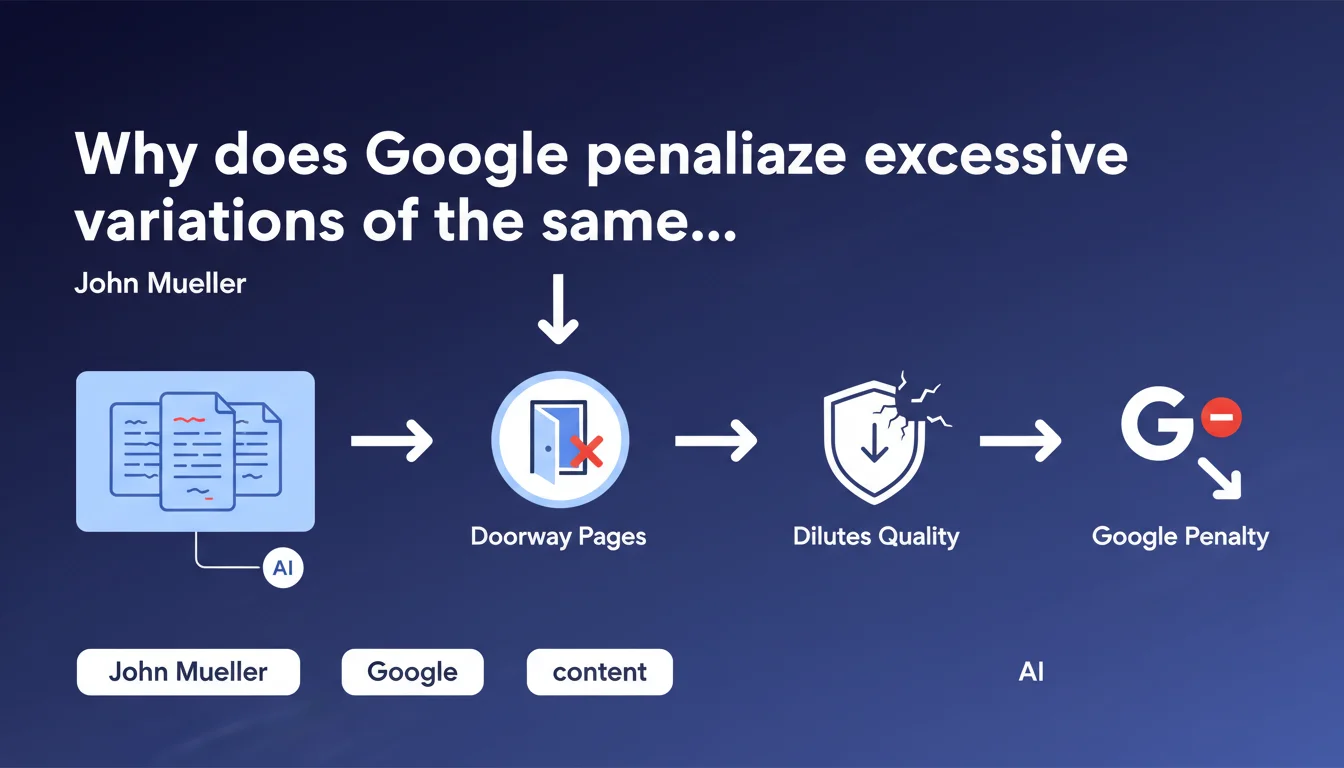
Creating dozens of nearly identical pages by changing only a few words (city, department, product category) constitutes doorway pages according to Google. This practice dilutes the perceived quality of your site instead of strengthening it, and exposes you to manual or algorithmic penalties.
What you need to understand
What exactly does Google mean by "excessive variations"?
Google targets websites that generate hundreds of pages from a common template by modifying only a few variables: city name, postal code, service category. The goal is to capture long-tail traffic on geo-targeted or hyper-specific queries without truly providing differentiated informational value.
The problem isn't variation itself — having a page "Plumber Paris" and "Plumber Lyon" remains legitimate. What raises concerns is the industrial scale and the absence of substantial unique content from one page to another.
Why does Google view this as quality dilution?
From a user perspective, landing on ten interchangeable pages creates a frustrating experience. Google seeks to prevent its SERPs from becoming a catalog of clone pages from the same domain. The algorithm interprets this multiplication as an attempt at ranking manipulation rather than a legitimate editorial effort.
Internally, this also fragments relevance signals: backlinks, engagement, behavioral signals scatter across dozens of URLs instead of concentrating on a few reference pages. The site loses thematic authority in the process.
What's the difference between doorway pages and legitimate localized pages?
The boundary remains fuzzy in Google's phrasing, and that's where it gets tricky. A hotel chain with 50 properties has 50 legitimate pages — each location has its own address, specific services, and customer reviews. Conversely, an SEO consultant who creates 100 pages "SEO Training + [city name]" with the same generic text crosses the red line.
- Criterion #1: Does each page correspond to a real, distinct entity with unique information?
- Criterion #2: Does the user find added value by navigating from one variation to another?
- Criterion #3: Is the volume of pages created proportional to the company's actual activities?
- Criterion #4: Are pages designed for users or to flood Google's index?
SEO Expert opinion
Is this statement consistent with practices observed in the field?
Yes, and it's well documented. Manual actions for doorway pages genuinely exist in Search Console and regularly affect websites — particularly in real estate, home services, and training. Google has even deployed algorithmic filters targeting these architectures, causing sudden traffic drops without prior notification.
That said, enforcement remains inconsistent. Some sites continue ranking with hundreds of minor variations while others get penalized for just dozens of localized pages. Detection likely depends on relative volume, domain age, link profile — in short, a bundle of indicators rather than a fixed threshold. [To verify]: Google has never disclosed a precise ratio between number of variations and site size to trigger a penalty.
What nuances should be added to this rule?
Google's discourse conflates two very different cases. On one side, pure doorway pages: pages created solely to capture clicks and redirect to a main page. On the other, template variations: pages that remain final destinations but offer little differentiation.
Let's be honest: the boundary is as much political as technical. A large corporation can get away with structures Google would penalize a smaller player for. The real underlying criterion seems to be the signal-to-noise ratio — if your site delivers overall value, a few borderline pages slip through; if most of your index consists of these variations, you expose the entire domain.
In which cases does this rule not apply strictly?
Marketplaces, aggregators, and e-commerce sites pose an interpretation challenge. Amazon offers millions of product pages with repetitive structures — but each product remains a distinct entity. Same for real estate listing sites: each property has its own characteristics, even if the template is identical.
The discriminating criterion appears to be the existence of a real object behind the page. If you create a page "SEO Training Marseille" when you have no physical presence or scheduled sessions in Marseille, it's pure doorway. If you actually have a local trainer, scheduled sessions, client reviews specific to that location — the page becomes defensible.
Practical impact and recommendations
What should you concretely do if you already have this structure?
First step: quantitative audit. How many pages fall into this category? What is their actual organic traffic? Often, 80% of these pages capture fewer than 10 visits monthly — they consume crawl budget without ROI. Use Search Console to identify indexed pages that never receive clicks.
Next, segment into three groups: pages to enrich (those already generating traffic deserve truly differentiated content), pages to consolidate (merge nearby geographic variations into one regional page), pages to deindex (noindex or outright removal for valueless URLs). 301 redirects to consolidated pages preserve any link equity.
What mistakes should you avoid when creating new localized pages?
Never launch a massive deployment all at once — Google misinterprets sudden additions of hundreds of similar pages. Prefer a gradual approach: test first 10-15 enriched pages, monitor their performance over 2-3 months, then scale only if results justify the investment.
Another classic pitfall: automated content spinning. Replacing "Paris" with "Lyon" in a text doesn't create real differentiation. Each page must integrate authentic local elements — regional statistics, local partners, events, geo-targeted testimonials. If you can't produce this level of specificity, the page has no reason to exist.
How do you verify your site meets Google's expectations?
- Examine the ratio of indexed pages to pages generating at least one monthly visit — if it exceeds 3:1, you likely have too much dead weight.
- Measure similarity rate between your pages using tools like Copyscape or Siteliner — beyond 70% common content, risk increases.
- Check Search Console for queries where multiple pages of yours cannibalize the same intent — sign that Google struggles to choose.
- Manual test: read 5 of your localized pages side by side. If you yourself struggle to justify why they exist separately, Google will reach the same conclusion.
- Analyze your link profile: if your variations never attract natural backlinks, that signals nobody finds them useful — including Google.
❓ Frequently Asked Questions
Combien de pages localisées peut-on créer sans risquer une pénalité ?
Les pages locales automatiquement générées sont-elles toutes considérées comme doorway pages ?
Peut-on utiliser des templates communs pour des pages localisées sans risque ?
Faut-il désindexer immédiatement toutes les pages similaires en noindex ?
Google peut-il sanctionner tout le site pour quelques dizaines de doorway pages ?
🎥 From the same video 16
Other SEO insights extracted from this same Google Search Central video · published on 08/05/2022
🎥 Watch the full video on YouTube →
💬 Comments (0)
Be the first to comment.