
Official statement
Other statements from this video 14 ▾
- □ Does Google really choose page titles independently of what users actually search for?
- □ Does simply changing a city name create doorway pages that Google will penalize?
- □ Is centralizing your competitive content really better than spreading it across multiple pages?
- □ Discovered but not indexed: Has Google really never crawled these pages at all?
- □ Why Is Google Refusing to Index a Technically Perfect Website?
- □ Should you really trust the recommendations your SEO tools are giving you?
- □ Should you still bother fixing broken redirects years after a migration?
- □ Is switching from a ccTLD to a gTLD really enough to conquer new international markets?
- □ Subdomain or subdirectory: Does Google really have a preference?
- □ Why Do Click Counts Differ Between Page-Level and Query-Level Reports in Search Console?
- □ Do structured data errors really block your pages from being indexed?
- □ Does internal linking really show Google which pages matter most on your site?
- □ Does the target attribute in links really have an impact on Google SEO rankings?
- □ Why are your CSS background images invisible to Google Images?
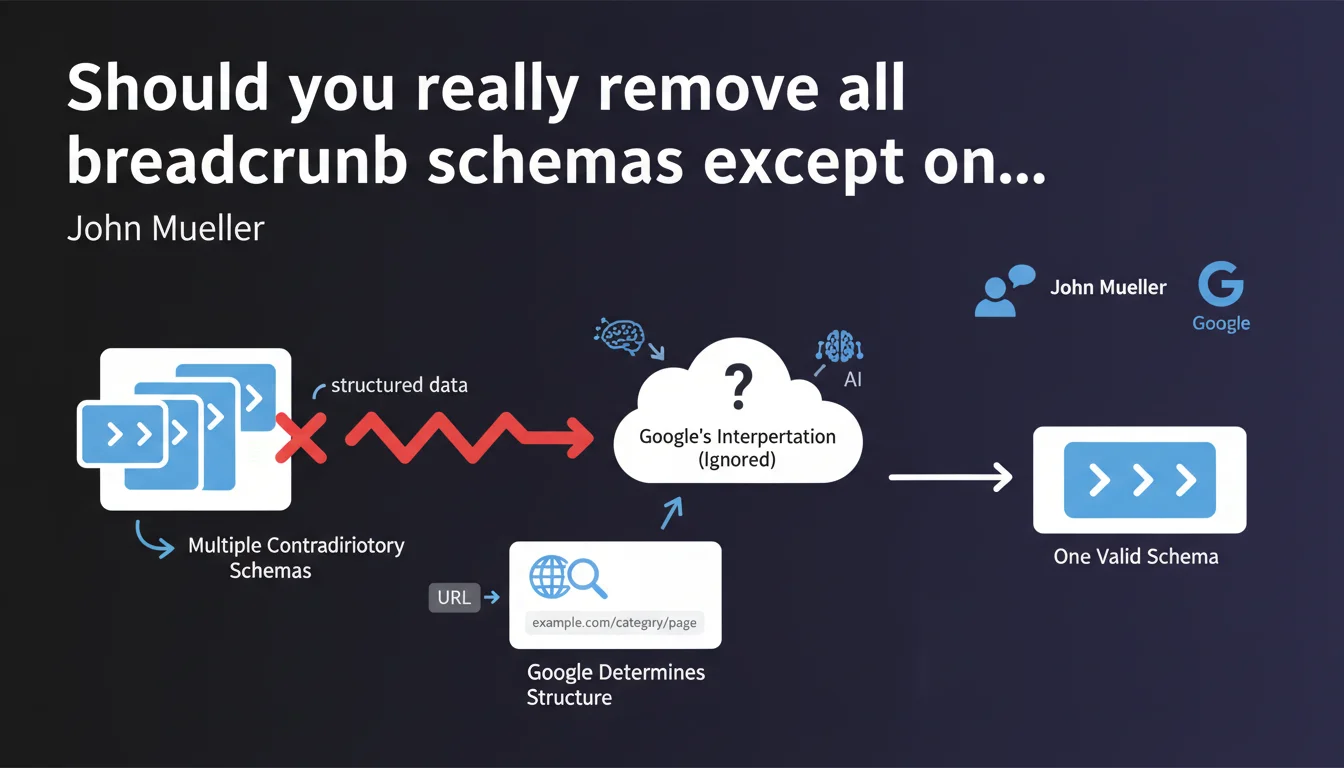
Google ignores all breadcrumb schemas if multiple contradictory versions coexist on the same page. The solution: a single set of breadcrumb structured data per page, even if multiple breadcrumb trails are displayed visually. In case of conflict, Google reconstructs the structure from the URL.
What you need to understand
Why does Google ignore breadcrumbs that are technically valid?
The search engine prioritizes consistency over quantity. When multiple breadcrumb schemas coexist with different structures, Google has no way to determine which one reflects the true hierarchy of your site.
Rather than risk displaying an incorrect path in the SERPs, it neutralizes all markup and falls back on secondary signals like URL architecture. This is a safeguard against spam and careless implementations.
What does "contradictory" concretely mean?
Two breadcrumbs are contradictory if they present different paths to reach the same page. For example: Home > Clothing > Pants versus Home > Men > Pants.
Even if both are technically valid from a business perspective, Google cannot guess which is the canonical reference. Mueller's statement targets these ambiguous situations.
What signals does Google use as a replacement?
Primarily the URL structure. If your URL follows a clear pattern (/men/clothing/pants/), Google reconstructs a breadcrumb trail consistent with that hierarchy.
Internal linking and link anchors also contribute. But these are weaker signals than clean structured data — hence the importance of fixing the problem at the source.
- A single breadcrumb schema per page, even if multiple visual paths exist
- Google prioritizes consistent structured data, otherwise falls back on the URL
- Contradictory breadcrumbs are ignored without exception
- URL structure becomes the reference signal when markup fails
SEO Expert opinion
Is this rule consistent with what we observe in the field?
Completely. For years, audits have shown that sites with multiple breadcrumb schemas rarely see their breadcrumb trails displayed correctly in SERPs.
What's new is the official clarification. Before, many developers assumed Google would choose "the best" breadcrumb — in reality, it ignores them all. This statement ends the speculation.
What nuances should be noted?
Mueller specifically talks about contradictory breadcrumbs, not multiple consistent ones. If you implement the same path multiple times (technical duplicate), it's not optimal but doesn't necessarily trigger the blocking.
The real problem occurs when two diverging paths coexist. In this case — and this is where it gets tricky — the fix isn't in the code: it's making a strategic choice at the organizational level about which hierarchy truly represents your site's architecture.
What if your business requires multiple legitimate classifications?
Typical in e-commerce: a product belongs to multiple categories (men/pants AND clothing/pants). Visually, you can display both paths for UX.
But for markup, choose only one — ideally the one reflecting your canonical URL. The others remain visible in plain HTML, without structured data. Google will understand the context through internal linking.
Practical impact and recommendations
How to identify if your site is affected?
Use Search Console and Google's Rich Results Testing Tool. Look for "Breadcrumb" warnings on your strategic pages.
Inspect the source code: search for "@type": "BreadcrumbList". If you find multiple ones with different structures, the problem is confirmed. Compare the paths — if they diverge, Google ignores them.
What should you do concretely to fix it?
Identify which primary hierarchy you want to push in the SERPs. The one that reflects your target SEO architecture, aligned with your canonical URLs.
Remove all other breadcrumb schemas from the code. If multiple breadcrumb trails remain necessary for UX, keep them in plain HTML without JSON-LD markup.
- Audit all pages with multiple breadcrumb schemas in the code
- Define the canonical hierarchy to push for each page template
- Remove secondary breadcrumb schemas from JSON-LD
- Validate with Google's Rich Results Testing Tool
- Monitor SERPs to verify rich breadcrumb display
- Document the logic to prevent regressions during CMS updates
❓ Frequently Asked Questions
Peut-on afficher plusieurs fils d'Ariane visuels sans markup schema ?
Google choisit-il automatiquement le « meilleur » breadcrumb s'il y en a plusieurs ?
Faut-il aligner le breadcrumb schema avec l'URL ou la navigation principale ?
Que se passe-t-il si deux breadcrumbs identiques sont présents en doublon ?
Les breadcrumbs schema influencent-ils le classement ou seulement l'affichage ?
🎥 From the same video 14
Other SEO insights extracted from this same Google Search Central video · published on 22/03/2022
🎥 Watch the full video on YouTube →
💬 Comments (0)
Be the first to comment.