
Official statement
Other statements from this video 14 ▾
- □ Does Google really choose page titles independently of what users actually search for?
- □ Does simply changing a city name create doorway pages that Google will penalize?
- □ Is centralizing your competitive content really better than spreading it across multiple pages?
- □ Discovered but not indexed: Has Google really never crawled these pages at all?
- □ Why Is Google Refusing to Index a Technically Perfect Website?
- □ Should you really trust the recommendations your SEO tools are giving you?
- □ Should you still bother fixing broken redirects years after a migration?
- □ Is switching from a ccTLD to a gTLD really enough to conquer new international markets?
- □ Subdomain or subdirectory: Does Google really have a preference?
- □ Why Do Click Counts Differ Between Page-Level and Query-Level Reports in Search Console?
- □ Do structured data errors really block your pages from being indexed?
- □ Does the target attribute in links really have an impact on Google SEO rankings?
- □ Should you really remove all breadcrumb schemas except one to avoid confusion?
- □ Why are your CSS background images invisible to Google Images?
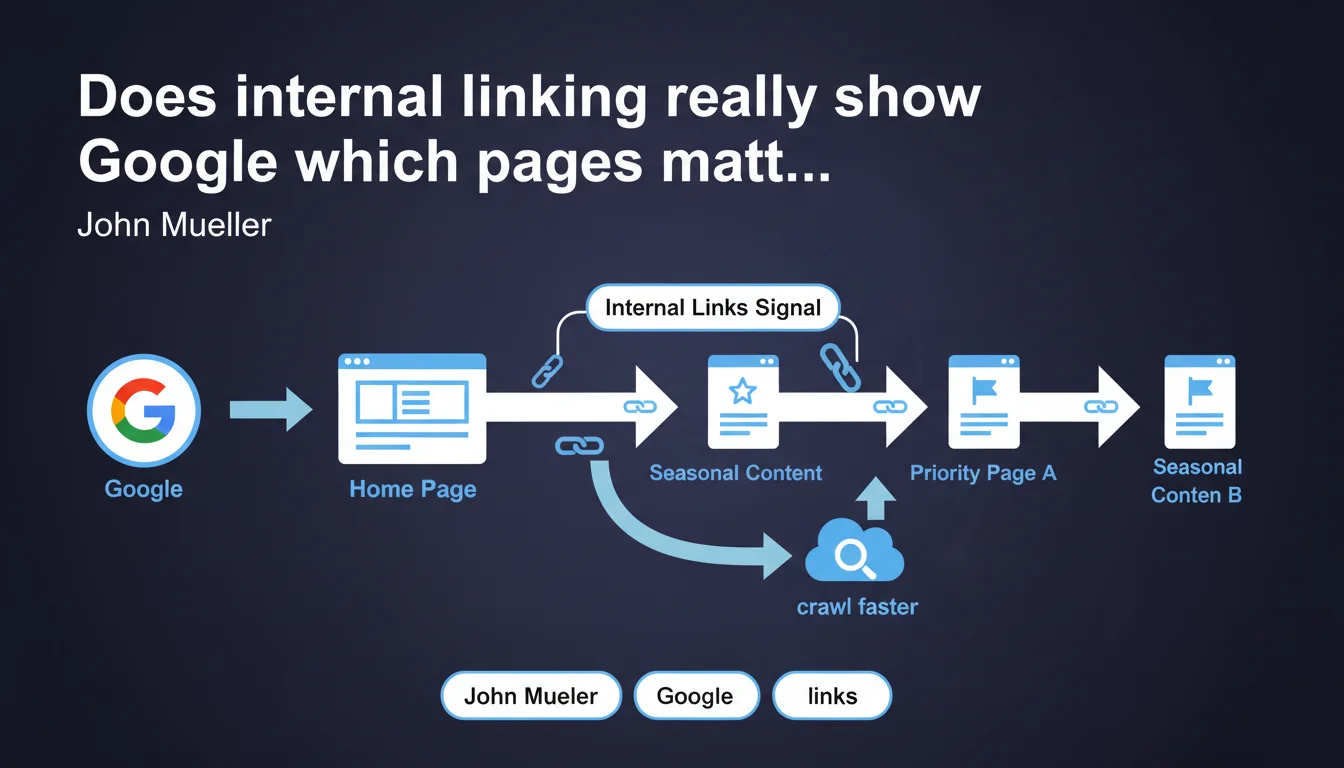
Google uses internal linking as a signal to identify a site's priority pages. The more visible links a page receives from the homepage, the faster it will be crawled and processed as a priority. For seasonal or strategic content, you need to create short link paths from your home page.
What you need to understand
Does Google really read our link architecture?
Mueller's statement confirms what many suspected: internal linking isn't just about SEO juice, it's also a language you speak directly to the bots. When you place a visible link from your homepage to a specific page, you're literally telling Google "this page matters to me".
Since crawl budget is limited, especially on large sites, Google must prioritize. And this prioritization is based partly on click depth and the frequency of internal links. A page with no links or buried 5 clicks deep? It will wait its turn.
Why specifically mention seasonal content?
Timing is everything. If you sell Halloween costumes, there's no point in Google crawling your landing page in January. But in September, you want it to reindex quickly your price updates, inventory, and new collections.
Creating temporary links from the homepage or hot sections of your site sends an urgency signal. Google understands that this page needs to move up in the crawler's queue.
What counts as a "visible link"?
We're talking about classic HTML links, in the page body or main menus — not footer links buried among 200 others. User visibility matters: if a human can't easily see the link, Google will draw less priority signal from it.
Links rendered late by JavaScript, mega-menus closed by default, carousels where the link only appears on the 5th slide — all of this dilutes the message. Be direct.
- Internal linking signals to Google which pages to prioritize for crawling and indexing
- Pages accessible from the homepage are processed faster
- Seasonal content should receive temporary visible links from hot pages
- Click depth and the frequency of internal links determine crawl priority
- A visible link = an HTML link easily identifiable by a human user
SEO Expert opinion
Is this statement consistent with real-world observations?
Yes, and it's actually one of the rare Mueller statements you can validate through A/B testing. Dozens of documented cases show that adding a homepage → strategic page link accelerates that page's crawl within 24-72 hours. Measurable, reproducible effect.
Where it sometimes falls short: on very large sites (e-commerce with millions of products), the internal linking signal isn't always enough. We've seen pages receive 50 internal links from hot categories and remain ignored for weeks. The overall crawl budget of the site also plays a role — and Google never details this factor.
What nuances should we consider?
Mueller speaks of "visible links," but doesn't quantify anything. How many links from the homepage? Is one enough, or do you need to create 5 from different sections? [To verify] — no official data on this.
Another point: the semantic context of the link probably matters as much as its position. A link embedded in a thematically coherent editorial paragraph sends a stronger signal than a link in a generic "Our pages" list. But again, Google remains vague about the relative weight of these signals.
Finally, be careful not to bet everything on the homepage. Thematic hub pages (main categories, strategic landings) also have high internal PageRank and can serve as launch pads. Diversify your internal link sources.
In what cases doesn't this rule apply?
On sites where crawl budget is already saturated by low-quality or duplicate content, adding internal links changes nothing. Google will crawl faster... but noise. Clean up first, optimize later.
Single-page or very small sites (fewer than 50 pages) don't really have a prioritization problem — everything gets crawled quickly anyway. The impact of internal linking there is negligible.
Practical impact and recommendations
What should you do concretely?
Identify your 3-5 strategic pages right now: new product, seasonal landing, freshly updated SEO content. Create for each one a visible link from the homepage — ideally in the editorial body or an editorialized block (not just a footer link).
For seasonal content, integrate these links 2-3 weeks before peak demand. Remove them once the season passes to avoid polluting your architecture year-round. Use a rotating editorial block ("Don't miss this month") to maintain this flexibility.
Audit your average click depth. No strategic page should be more than 3 clicks from the homepage. If it is, rewire your information architecture or add cross-navigation links.
What mistakes to avoid?
Don't create 50 homepage → various pages links. You dilute everything. Less is more. 3-5 strategic links beat 20 "just in case" links.
Avoid pure JavaScript links not rendered server-side, or links hidden by default (closed accordions, inactive tabs). Google can follow them, but the priority signal will be weak. Favor pure HTML, visible on load.
Don't rely solely on the homepage. Main category pages, content hubs — anything with high internal PageRank — can also serve as launch pads. A link from a hot category can be as powerful as a homepage link.
How do you verify your site complies?
Crawl your site with Screaming Frog or Oncrawl. Export the click depth of each URL. Cross-reference with your GA4 or Search Console data to identify strategic pages (traffic, conversions). If an important page is 4+ clicks deep, that's a red flag.
Check in Search Console the crawl frequency of your priority pages. If they're not being crawled at least weekly, strengthen the internal linking from the homepage or hubs.
- Identify 3-5 current strategic pages
- Create visible HTML links from the homepage to these pages
- Audit average click depth (no key pages > 3 clicks)
- Remove seasonal links once the period ends
- Avoid diluting with too many simultaneous "priority" links
- Cross-reference crawl data (Search Console) with business priorities (GA4)
- Favor contextualized editorial links over footer/sidebar
- Verify that strategic links are pure HTML, not hidden in JS
❓ Frequently Asked Questions
Combien de liens internes depuis la homepage faut-il pour qu'une page soit considérée prioritaire ?
Les liens en footer ou sidebar comptent-ils autant que les liens dans le corps de page ?
Faut-il retirer les liens saisonniers une fois la période passée ?
Le maillage interne remplace-t-il le fichier sitemap XML pour prioriser le crawl ?
Quelle profondeur de clic maximale viser pour les pages stratégiques ?
Thematic analysis
🎥 From the same video 14
Other SEO insights extracted from this same Google Search Central video · published on 22/03/2022
🎥 Watch the full video on YouTube →
💬 Comments (0)
Be the first to comment.