
Official statement
Other statements from this video 11 ▾
- □ La documentation SEO de Google est-elle vraiment accessible aux non-experts ?
- □ Peut-on vraiment chiffrer le ROI des Core Web Vitals ?
- □ Pourquoi le trafic SEO stagne-t-il malgré six mois de travail continu ?
- □ Pourquoi votre audit SEO de 500 recommandations est-il inutile sans priorisation ?
- □ Faut-il vraiment tracker toutes vos métriques SEO, même quand ça va mal ?
- □ Pourquoi Google insiste-t-il autant sur la communication régulière avec son SEO ?
- □ Pourquoi un bon prestataire SEO doit-il interroger votre business avant de signer ?
- □ La proactivité dans la communication est-elle vraiment un critère de qualité pour un SEO ?
- □ Pourquoi le SEO échoue-t-il sans l'implication des autres équipes ?
- □ Faut-il vraiment recommander de ne PAS faire de SEO à certains clients ?
- □ Pourquoi un bon consultant SEO ne vous promettra jamais le top 3 Google ?
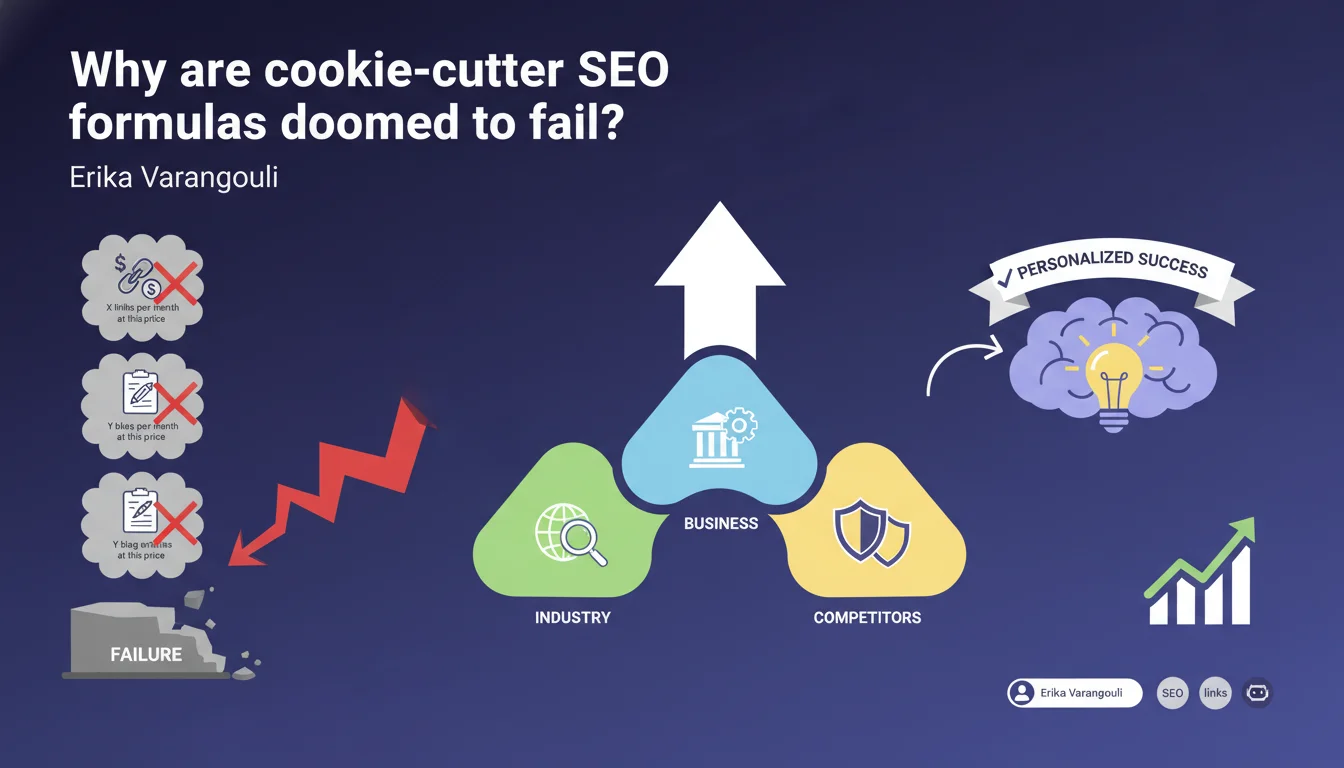
Google makes it clear: standardized SEO services (X links/month, Y articles/month) are ineffective. Ranking requires a customized approach that accounts for your specific business, industry, and competitors. One-size-fits-all recipes simply don't work.
What you need to understand
What exactly does Google have against generic approaches?
Google is targeting standardized SEO services sold as one-size-fits-all packages. Think "10 backlinks per month + 5 optimized articles = rank #1 on Google." This model ignores a fundamental reality: two websites in the same sector can require radically different strategies.
The criticism centers on the lack of personalized diagnostics. A shoe e-commerce store competing against Amazon doesn't have the same needs as a new player in an emerging tech niche. Claiming that the same formula will work for both is either incompetence or dishonesty.
What actually makes an SEO approach genuinely personalized?
Personalization starts with competitive landscape analysis. How many referring domains do your competitors have? What's their content strategy? Their technical architecture? You can't define an action plan without this data.
It continues with understanding your business model. A B2B SaaS site that converts through demos isn't optimized the same way as a media outlet monetizing through display advertising. The KPIs, keyword targets, technical priorities—everything differs.
Why is Google saying this now?
Google doesn't make statements like this by accident. The market is flooded with false prophets offering magic formulas, often automated, sometimes generated by unsupervised AI.
It's also a signal to buyers: if your vendor doesn't ask questions about your business, your goals, your constraints—be wary. Effective SEO requires upfront analysis time, which justifies an initial cost reflecting real expertise.
- Uniform SEO packages (X links + Y content) ignore each project's unique characteristics
- An effective strategy demands competitive analysis and understanding of your business model
- Google warns against vendors who don't customize their approach
- Initial diagnostics should justify recommended actions, not the other way around
SEO Expert opinion
Does this position actually reflect the winning practices observed in the field?
Let's be honest: yes, largely. Sites that progress sustainably in the SERPs all benefit from a customized strategy. I've seen clients stall for months with "20 backlinks/month" services only to take off after a proper audit revealing their real problem was… massive keyword cannibalization.
Conversely, some ultra-competitive sectors genuinely require significant production volume. But even there, that volume comes from analysis—not from a pre-built package. Volume becomes a consequence, not a starting point.
Where does this declaration become too vague to be actionable?
Google doesn't define what "sufficiently personalized" looks like. How many hours of audit? What minimum deliverables prove personalization? [To verify]—this declaration remains a guiding principle, not a specification.
Practically? A vendor can easily dress up a standardized service in personalization veneer (a generic 3-page audit, then identical actions for everyone). How does a non-expert client tell the difference? Google provides no objective criteria.
Are mixed approaches viable?
Some SEO tasks are genuinely scalable: recurring technical fixes, on-page optimizations following proven templates, link-building in stable niches. Don't throw the baby out with the bathwater.
The real question: is the overall strategy personalized, even if some tactical execution is standardized? A good vendor can use proven processes for efficiency, as long as strategic direction stays customized. Google criticizes uniformity of thinking, not necessarily of execution.
Practical impact and recommendations
How do you tell the difference between genuine personalized services and a disguised package?
Ask specific questions during initial briefings. If the vendor immediately pulls out a proposal with round numbers ("15 articles + 10 backlinks"), run. A real approach starts with "I need 2 weeks to analyze your situation before proposing anything."
Ask to see an example competitive audit (anonymized). If they show you an Excel sheet with 3 competitors and 5 metrics—that's thin. A proper audit compares 10-15 criteria (link profiles, architecture, editorial strategy, technical performance) across at least 5-10 direct competitors.
What mistakes should you avoid when buying SEO?
Don't be seduced by the apparent simplicity of packaged formulas. "$500/month for 3 optimized articles" seems transparent—but often hides total misunderstanding of your real needs.
Avoid comparing prices alone. Two quotes at $2000/month aren't equal if one includes 40 hours of monthly strategic analysis and the other just 10 hours of mechanical content production. Check the time breakdown: strategy vs execution.
- Demand a preliminary audit before any commitment (paying for it is normal)
- Request a personalized roadmap with justification for each recommended action
- Verify the vendor analyzes your specific competitors, not "the market in general"
- Confirm proposed KPIs match your business model (conversions, revenue, not just traffic)
- Refuse any commitment without an initial analysis phase of at least 2-4 weeks
- Compare methodologies, not just prices
Google reminds everyone of an obvious truth many forget: effective SEO is custom tailoring, not ready-to-wear. Every business has constraints, opportunities, blind spots—ignoring this reality condemns you to mediocrity.
These personalized optimizations demand sharp expertise and substantial analysis time that not all internal teams possess. Working with an SEO agency that genuinely practices customization—with senior consultants able to challenge your strategy—can be the difference between stalling on page 3 and capturing qualified traffic. But only if you choose a partner who starts by listening instead of selling.
❓ Frequently Asked Questions
Les packages SEO mensuels fixes sont-ils toujours une mauvaise idée ?
Comment justifier un budget SEO sans savoir à l'avance combien de liens ou d'articles seront produits ?
Un petit site peut-il se permettre une approche personnalisée ou est-ce réservé aux gros budgets ?
Les outils SEO automatisés contredisent-ils cette recommandation de personnalisation ?
Comment un prestataire peut-il standardiser ses process tout en restant personnalisé ?
🎥 From the same video 11
Other SEO insights extracted from this same Google Search Central video · published on 19/09/2024
🎥 Watch the full video on YouTube →
💬 Comments (0)
Be the first to comment.