
Official statement
Other statements from this video 11 ▾
- □ La documentation SEO de Google est-elle vraiment accessible aux non-experts ?
- □ Peut-on vraiment chiffrer le ROI des Core Web Vitals ?
- □ Pourquoi le trafic SEO stagne-t-il malgré six mois de travail continu ?
- □ Pourquoi votre audit SEO de 500 recommandations est-il inutile sans priorisation ?
- □ Faut-il vraiment tracker toutes vos métriques SEO, même quand ça va mal ?
- □ Pourquoi Google insiste-t-il autant sur la communication régulière avec son SEO ?
- □ Pourquoi un bon prestataire SEO doit-il interroger votre business avant de signer ?
- □ Pourquoi les formules SEO clés en main sont-elles vouées à l'échec ?
- □ La proactivité dans la communication est-elle vraiment un critère de qualité pour un SEO ?
- □ Pourquoi le SEO échoue-t-il sans l'implication des autres équipes ?
- □ Pourquoi un bon consultant SEO ne vous promettra jamais le top 3 Google ?
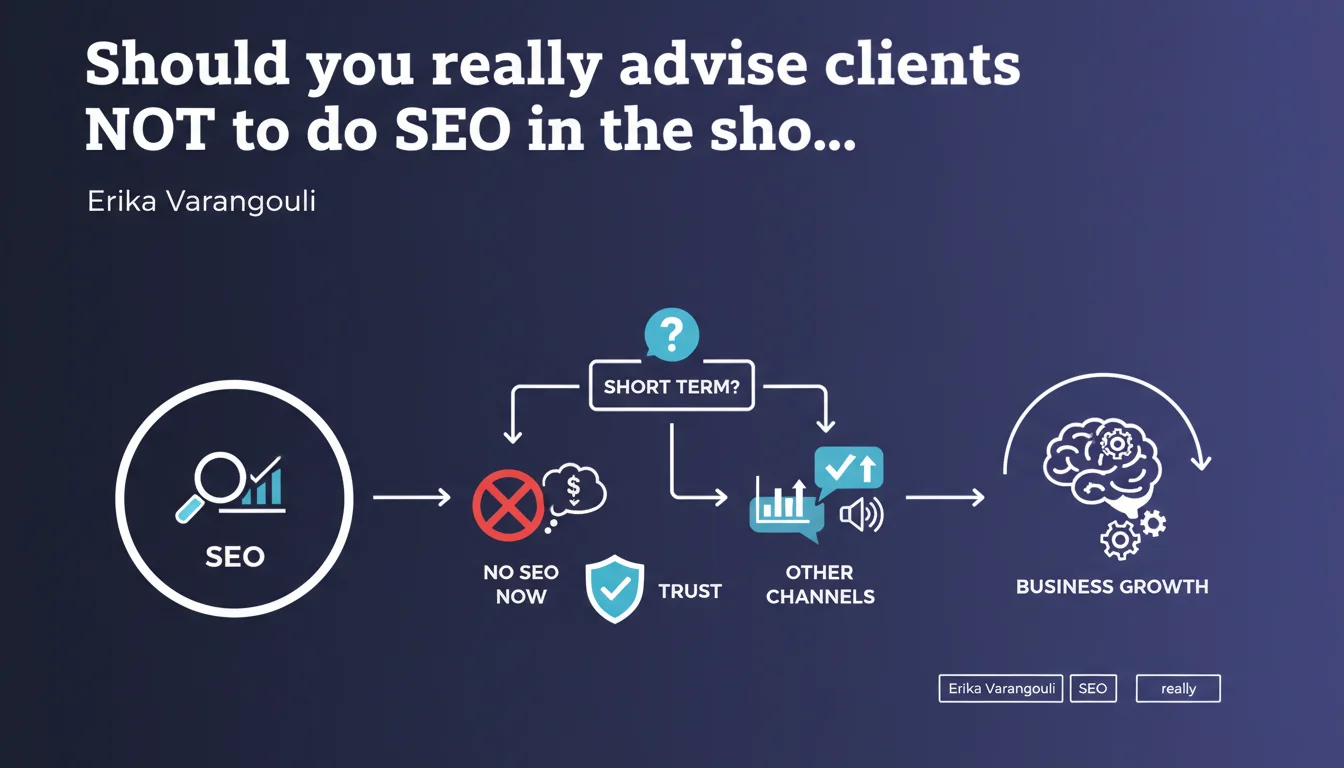
An SEO consultant who advises against SEO in the short term and redirects toward other business priorities isn't losing a contract — they're gaining credibility. Google values this holistic approach that places SEO within a broader strategy rather than as a universal miracle solution.
What you need to understand
Why does this statement contradict the classic image of the SEO consultant?
Traditionally, an SEO consultant is paid to... do SEO. Recommending against immediate investment in organic search looks like commercial suicide. Yet Erika Varangouli points to a revealing paradox: this honesty is precisely what distinguishes an expert from a service vendor.
The nuance lies in timing. A site in the product development phase, without a stabilized offering or capacity to absorb qualified traffic, will gain far more by investing in CRO or infrastructure than by pushing link-building campaigns. SEO doesn't create value on a flawed product — it amplifies what already exists.
What does "looking at other channels" really mean for an SEO professional?
It's not about becoming an expert in paid advertising or social content strategy. The idea is to diagnose the client's digital maturity before prescribing an SEO solution. If conversion rates are catastrophic, if user experience breaks down at every step, or if the value proposition remains unclear, injecting organic traffic is like filling a leaky bucket.
Concretely? A good SEO asks questions about business objectives, available resources (technical, editorial, budgetary), and identifies structural blockers. If the platform can't handle intensive crawling or if no editorial team exists, it's better to address these foundations before launching an ambitious content strategy.
Is this stance really a "signal of trust" or a luxury for well-established consultants?
Both, probably. A freelancer starting out will struggle to refuse contracts — real commercial pressure exists. But for an experienced consultant or established agency, this strategic candor becomes a powerful differentiator. It signals expertise that goes beyond tactical execution to enter strategic advisory territory.
Google values this approach because it reduces unrealistic expectations and client disappointment that ultimately harms SEO's credibility as a discipline. A client who invests €50k in SEO on a poorly built site and gets mediocre results won't say "my site was bad" — they'll say "SEO doesn't work".
- SEO is not a miracle solution applicable at every stage of a digital business's lifecycle
- Diagnosing digital maturity before selling SEO services prevents foreseeable failures
- A consultant who redirects toward other priorities (CRO, UX, technical infrastructure) gains strategic credibility
- This stance requires sufficient financial independence to turn down short-term contracts
SEO Expert opinion
Is this statement consistent with what we observe in practice?
Yes and no. In large agencies or with senior consultants, this approach is indeed valued — but rarely applied systematically. Commercial pressure, even in mature structures, often pushes toward accepting suboptimal engagements. The pitch "we'll start with light technical SEO and see how it goes" becomes a compromise to close a deal without overpromising.
In practice, the difference comes mainly through rigorous initial qualification. The best consultants spend 2-3 hours on preliminary audits before even discussing pricing. They ask about resources, quantified objectives, content production capacity, and technical velocity. If the answers reveal structural blockers, they say so — even at the risk of losing the contract. But this honesty creates trust capital that generates referrals and returning clients when timing becomes favorable.
In what cases does this rule absolutely not apply?
When SEO is already an active disaster. If a site is losing 40% of its organic traffic because of a botched migration, an algorithm penalty, or massive keyword cannibalization, there's no "let's wait until other priorities are handled." SEO urgency becomes the absolute priority.
Another exception: mature e-commerce sites with existing catalog and proven demand. Even if conversion rates are average, fixing indexing errors, optimizing rich snippets, or restructuring internal linking can unlock quick, measurable gains. In this context, SEO isn't amplifying a problem — it's fixing obvious leaks.
Finally, projects with a seasonal window. If a tourism client contacts you in March for summer season, telling them "come back next year after you've reworked your UX" isn't strategic advice — it's blindness. SEO must adapt to your client's real business constraints.
What nuances should be added to this idealized view of the "good consultant"?
This statement assumes the SEO consultant has a holistic view of the client's business, which is rarely true in practice. Many consultants work within limited scope, without access to conversion data, product roadmaps, or budget decisions. Hard to recommend "don't invest in SEO now" when you lack credibility to comment on other channels.
Moreover, this stance works mainly in B2B or for large accounts where decision cycles are long and commercial relationships extend over time. In SMBs or mass-market e-commerce, clients often expect quick, operational answers — not a three-month strategic audit before knowing if you can help.
Practical impact and recommendations
How can you implement this approach in your consulting practice without shooting yourself in the foot?
Start by building a pre-qualification questionnaire that you send before any deep commercial meeting. Quantified objectives, available resources (dev, editorial, budget), traffic history, current conversion capacity. If the answers reveal obvious red flags — zero editorial resources for a content marketing project, frozen technical infrastructure, conversion rates below 0.5% — you already have a foundation to guide the discussion.
Next, propose a paid strategic audit phase before any long-term engagement. 2-3 billable days to diagnose digital maturity, identify blockers, and prioritize initiatives. This service serves dual purpose: it lets you properly qualify the need, and it credibilizes your advisory approach with the client. If the audit concludes SEO isn't the priority, you bill it anyway — and recommend the right resources to address real problems.
What mistakes should you avoid when redirecting a client toward other priorities?
Never say "you don't need SEO" without offering a concrete alternative. If the problem is UX, recommend an expert. If it's content production, point to editorial agencies. Otherwise, you look like someone refusing work without adding value — and that kills future referrals.
Also avoid the trap of endless free advice. Some consultants spend hours explaining why clients should first redesign their conversion funnel, optimize CRO, rethink positioning... without ever billing for that time. Result: client takes the advice, hires other vendors, and you've gained nothing — neither financially nor in relationship capital.
Finally, stay vigilant about re-engagement timing. If you tell a client "come back in 6 months after you've fixed X and Y," make sure you maintain contact. A simple quarterly email asking where they stand is enough. Otherwise, they'll contact a competitor when ready — and your initial honesty will only have educated the market for someone else.
What concrete steps ensure you can apply this stance without hurting profitability?
- Build a pre-qualification questionnaire sent before any substantial commercial discussion
- Propose a paid strategic audit phase (2-3 days) to diagnose digital maturity before any long-term mission
- Maintain a partner network (CRO, UX, dev, editorial) to redirect clients when SEO isn't the immediate priority
- Bill systematically for strategic advice, even if it results in short-term non-recommendation of SEO
- Set up automated quarterly follow-up with redirected prospects to stay present when timing becomes favorable
- Document well-argued refusal cases to use as commercial case studies (anonymized) — it strengthens expert positioning
❓ Frequently Asked Questions
Est-ce que refuser un client pour des raisons stratégiques ne revient pas à perdre du chiffre d'affaires inutilement ?
Comment facturer un conseil qui consiste à dire au client de ne pas investir dans le SEO maintenant ?
Dans quels cas le SEO reste-t-il prioritaire même si d'autres canaux sont défaillants ?
Comment maintenir le lien avec un client qu'on a redirigé vers d'autres priorités ?
Est-ce que cette approche fonctionne aussi pour les petites agences ou uniquement pour les consultants seniors établis ?
🎥 From the same video 11
Other SEO insights extracted from this same Google Search Central video · published on 19/09/2024
🎥 Watch the full video on YouTube →
💬 Comments (0)
Be the first to comment.