
Official statement
Other statements from this video 11 ▾
- □ La documentation SEO de Google est-elle vraiment accessible aux non-experts ?
- □ Peut-on vraiment chiffrer le ROI des Core Web Vitals ?
- □ Pourquoi le trafic SEO stagne-t-il malgré six mois de travail continu ?
- □ Pourquoi votre audit SEO de 500 recommandations est-il inutile sans priorisation ?
- □ Faut-il vraiment tracker toutes vos métriques SEO, même quand ça va mal ?
- □ Pourquoi Google insiste-t-il autant sur la communication régulière avec son SEO ?
- □ Pourquoi les formules SEO clés en main sont-elles vouées à l'échec ?
- □ La proactivité dans la communication est-elle vraiment un critère de qualité pour un SEO ?
- □ Pourquoi le SEO échoue-t-il sans l'implication des autres équipes ?
- □ Faut-il vraiment recommander de ne PAS faire de SEO à certains clients ?
- □ Pourquoi un bon consultant SEO ne vous promettra jamais le top 3 Google ?
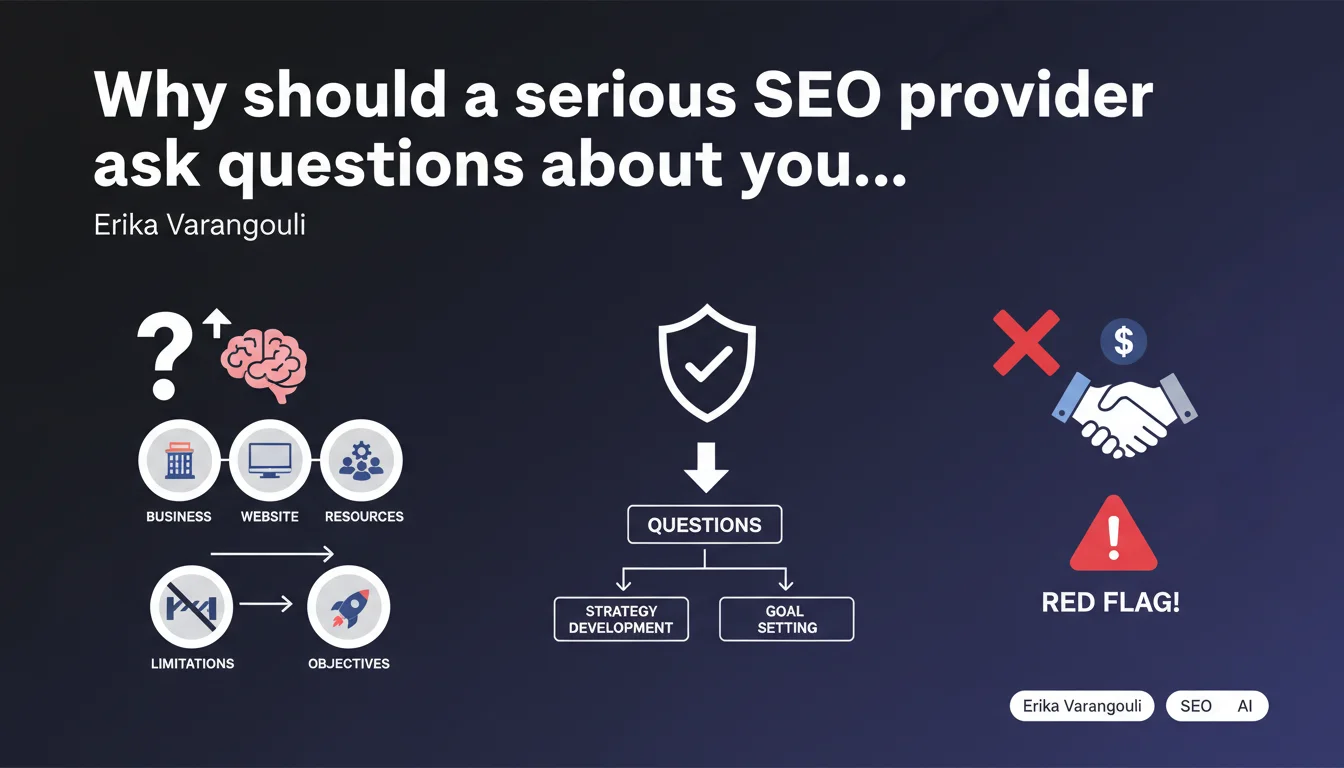
Google emphasizes that a serious SEO provider first asks questions about the business, website, resources, and objectives before proposing a contract. The absence of this audit and understanding phase is a major red flag that reveals a standardized and ineffective approach.
What you need to understand
Why does Google insist on this onboarding phase?
The statement aims to protect businesses from opportunistic SEO providers who sell off-the-shelf solutions without prior analysis. Google knows that these uniform approaches often generate penalties or zero results.
Effective SEO relies on a deep understanding of the business context: industry, competition, technical constraints, budget, timeline. It's impossible to build a coherent strategy without this data.
What questions should a good provider ask?
The initial audit covers several dimensions. First, the business model: B2B or B2C, sales cycle, average order value, seasonality. Next, the state of the website: CMS, technical stack, penalty history, existing architecture.
Available resources also matter — internal team, content creation capacity, development budget. Not to mention objectives: traffic growth, conversions, brand positioning.
- A serious provider questions the business model and commercial objectives
- They audit the technical architecture and SEO history of the site
- They evaluate internal resources (team, budget, skills)
- They identify constraints and limitations (technical, organizational, budgetary)
- They clarify expectations and timeline before any proposal
How does this approach differ from standardized practices?
Low-cost agencies or unscrupulous freelancers apply the same recipes everywhere: same silo structure, same on-page optimizations, same backlink lists. That only works by accident.
A personalized SEO strategy adjusts priorities based on context. A niche e-commerce doesn't have the same needs as a media outlet or corporate website. Onboarding serves precisely to calibrate the approach.
SEO Expert opinion
Does this recommendation really reflect field practices?
Yes, but not everywhere. Serious agencies systematically go through a free or paid audit phase before any proposal. It's often even a commercial argument — showing you're not selling hot air.
However, many providers on platforms like Fiverr or Malt offer standardized "SEO packages". Result: generic reports, useless optimizations, sometimes even counterproductive ones. Google is clearly targeting this segment.
What nuances should be added to this statement?
Sometimes, a client has neither the time nor the skills to answer a detailed questionnaire. In this case, onboarding can happen progressively — first a quick technical audit, then discussions over the weeks.
Another point: certain sectors (SaaS, finance, healthcare) have specific regulatory or technical constraints. A provider who doesn't identify them from the start risks proposing impossible actions. [To verify]: Google doesn't clarify whether this onboarding phase should be free or paid — this ambiguity leaves room for abuse.
In what cases does this rule not fully apply?
For one-off interventions (HTTPS migration, 404 error correction, speed optimization), an exhaustive questionnaire can be excessive. The key is understanding the immediate context, not redoing the entire business plan.
Similarly, a recurring client who has been working with you for years doesn't need a new onboarding for each mission. The relationship of trust and understanding of context are already established.
Practical impact and recommendations
What should you concretely do if you're looking for an SEO provider?
Before signing, demand an audit or discovery phase. If the provider refuses or downplays this step, run away. A good professional spends at minimum 2-3 hours analyzing your site and market before any proposal.
Verify that the provider asks questions about your business model, objectives, constraints. If they propose a "standard package" without customization, it's a major red flag.
What mistakes should you avoid when selecting a provider?
Don't be seduced by guaranteed results promises ("first page in 30 days"). A serious SEO professional never guarantees specific positions — too many external variables come into play.
Also avoid providers who only talk about backlink volume or keywords. Modern SEO relies on relevance, user experience, technical aspects. Vanity metrics (DA, PA) are no longer enough.
- Request a free or paid preliminary audit before any proposal
- Verify that the provider questions your business, objectives, and constraints
- Demand a personalized strategy, not a standard package
- Be wary of result guarantees or unrealistic promises
- Prefer providers who discuss UX, technical aspects, and content, not just backlinks
- Ask for verifiable references in your industry
These audits and customization require specialized expertise and time. If you don't have the internal resources to pilot this process, hiring a specialized SEO agency allows you to benefit from tailored support, an in-depth diagnosis, and a strategy calibrated to your actual challenges.
❓ Frequently Asked Questions
Un audit SEO initial doit-il toujours être payant ?
Combien de temps dure une phase d'onboarding typique ?
Quels documents faut-il préparer pour faciliter l'onboarding ?
Un prestataire peut-il refuser une mission après l'onboarding ?
Comment vérifier la qualité d'un audit initial ?
🎥 From the same video 11
Other SEO insights extracted from this same Google Search Central video · published on 19/09/2024
🎥 Watch the full video on YouTube →
💬 Comments (0)
Be the first to comment.