
Official statement
Other statements from this video 11 ▾
- □ La documentation SEO de Google est-elle vraiment accessible aux non-experts ?
- □ Peut-on vraiment chiffrer le ROI des Core Web Vitals ?
- □ Pourquoi le trafic SEO stagne-t-il malgré six mois de travail continu ?
- □ Pourquoi votre audit SEO de 500 recommandations est-il inutile sans priorisation ?
- □ Faut-il vraiment tracker toutes vos métriques SEO, même quand ça va mal ?
- □ Pourquoi Google insiste-t-il autant sur la communication régulière avec son SEO ?
- □ Pourquoi un bon prestataire SEO doit-il interroger votre business avant de signer ?
- □ Pourquoi les formules SEO clés en main sont-elles vouées à l'échec ?
- □ La proactivité dans la communication est-elle vraiment un critère de qualité pour un SEO ?
- □ Pourquoi le SEO échoue-t-il sans l'implication des autres équipes ?
- □ Faut-il vraiment recommander de ne PAS faire de SEO à certains clients ?
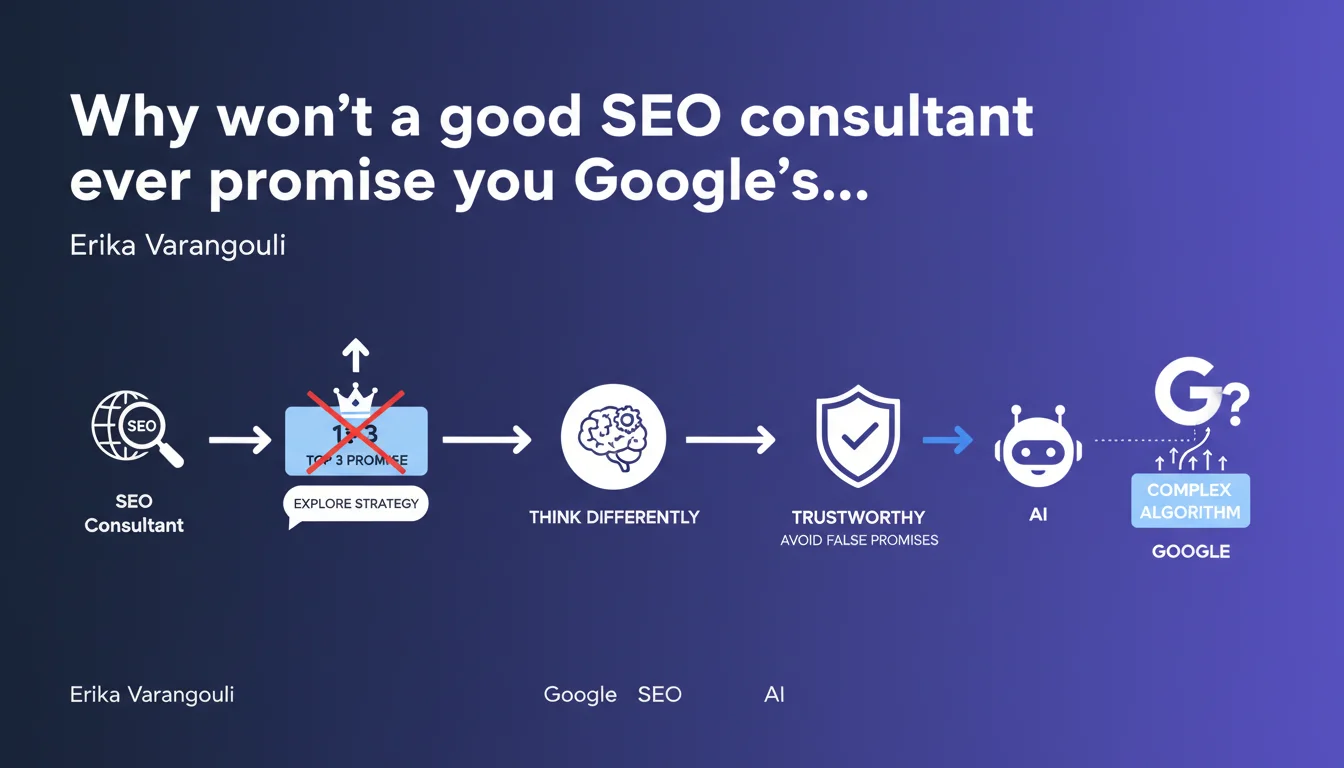
Google warns that promises of specific rankings (number 1, top 5, top 10) are a major red flag. A true SEO professional explains how to rethink your approach rather than guarantee positions that depend on hundreds of factors beyond their control. This is a warning against agencies that sell dreams without solid methodology.
What you need to understand
Why does Google warn against ranking promises?
Search algorithms integrate hundreds of signals in constant evolution. No consultant, however skilled, controls all these parameters — nor unexpected updates, nor your competitors' actions, nor the volatility of the advertising market that impacts SERPs.
Promising a specific position is to ignore this complexity. It's either incompetence or an aggressive sales tactic to sign a contract. Google is clear about it: run away from these promises.
What does "thinking differently" in SEO mean?
A serious consultant doesn't sell a result but a methodology and strategic vision. He analyzes your business objectives, identifies qualified traffic opportunities, optimizes user experience and builds a lasting architecture.
Concretely? He explains why targeting "lawyer Paris" in position 1 might make no sense if your firm lacks capacity to absorb new clients. Or why aiming for top 10 on an informational keyword won't generate conversions. The real value lies in alignment between search intent and business objectives.
Are ranking promises always illegitimate?
Important nuance: on ultra-niche queries with zero competition, yes, you can quickly reach high positions. But that's not what Google is targeting here.
The problem occurs when an agency guarantees top 3 on "car insurance" or "plumber New York" without knowing your budget, resources, or your site's technical state. It's mathematically impossible to promise without lying.
- Rankings depend on uncontrollable factors (competition, algorithm updates, seasonality)
- A good SEO sells a methodology, not a fixed position in results
- Beware of guaranteed figures without thorough prior audit
- The real question isn't "will I be first?" but "will I attract the right traffic and convert?"
SEO Expert opinion
Is Google's warning consistent with market practices?
Absolutely. Over 15 years, I've seen many victims of agencies that promised the moon. Result? Contracts signed on unrealistic hopes, budgets wasted, no measurable ROI.
What Google doesn't say explicitly but every practitioner knows: some agencies use grey hat or black hat techniques to keep their promises short-term, before the site gets penalized. Others optimize for hollow KPIs — rising average position, but unqualified traffic that never converts.
What nuances should be added to this statement?
Google remains intentionally vague on one point: there are contexts where ranking objectives make sense. In local SEO on less competitive markets, or for brands with strong authority seeking to optimize existing positions, talking about top 3 or top 5 isn't delusional.
Let's be honest — the difference between a good consultant and a charlatan doesn't lie solely in the absence of numerical promises. It lies in transparency about risks, timelines and conditions necessary to reach these positions. An expert can say: "on this term, with 6 months of work and this budget, we're aiming for top 10" — that's different from guaranteeing "you'll be number 1".
In which cases doesn't this rule fully apply?
On technical overhaul projects where a site loses positions due to glaring errors (misconfigured canonicals, JS blocking indexation, etc.), recovering lost positions is predictable. It's not a "ranking promise" but a correction of anomalies.
Similarly, in programmatic SEO on long-tail queries with low competition, results are statistically predictable if execution is clean. But again, that's not what dream-sellers are targeting when they promise top 3 on "lawyer".
Practical impact and recommendations
What should you do concretely when facing an SEO provider who promises specific rankings?
First reaction: ask precise questions. Demand methodology, timelines, identified risks, resources needed on your side. If the salesperson dodges or stays vague, immediate red flag.
Require a free or paid audit before any result promise. No serious consultant can commit without knowing the site's technical state, backlink profile, real competition and your content production capacity.
What criteria should you use to evaluate a serious SEO provider?
A good consultant talks to you about qualified traffic, conversion rates, ROI — not just rankings. He contextualizes each KPI based on your industry and business objectives.
He mentions risks: "If Google rolls out an update targeting your sector, we could temporarily lose positions. Here's how we manage that." This transparency is a sign of professional maturity.
How do you structure an SEO contract to avoid disappointments?
Favor measurable tiered objectives: organic traffic increase of X%, click-through rate improvement on specific pages, bounce rate reduction, etc. These KPIs better reflect work quality than a volatile position.
Include quarterly review clauses with transparent reporting. If results stagnate, the provider must explain why and adjust strategy — not hide behind "Google changed its algorithm".
- Request technical and competitive audit before any contract signature
- Demand business objectives (qualified traffic, conversions) rather than fixed positions
- Check client references and request documented case studies
- Run from guaranteed results promises without prior context analysis
- Prioritize consultants who discuss methodology, risks and necessary resources
- Negotiate transparent reporting with KPIs aligned to your business goals
❓ Frequently Asked Questions
Un consultant SEO peut-il garantir une amélioration du trafic sans promettre de positions ?
Pourquoi les agences continuent-elles à promettre le top 10 si c'est un red flag ?
Existe-t-il des cas où viser une position spécifique a du sens en SEO ?
Comment différencier une agence sérieuse d'un vendeur de rêve en SEO ?
Que faire si j'ai signé un contrat basé sur des promesses de classement irréalistes ?
🎥 From the same video 11
Other SEO insights extracted from this same Google Search Central video · published on 19/09/2024
🎥 Watch the full video on YouTube →
💬 Comments (0)
Be the first to comment.