
Official statement
Other statements from this video 11 ▾
- □ Peut-on vraiment chiffrer le ROI des Core Web Vitals ?
- □ Pourquoi le trafic SEO stagne-t-il malgré six mois de travail continu ?
- □ Pourquoi votre audit SEO de 500 recommandations est-il inutile sans priorisation ?
- □ Faut-il vraiment tracker toutes vos métriques SEO, même quand ça va mal ?
- □ Pourquoi Google insiste-t-il autant sur la communication régulière avec son SEO ?
- □ Pourquoi un bon prestataire SEO doit-il interroger votre business avant de signer ?
- □ Pourquoi les formules SEO clés en main sont-elles vouées à l'échec ?
- □ La proactivité dans la communication est-elle vraiment un critère de qualité pour un SEO ?
- □ Pourquoi le SEO échoue-t-il sans l'implication des autres équipes ?
- □ Faut-il vraiment recommander de ne PAS faire de SEO à certains clients ?
- □ Pourquoi un bon consultant SEO ne vous promettra jamais le top 3 Google ?
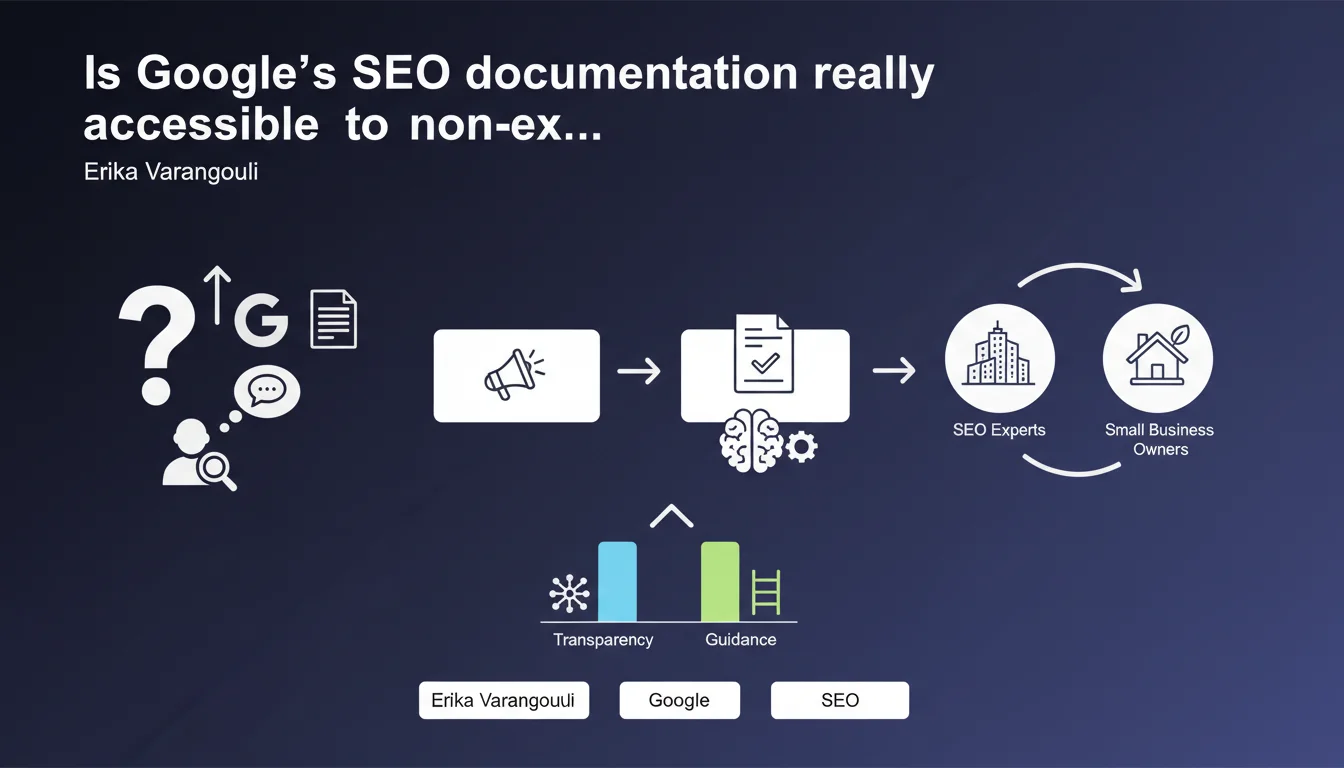
Google claims to have made its SEO documentation more transparent and accessible, now targeting small business owners without technical expertise. This evolution aims to democratize SEO best practices beyond the circle of specialists. The question remains whether this simplification sacrifices the precision necessary for professionals.
What you need to understand
What does this documentary openness from Google really mean?
Google has historically published SEO guidelines, but their technical complexity made them poorly exploitable for non-initiates. This statement marks a turning point: the goal is to make the documentation comprehensible to a wider audience, including SMEs/SMBs that manage their site without SEO competencies.
Concretely, this translates into a reformulation of recommendations in less jargon-heavy language, more concrete examples, and a more pedagogical documentary structure. The stated intention? Reduce the barrier to entry so everyone can apply the fundamentals without going through a consultant.
Why this transparency approach now?
Several factors explain this positioning. First, the proliferation of dubious-quality SEO content on the web creates confusion. By centralizing clear and official documentation, Google attempts to regain control of the discourse on best practices.
Then there's an economic dimension. The more small sites respect technical and editorial standards, the better the overall quality of the index. It's win-win: Google saves crawl budget on poorly built sites, owners improve their visibility.
What are the risks of over-simplification?
Vulgarizing also means reducing nuance. A site owner who reads "create useful content" might think they've understood everything, while Google's notion of usefulness covers dozens of implicit criteria: depth, freshness, authority, semantic structure, etc.
The danger is that this accessibility generates false confidence. People apply basic recipes thinking they're compliant, without grasping the subtleties that make the difference between page 1 and page 3. Real professionals know how to read between the lines.
- Official documentation now oriented towards a non-expert audience
- Language simplification to democratize best practices
- Risk of excessive vulgarization that masks the real complexity of SEO
- Google's intention: improve overall index quality by guiding small players
- Usefulness for pros: limited, except for briefing clients or non-technical teams
SEO Expert opinion
Does this simplified documentation really change the game for professionals?
Let's be honest: SEO experts won't learn much from this vulgarized documentation. What's useful, however, is having an official reference to share with clients who contest certain recommendations. "It's not me saying it, it's Google" — that sometimes helps unblock situations.
But fundamentally, nothing new. The foundational guidelines haven't changed in years. What shifts is the weighting of signals and the subtleties of interpretation — and that, Google doesn't document transparently. So yes, it's good for beginners. No, it doesn't replace field experience.
Should we be wary of this displayed transparency?
Always. Google communicates what suits them. Transparency has its limits: you'll never be told exactly how the ranking algorithm works, or how factors are weighted against each other. What you get is a general compass — not a detailed map.
For example, Google repeatedly insists "create quality content for users." OK, but why then do some sites with mediocre content rank better than others with excellent content? Because there are dozens of other variables at play — domain authority, link profile, UX signals, freshness, etc. — that simplified documentation doesn't address.
What are the real motivations behind this accessibility?
Google wants to reduce the volume of support requests and complaints from webmasters who don't understand why their site isn't performing. By providing clear documentation, they shift responsibility: if your site is bad, it's because you didn't apply the guidelines — not because the algorithm is unfair.
There's also a political issue. Facing regulators who point out algorithm opacity, displaying documentary transparency allows showing you're playing fair. Even if, again, this transparency remains partial and oriented.
Practical impact and recommendations
What should you concretely do with this documentation?
For pros, use it as a pedagogical tool in your interactions with clients or internal teams. It's a good entry point for explaining basics without diving into overly technical considerations. But don't take it as your sole reference for building your strategy.
For beginners or small structures without an SEO budget, it's genuinely a valuable resource. Scrupulously apply the fundamentals: clean HTML structure, relevant content, correct loading times, mobile-friendly. It won't work miracles, but it avoids fatal errors.
What mistakes to avoid when relying solely on this documentation?
Don't believe that following guidelines is enough to rank. Google documents the minimum acceptable, not the recipe for success. If you just tick the boxes, you'll have a "compliant" site — but likely mediocre in terms of visibility.
Another pitfall: official documentation is often lagging behind actual algorithm evolution. Changes are tested first, deployed, observed — and documented much later. If you wait for Google to officially confirm a practice before applying it, you're already months behind.
How to verify your strategy goes beyond the basics?
Compare your site to competitors ranking on your target queries. Identify the gaps — not just technical, but editorial, semantic, structural too. Effective SEO is reverse engineering: you observe what works, you test, you measure.
Use advanced analysis tools to audit semantic depth, link quality, UX signals. Never settle for the official checklist — it's the bare minimum, not the optimum.
- Use official documentation as support for internal or client training
- Don't limit yourself to guidelines: observe competitors who perform
- Audit your site with professional tools to go beyond basics
- Test and measure: SEO is empirical, not dogmatic
- Stay alert to algorithm evolution before it's officially documented
- Invest in active SEO monitoring to capture weak signals
Google's simplified documentation is good news for democratizing SEO fundamentals, but it doesn't replace either expertise or field experience. Real gains are found beyond official guidelines, in fine analysis of your market, your competitors, and in the ability to test and iterate quickly.
If your site requires advanced optimization that exceeds simple basic recommendations, support from a specialized SEO agency can prove valuable. These advanced optimizations — in-depth semantic analysis, complex technical architecture, customized link strategy — require expertise and tools that only a dedicated team can deploy effectively.
❓ Frequently Asked Questions
Cette documentation remplace-t-elle les anciens Search Quality Rater Guidelines ?
Un site conforme à cette documentation est-il assuré de bien ranker ?
Faut-il réajuster sa stratégie SEO après cette annonce ?
Les petites entreprises peuvent-elles vraiment se passer d'un expert SEO grâce à cette doc ?
Google documente-t-il vraiment tout ce qui compte pour le ranking ?
🎥 From the same video 11
Other SEO insights extracted from this same Google Search Central video · published on 19/09/2024
🎥 Watch the full video on YouTube →
💬 Comments (0)
Be the first to comment.