
Official statement
Other statements from this video 11 ▾
- □ La documentation SEO de Google est-elle vraiment accessible aux non-experts ?
- □ Peut-on vraiment chiffrer le ROI des Core Web Vitals ?
- □ Pourquoi le trafic SEO stagne-t-il malgré six mois de travail continu ?
- □ Faut-il vraiment tracker toutes vos métriques SEO, même quand ça va mal ?
- □ Pourquoi Google insiste-t-il autant sur la communication régulière avec son SEO ?
- □ Pourquoi un bon prestataire SEO doit-il interroger votre business avant de signer ?
- □ Pourquoi les formules SEO clés en main sont-elles vouées à l'échec ?
- □ La proactivité dans la communication est-elle vraiment un critère de qualité pour un SEO ?
- □ Pourquoi le SEO échoue-t-il sans l'implication des autres équipes ?
- □ Faut-il vraiment recommander de ne PAS faire de SEO à certains clients ?
- □ Pourquoi un bon consultant SEO ne vous promettra jamais le top 3 Google ?
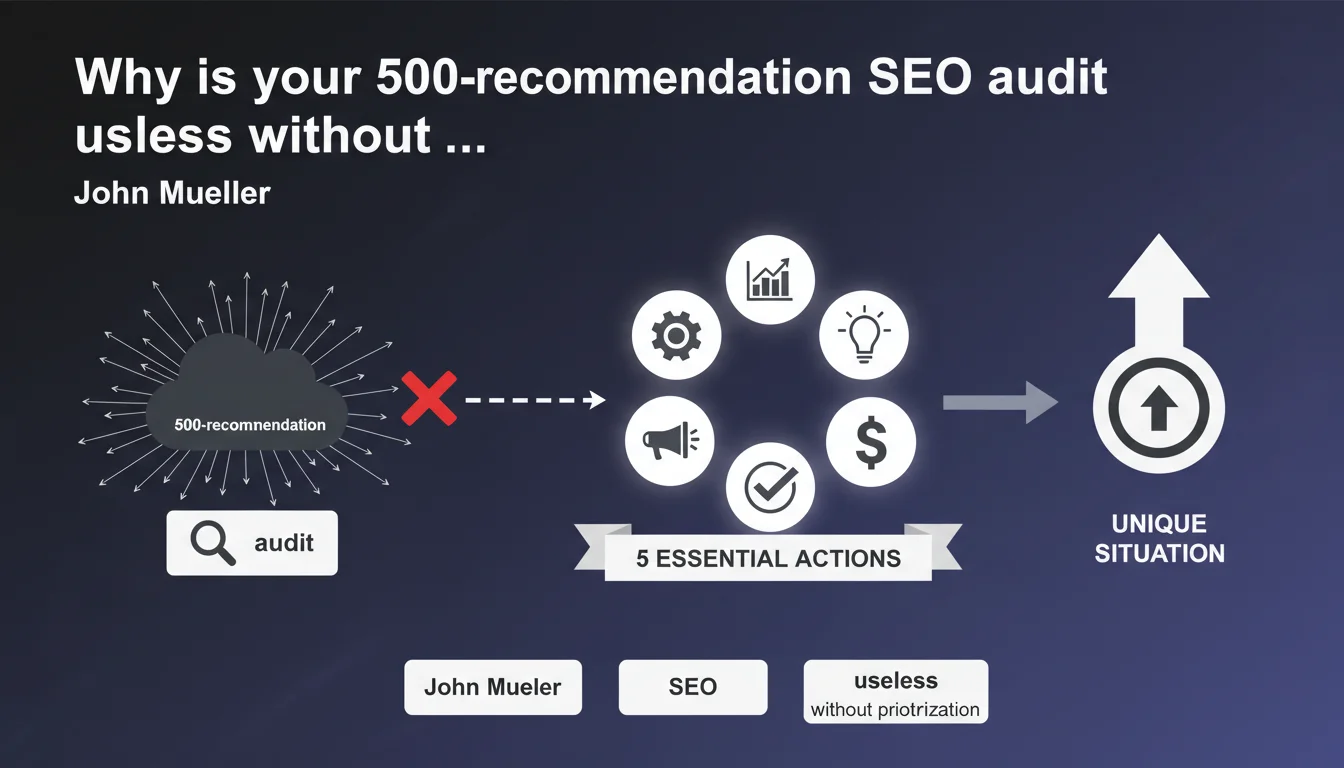
John Mueller states that an SEO audit generated by a tool has no value without human prioritization. The real work of SEO consists of identifying the 5 critical actions among hundreds of recommendations, based on each company's unique context. Expertise lies in sorting, not in data collection.
What you need to understand
John Mueller sets the record straight on a practice that has become far too common: generating an automated audit and presenting it as a final deliverable. The problem? These reports often produce 500 points for improvement without distinguishing their importance.
The statement clearly targets SEOs who rely on tools without bringing strategic thinking. Mueller insists on the need for intelligent sorting based on the company's unique situation — industry, competition, resources, business objectives.
What is an SEO audit without prioritization?
A raw report containing all detected issues: missing tags, redirects, loading time, internal linking, duplicate content, etc. These tools scan efficiently but don't know what actually impacts your traffic.
The danger? Drowning genuine quick wins in a mass of secondary fixes. A B2B SME doesn't have the same priorities as an online media outlet or a high-volume e-commerce site.
Why does Mueller insist on the "5 essential actions"?
Because resources are limited. Development, writing, budget — everything has a cost. Addressing 500 points in parallel is unrealistic and counterproductive.
Expertise consists of identifying high-impact levers: those that will unlock qualified traffic, fix critical indexing errors, or resolve cannibalization issues. Everything else can wait.
What is the risk of poor prioritization?
Wasting time on cosmetic fixes while structural problems continue to tank performance. I've seen teams spend three months optimizing meta descriptions while their site suffered from catastrophic architecture.
Poor prioritization also leads to dilution of effort. Technical teams become demotivated facing endless lists with no clear vision of the end goal.
- An automated audit never replaces human analysis
- Identifying 5 priority actions > fixing 500 minor details
- Prioritization depends on business context, not just technical metrics
- SEO tools are assistants, not strategic decision-makers
- SEO expertise lies in the ability to distinguish the urgent from the trivial
SEO Expert opinion
Does this statement reflect what we see in the field?
Absolutely. I've encountered too many "SEO consultants" who throw out an uncommented Screaming Frog export and consider the job done. The client ends up with an 80-tab Excel file with no idea where to start.
What Mueller doesn't say explicitly: prioritization is a difficult art. It requires experience, a nuanced understanding of Google's mechanics, and above all — knowledge of the client's business. An audit without context is just noise.
Where does this approach find its limits?
Mueller deliberately simplifies. Sometimes, the 5 priority actions aren't obvious to isolate. A site can have interdependent problems: failing architecture AND weak content AND toxic backlinks. Fixing everything in parallel becomes necessary.
Another caveat: some sites require a complete overhaul. In that case, the "5 actions" approach is insufficient — a comprehensive transformation plan is needed. [To verify]: Mueller speaks to common situations, not complex cases requiring deep restructuring.
What is the real added value of an SEO according to Mueller?
Discernment. Anyone can launch a crawler. Understanding that a 404 on a page dead for 10 years has no priority while a duplication issue on product sheets kills 30% of potential traffic — that's expertise.
Mueller also highlights an industry malaise: the overvaluation of tools at the expense of strategic thinking. The best SEOs spend 20% of their time on tools and 80% analyzing, testing, prioritizing.
Practical impact and recommendations
How do you identify the 5 truly priority actions?
Start by cross-referencing three sources: Search Console (critical indexing errors, traffic drops), analytics (high-potential underperforming pages), and your crawl tool (blocking technical issues). Points that appear in all three deserve immediate attention.
Ask yourself these questions: Which fix will unlock the most indexable pages? What problem affects pages already generating traffic? What error prevents Google from understanding my architecture? Prioritize systemic blockers before marginal optimizations.
What mistakes should you avoid during prioritization?
Don't get obsessed with a tool's score. A site at 60/100 on Lighthouse can outperform a competitor at 95/100 if the architecture and content are solid. Technical metrics are indicators, not objectives.
Another trap: treating all 404s as urgent. A 404 on an old page with no backlinks or traffic history? Ignore it. Focus on 404s that break user journeys or lose link juice.
- Audit Search Console first: indexing errors, coverage, Core Web Vitals
- Identify high-traffic pages with simple technical issues to fix
- Prioritize fixes that unblock multiple pages (templates, systemic problems)
- Distinguish quick wins (fast impact) from heavy projects (redesigns)
- Document why you're prioritizing each action — this helps sell recommendations internally
- Never tackle 50 points at once: 5 well-implemented fixes beat 50 poorly done ones
- Test the impact of each fix before moving to the next
How do you structure a prioritized audit for the client?
Divide your report into three levels: Critical (address within 1 month, direct impact on indexing or UX), Important (moderate impact, addressable within 3 months), and Opportunities (long-term optimizations, no strict deadline).
Each recommendation should include three elements: why it's a problem, what business impact it has (traffic, conversions, authority), and how much time/resources the fix requires. The client then decides with full knowledge.
❓ Frequently Asked Questions
Combien d'actions prioritaires faut-il vraiment traiter en premier ?
Un outil d'audit SEO est-il inutile dans ce cas ?
Comment convaincre un client qu'on ne va traiter que 5 points sur 500 ?
Faut-il ignorer complètement les 495 autres recommandations ?
Quel est le principal critère pour prioriser une action SEO ?
🎥 From the same video 11
Other SEO insights extracted from this same Google Search Central video · published on 19/09/2024
🎥 Watch the full video on YouTube →
💬 Comments (0)
Be the first to comment.