
Official statement
Other statements from this video 11 ▾
- □ La documentation SEO de Google est-elle vraiment accessible aux non-experts ?
- □ Peut-on vraiment chiffrer le ROI des Core Web Vitals ?
- □ Pourquoi le trafic SEO stagne-t-il malgré six mois de travail continu ?
- □ Pourquoi votre audit SEO de 500 recommandations est-il inutile sans priorisation ?
- □ Pourquoi Google insiste-t-il autant sur la communication régulière avec son SEO ?
- □ Pourquoi un bon prestataire SEO doit-il interroger votre business avant de signer ?
- □ Pourquoi les formules SEO clés en main sont-elles vouées à l'échec ?
- □ La proactivité dans la communication est-elle vraiment un critère de qualité pour un SEO ?
- □ Pourquoi le SEO échoue-t-il sans l'implication des autres équipes ?
- □ Faut-il vraiment recommander de ne PAS faire de SEO à certains clients ?
- □ Pourquoi un bon consultant SEO ne vous promettra jamais le top 3 Google ?
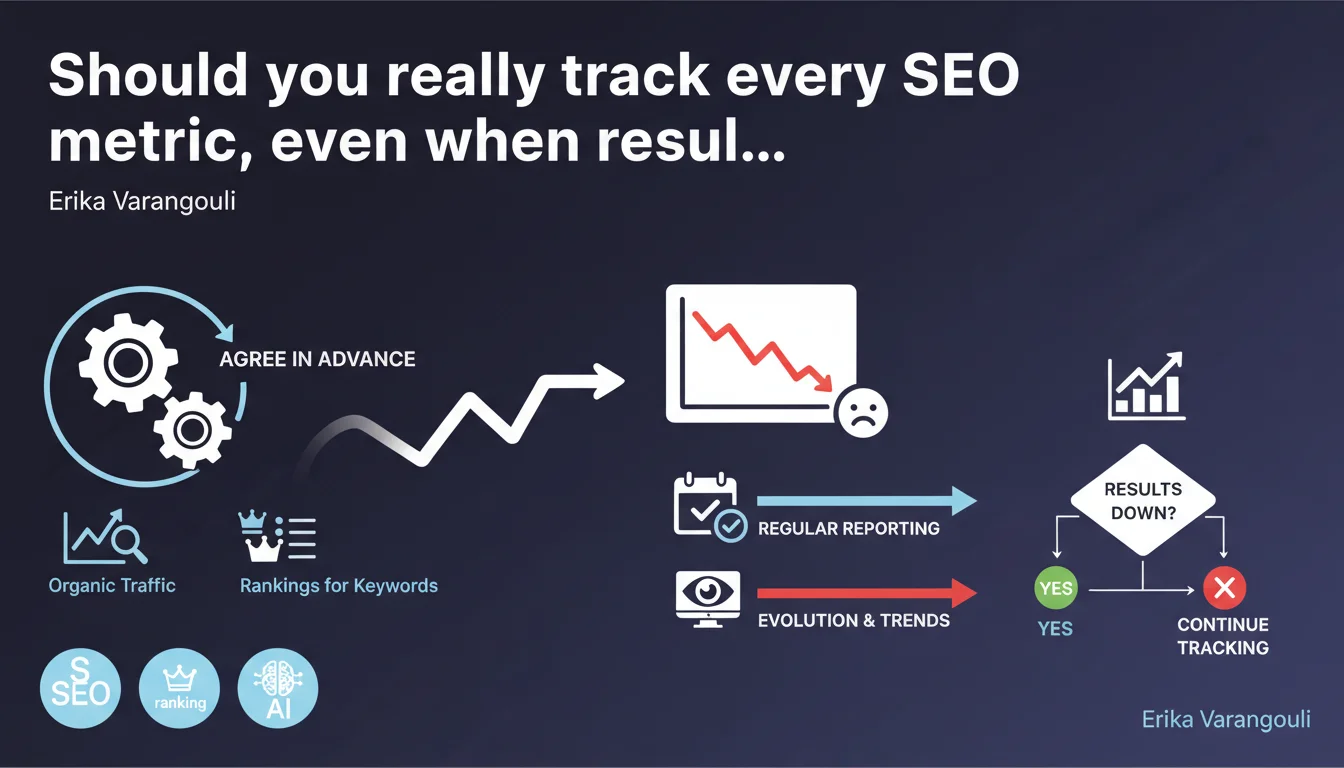
Google insists: define your priority SEO metrics (organic traffic, rankings) and monitor them rigorously, even during downturns. Regular reporting must show actual trends, not just good news. The stakes? Understanding what's broken before it's too late.
What you need to understand
Why does Google insist on continuous metric tracking?
This statement isn't just common sense. Google is pointing out a recurring problem: avoiding tracking when results aren't favorable. Many sites reduce or abandon reporting during decline phases, precisely when analysis becomes crucial.
The underlying message? Without a clear view of actual trends, you're flying blind. It's impossible to tell if a drop is structural, caused by an algorithm update, or due to a technical error. Regular tracking transforms raw data into actionable insights.
Which metrics should be prioritized for tracking?
Google explicitly mentions two pillars: organic traffic and rankings for certain keywords. No surprises, but nuance matters. This isn't about tracking 500 random keywords, but selecting those that actually drive business results.
Organic traffic alone isn't enough — it can mask losses in strategic keyword positions offset by gains in worthless long-tail terms. Individual rankings alone don't tell the whole story either: they reveal nothing about associated search volume or actual CTR.
How do you structure reporting that stays relevant over time?
The emphasis on regularity is important. Systematic monthly reporting lets you distinguish temporary fluctuations from lasting trends. But frequency should adapt: weekly after a migration or penalty, monthly during stable phases.
The trap? Generating reports nobody reads or that don't inform any decisions. Good SEO reporting establishes correlations between actions and results, documents tested hypotheses, and maintains historical records enabling year-over-year or period-over-period comparisons.
- Define metrics before launching any strategy — not three months in when you're wondering if it's working
- Document declines as rigorously as gains — that's where learning happens
- Separate vanity metrics from business metrics — number of indexed pages matters less than qualified traffic
- Contextualize all changes — a 10% drop can be excellent if the market drops 30%
- Automate collection but maintain human analysis — tools don't tell the story
SEO Expert opinion
Is this approach sufficient given current Google volatility?
Principle-wise, no complaints. But let's be honest: during Core Update rollouts or major algorithm updates, daily fluctuations can make monthly reporting obsolete. I regularly observe sites losing 40% of traffic within 72 hours following an update, then recovering 25% the following week.
Google's recommendation remains valid but incomplete. It assumes a certain algorithmic stability that doesn't really exist anymore. An automated alert system for sharp variations becomes essential — waiting for the monthly report to discover you lost half your traffic two weeks earlier is too late.
Does focusing on rankings and traffic ignore other critical signals?
Concentrating on these two metrics makes sense for most sites. But [To verify]: this approach can hide deep structural problems. A site can maintain overall organic traffic while progressively losing rankings on strategic commercial queries, offset by less-qualified informational traffic.
Google mentions neither organic CTR (yet an indicator of perceived relevance) nor engagement metrics (time on page, adjusted bounce rate) nor traffic distribution by query type. These blind spots can be costly. Rising traffic with falling conversions signals a targeting quality problem that rankings alone won't reveal.
When can this reporting logic become counterproductive?
For sites managing hundreds of thousands of pages across dozens of thematic silos, aggregated reporting hides more than it reveals. Apparent global stability can mask sectional collapses — some categories lose 70% while others compensate with +30%.
Another problematic case: seasonal or event-driven sites. Comparing January to February on a Valentine's Day e-commerce site makes no sense. Reporting must then incorporate systematic year-over-year comparisons and seasonality adjustments. Google doesn't clarify these nuances — its advice stays generic.
Practical impact and recommendations
What metrics should you concretely track and how to organize them?
Build a three-tier dashboard. Tier 1: business metrics (organic conversions, generated revenue, qualified leads). Tier 2: SEO performance metrics (total traffic, traffic by strategic keyword group, weighted average rankings). Tier 3: technical metrics and weak signals (crawl budget consumed, indexation rate, critical 404 errors).
For ranking tracking, segment: brand keywords (daily monitoring), high-value strategic terms (weekly), long-tail and discovery (monthly). Use tools that track actual SERP CTR — a position 3 with 8% CTR raises a different question than position 3 at 2% CTR.
Organic traffic should be broken down: by page template (product sheet vs category vs blog), by device (mobile vs desktop), by query type (informational vs transactional), and by user intent. Google Analytics 4 enables this granularity — assuming custom dimensions are configured correctly.
How do you interpret negative trends without panicking?
First rule: contextualize before reacting. A 15% July drop on a B2B site can be entirely normal (holidays, reduced search activity). Always compare year-over-year on the same period, and cross-reference with Google Trends to check if your site or the entire market is declining.
Second filter: identify the nature of the drop. Sudden loss in 48 hours? Likely algorithm update or critical technical issue. Progressive decline over three months? Competitive erosion or gradual content quality degradation. Drop localized to one category? Sign of a targeted problem (cannibalization, outdated content, search intent shift).
Don't react to every 5% variation. Establish alert thresholds: -10% in one week triggers investigation, -20% in one month triggers deep audit, -30% demands immediate corrective action. And systematically document — what looks like an anomaly today can reveal a pattern six months later.
Which tools should you use to automate without losing relevance?
Google Search Console remains foundational — set up automatic alerts on impression drops and indexing errors. For rankings, tools like SEMrush, Ahrefs, or SE Ranking offer grouped tracking by tag and fluctuation alerts.
But the real lever is multi-source integration. Create a centralized dashboard (Google Data Studio / Looker Studio, Tableau, Power BI) that crosses GSC, GA4, your ranking tool, and CRM data. This reveals correlations invisible in single silos: for example, traffic drop offset by conversion rate increase.
For semantic analysis and thematic coverage tracking, solutions like OnCrawl, Botify, or Screaming Frog (via programmed crawls) detect technical anomalies affecting indexation before they translate into traffic loss. The ideal? Cross technical crawl and business performance in one report.
- Define 5-10 maximum truly strategic KPIs (not 50 vanity metrics)
- Set up automatic alerts on sharp variations (+/- 15% in 7 days)
- Segment organic traffic by user intent and page template
- Track positions on 20-50 critical keywords, not 500 random terms
- Systematically compare year-over-year to neutralize seasonality
- Document all SEO actions with precise dates to correlate impacts
- Plan full monthly reporting + weekly flash on critical metrics
- Cross SEO data with business data (revenue, conversions) — traffic alone says nothing
- Keep clean history: monthly GSC exports, reporting backups
❓ Frequently Asked Questions
Quelle est la fréquence idéale de reporting SEO ?
Doit-on continuer à reporter des métriques en baisse ?
Le trafic organique suffit-il comme métrique principale ?
Comment distinguer une fluctuation normale d'un problème sérieux ?
Faut-il tracker toutes les positions de mots-clés ?
🎥 From the same video 11
Other SEO insights extracted from this same Google Search Central video · published on 19/09/2024
🎥 Watch the full video on YouTube →
💬 Comments (0)
Be the first to comment.