
Official statement
Other statements from this video 11 ▾
- □ La documentation SEO de Google est-elle vraiment accessible aux non-experts ?
- □ Peut-on vraiment chiffrer le ROI des Core Web Vitals ?
- □ Pourquoi le trafic SEO stagne-t-il malgré six mois de travail continu ?
- □ Pourquoi votre audit SEO de 500 recommandations est-il inutile sans priorisation ?
- □ Faut-il vraiment tracker toutes vos métriques SEO, même quand ça va mal ?
- □ Pourquoi un bon prestataire SEO doit-il interroger votre business avant de signer ?
- □ Pourquoi les formules SEO clés en main sont-elles vouées à l'échec ?
- □ La proactivité dans la communication est-elle vraiment un critère de qualité pour un SEO ?
- □ Pourquoi le SEO échoue-t-il sans l'implication des autres équipes ?
- □ Faut-il vraiment recommander de ne PAS faire de SEO à certains clients ?
- □ Pourquoi un bon consultant SEO ne vous promettra jamais le top 3 Google ?
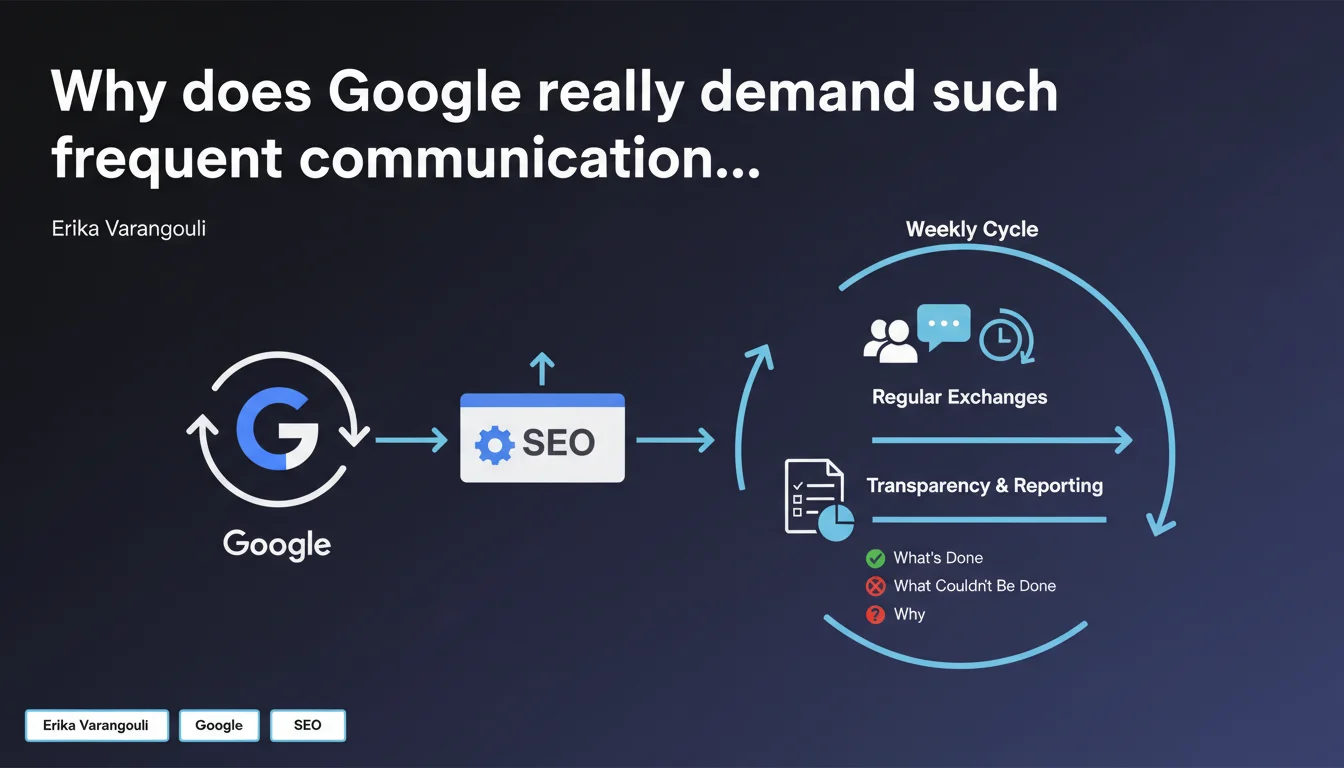
Google states that a week without contact with your SEO provider is already excessive. The requirement focuses on regular exchanges, complete transparency, and minimal reporting showing actions completed, obstacles encountered, and reasons why. This position clearly targets the relationship quality of SEO services.
What you need to understand
What is Google really aiming for with this statement?
The position is crystal clear: minimum weekly communication is becoming a required standard in a professional SEO relationship. Google is no longer just dictating technical best practices — it's now inserting itself into project management and client-provider relationships.
The emphasis on transparency and reporting reflects a desire to combat opaque SEO services where clients have no idea what's actually being done. The underlying message? An SEO provider who doesn't communicate regularly is probably hiding their inactivity or incompetence.
What form should this minimum reporting take?
Google deliberately remains vague about the exact format. It mentions three axes: what has been done, what couldn't be done, and why. No imposed metrics, no template — just a requirement for visibility into actual activity.
This approach leaves considerable room for interpretation. Is a simple weekly email enough? Do you need a real-time dashboard? The statement doesn't settle this — and that's probably intentional to encompass all types of missions.
Is this really realistic for all types of services?
Short answer: no. A limited flat-rate service doesn't necessarily justify weekly follow-up. A client paying €500/month for one-off technical optimization doesn't need a point every single week.
However, for strategic consulting engagements or significant budgets, the absence of weekly communication definitely becomes a red flag. The problem is that Google generalizes without nuancing based on scope or budget.
- Regular communication defined as weekly minimum by Google
- Complete transparency required on actions and obstacles encountered
- Structured reporting around three axes: done, not done, justifications
- Blurry scope: applicable regardless of service size or nature according to Google
- Red flag: one week without contact already considered too long
SEO Expert opinion
Does this statement reflect the reality of high-performing SEO services?
Let's be honest: the best SEO services genuinely do include sustained communication. When a provider delivers results, they have every reason not to hide. Transparency actually becomes a sales argument — showing what you're doing builds trust and justifies your fees.
But here's the flip side. This statement stigmatizes low-cost or automated services that actually work very well for certain clients. An e-commerce site that just wants monthly technical monitoring doesn't need weekly check-ins — yet Google presents it as a failing.
What abuses could this position generate?
Immediate danger: cosmetic over-communication. Some agencies will multiply emails and empty reports just to tick the "regular communication" box, without substantive content backing them up. Weekly reporting can easily mask a complete absence of results — it's even easier to disguise than radio silence.
Second trap: inflation of management time. Producing quality weekly reports consumes hours that could go toward execution. On small budgets, this quickly becomes counterproductive. [To verify]: Does Google have data showing that communication frequency correlates with SEO results? Nothing in this statement backs it up.
In what cases shouldn't this rule apply strictly?
Several configurations logically escape this weekly standard. One-off audit missions conclude with a single deliverable — no point in weekly check-ins for three weeks. Automated technical services (monitoring, alerts) function in "exception" mode: you only communicate if there's a problem.
And that's where it breaks down. Google imposes a standard designed for long-term strategic consulting engagements, but frames it as a universal rule. A solo SEO consultant managing 15 small clients simply cannot keep this pace without doubling their fees — which would kill their commercial positioning.
Practical impact and recommendations
How do you concretely structure this regular communication?
First step: define the format at kick-off. Recap email? Weekly 15-minute call? Shared dashboard with async comments? No format is inherently better — the key is that both parties accept it and stick with it.
Second pillar: structure around Google's three axes. Each update must cover what was accomplished (with tangible proof), what got blocked (with details) and why. This discipline enforces transparency — you can't mask inactivity behind tech jargon when you have to justify every week what didn't move forward.
What pitfalls should you avoid in this reporting?
Pitfall number one: alibi reporting. Sending an auto-generated dashboard without context or analysis doesn't meet the communication requirement. Google explicitly mentions transparency — that implies a human dimension, not just data dumps.
Second common mistake: confusing activity with results. Listing "12 articles optimized this week" without showing impact on traffic or rankings doesn't constitute quality communication. Reporting must link actions to business metrics — that's what justifies the service.
What if the client never responds to weekly updates?
Common problem: you religiously send your reports, but the client doesn't even read them. In this case, document everything and keep going anyway. If a dispute arises, you'll have proof that communication was properly maintained on your end.
Also consider switching channels. A weekly email that gets ignored might become a Slack message that gets read immediately. Some clients prefer one dense monthly update rather than four lighter ones — negotiate a frequency that guarantees real engagement rather than mechanically following the weekly rule.
- Define communication frequency and format contractually at the start
- Structure each report around the three axes: done, not done, why
- Systematically include tangible proof (screenshots, metrics, URLs)
- Link actions to business results, not just list activity
- Adapt the channel to client preferences (email, Slack, dashboard, calls)
- Archive all exchanges to document communication in case of dispute
- Schedule quarterly sync points to adjust frequency if needed
❓ Frequently Asked Questions
Une communication hebdomadaire est-elle vraiment nécessaire sur toutes les prestations SEO ?
Quel format de reporting Google recommande-t-il concrètement ?
Comment éviter que le reporting hebdomadaire ne devienne du temps perdu ?
Que faire si le client ignore systématiquement les rapports envoyés ?
Cette exigence de communication impacte-t-elle les tarifs SEO ?
🎥 From the same video 11
Other SEO insights extracted from this same Google Search Central video · published on 19/09/2024
🎥 Watch the full video on YouTube →
💬 Comments (0)
Be the first to comment.