
Official statement
Other statements from this video 11 ▾
- □ La documentation SEO de Google est-elle vraiment accessible aux non-experts ?
- □ Peut-on vraiment chiffrer le ROI des Core Web Vitals ?
- □ Pourquoi votre audit SEO de 500 recommandations est-il inutile sans priorisation ?
- □ Faut-il vraiment tracker toutes vos métriques SEO, même quand ça va mal ?
- □ Pourquoi Google insiste-t-il autant sur la communication régulière avec son SEO ?
- □ Pourquoi un bon prestataire SEO doit-il interroger votre business avant de signer ?
- □ Pourquoi les formules SEO clés en main sont-elles vouées à l'échec ?
- □ La proactivité dans la communication est-elle vraiment un critère de qualité pour un SEO ?
- □ Pourquoi le SEO échoue-t-il sans l'implication des autres équipes ?
- □ Faut-il vraiment recommander de ne PAS faire de SEO à certains clients ?
- □ Pourquoi un bon consultant SEO ne vous promettra jamais le top 3 Google ?
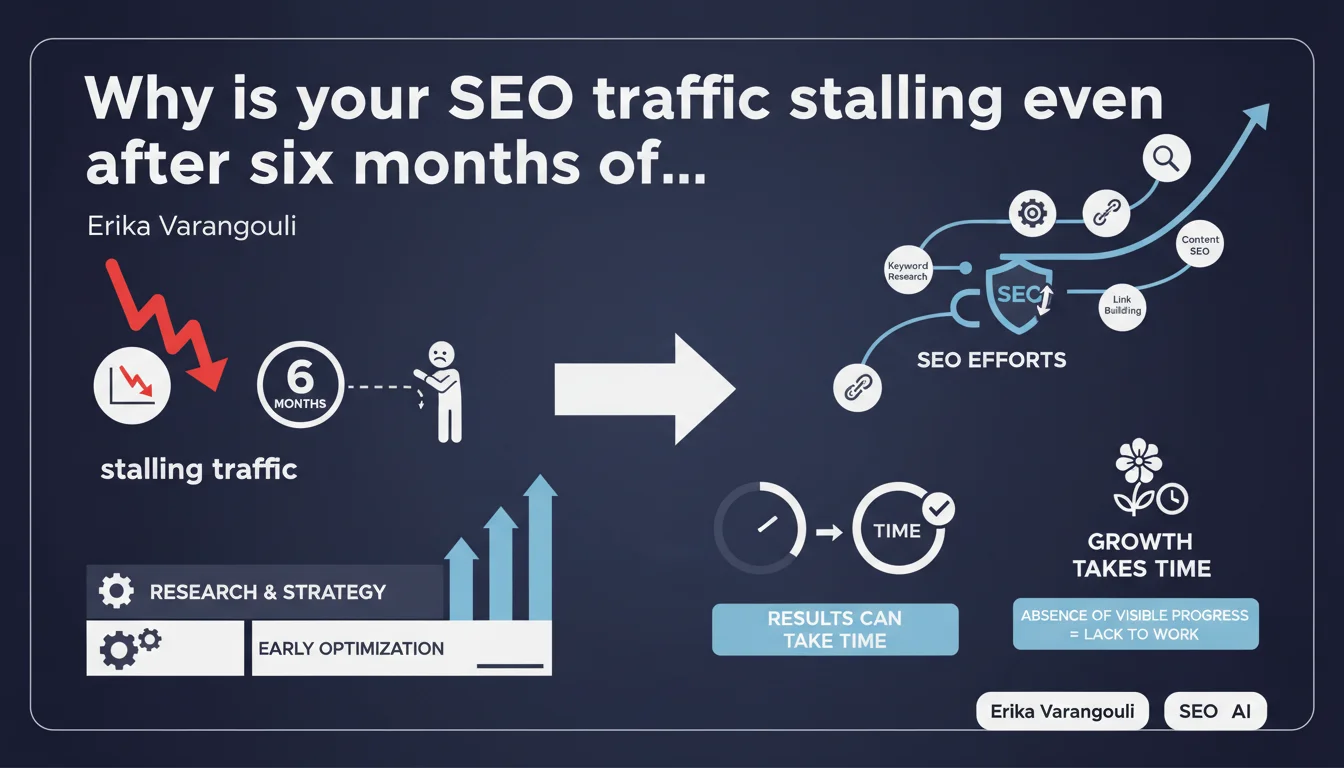
Google reminds us that an SEO agency can work effectively without traffic progressing after six months. The absence of visible results doesn't mean a lack of effort, but often reflects the unavoidable maturation period for optimizations. A statement that raises more questions than it provides concrete answers.
What you need to understand
What does Google mean by "delay" in SEO?
Google states that SEO results require time, sometimes well beyond six months. This statement aims to temper client expectations who judge SEO performance solely on short-term traffic curves.
The problem is that this claim remains vague. Six months is a long time — but exactly how long should you wait before worrying? Google provides no precise timeframe, no framework for distinguishing between work that's slowly bearing fruit and ineffective work.
What factors explain this delay?
Several mechanisms justify these timelines: the time for crawling and indexing, the period needed for Google to reassess a site's authority after structural optimizations, or the gradual maturation of internal linking and semantic signals.
Technical actions — architecture overhaul, migration, speed optimization — can even trigger temporary fluctuations before stabilization. The same applies to content: publishing 50 optimized articles doesn't guarantee immediate growth if domain authority remains weak.
How do you distinguish legitimate patience from insufficient work?
This is where Google's statement becomes problematic. It provides a ready-made excuse for mediocre service providers: "Results take time." But it doesn't help clients identify red flags.
Serious SEO work generates intermediate indicators long before traffic spikes: growth in indexed pages, improved rankings on strategic keywords, increased impressions in Search Console. If nothing moves after six months, even on these weaker signals, there's a problem.
- Normal timeline: between 4 and 12 months depending on sector competitiveness and site's initial state
- Intermediate indicators: impressions, rankings, indexed pages, Core Web Vitals
- Complete lack of movement after six months = red flag, not normalcy
- Transparency on actions taken is as important as results themselves
SEO Expert opinion
Does this statement protect good or bad agencies?
Let's be honest: Google's communication serves both serious agencies and charlatans equally. On one hand, it protects professionals conducting deep structural work — technical overhaul, penalty recovery, authority rebuilding — whose effects manifest later.
On the other, it offers the perfect alibi for service providers who bill empty monthly reports, implement a few cosmetic optimizations, and invoke this statement to justify six months of stagnation. [To verify]: Google never specifies how to measure whether the work performed is proportional to the observed delays.
What types of SEO projects truly justify six months of lag?
Certain contexts legitimately explain long timelines. A complex technical migration, for example, can require several months before Google stabilizes crawl and reassesses site quality. The same applies to heavily penalized sites (manually or algorithmically) that must rebuild credibility.
Conversely, standard on-page optimizations — title tags, internal linking, existing content improvement — should produce first signals within 8 to 12 weeks. If nothing happens, either execution is flawed or strategic priorities are poorly calibrated.
What should you do if stagnation persists beyond six months?
Demand radical transparency. A serious agency must detail what was done, what's in maturation phase, and especially show even minor evolutions on intermediate KPIs. No rising graph? There must be documented and verifiable explanations.
Practical impact and recommendations
How to track the right indicators to anticipate results?
Instead of using organic traffic as the sole measure of success, implement a multi-level dashboard. Search Console is your best ally: monitor impression growth (even without clicks), average rankings on strategic queries, and number of indexed pages.
Add technical metrics: loading time (Core Web Vitals), crawl rate, indexation errors. These signals move well before traffic and let you verify that the work is producing structural effects. If these indicators remain dormant after three months, dig deeper.
What concrete actions should you validate with your SEO provider?
Demand a detailed project plan with verifiable deliverables. Architecture overhaul? Ask for the redirect plan and new site structure. Content optimization? List of treated pages with measurable before/after (word count, targeted keywords, ranking evolution).
Schedule monthly check-ins where the provider presents not just what was done, but also impact hypotheses: "We optimized 30 product pages this month, we expect to see impressions move on this semantic cluster within 6 weeks." If these predictions never materialize, ask questions.
What if results really take time?
First, verify that technical fundamentals are in place: active indexation, no robots.txt blockages, clean redirects, proper server response time. An invisible technical issue can nullify months of editorial effort.
Next, conduct competitive benchmarking. If your competitors are also stalling, the industry might be in algorithmic consolidation phase — rare but real. If they're progressing and you're not, the problem comes from your strategy or its execution.
- Install weekly monitoring of impressions and rankings in Search Console
- Document each SEO project with expected intermediate KPIs (4-8 week timeline)
- Verify monthly evolution of indexed pages and crawl errors
- Compare your metric evolution with that of 3-5 direct competitors
- Require monthly reporting that correlates actions taken and observed evolutions
- Plan external technical audit if no intermediate metric moves after three months
❓ Frequently Asked Questions
Combien de temps faut-il réellement attendre avant de juger l'efficacité d'une stratégie SEO ?
Quels signaux permettent de distinguer une agence qui travaille d'une qui temporise ?
Pourquoi certaines actions SEO prennent-elles autant de temps à produire des effets ?
Que faire si mon trafic stagne malgré six mois de travail SEO documenté ?
Les impressions et positions sont-elles des indicateurs fiables pour anticiper le trafic ?
🎥 From the same video 11
Other SEO insights extracted from this same Google Search Central video · published on 19/09/2024
🎥 Watch the full video on YouTube →
💬 Comments (0)
Be the first to comment.