
Official statement
Other statements from this video 11 ▾
- □ La documentation SEO de Google est-elle vraiment accessible aux non-experts ?
- □ Peut-on vraiment chiffrer le ROI des Core Web Vitals ?
- □ Pourquoi le trafic SEO stagne-t-il malgré six mois de travail continu ?
- □ Pourquoi votre audit SEO de 500 recommandations est-il inutile sans priorisation ?
- □ Faut-il vraiment tracker toutes vos métriques SEO, même quand ça va mal ?
- □ Pourquoi Google insiste-t-il autant sur la communication régulière avec son SEO ?
- □ Pourquoi un bon prestataire SEO doit-il interroger votre business avant de signer ?
- □ Pourquoi les formules SEO clés en main sont-elles vouées à l'échec ?
- □ La proactivité dans la communication est-elle vraiment un critère de qualité pour un SEO ?
- □ Faut-il vraiment recommander de ne PAS faire de SEO à certains clients ?
- □ Pourquoi un bon consultant SEO ne vous promettra jamais le top 3 Google ?
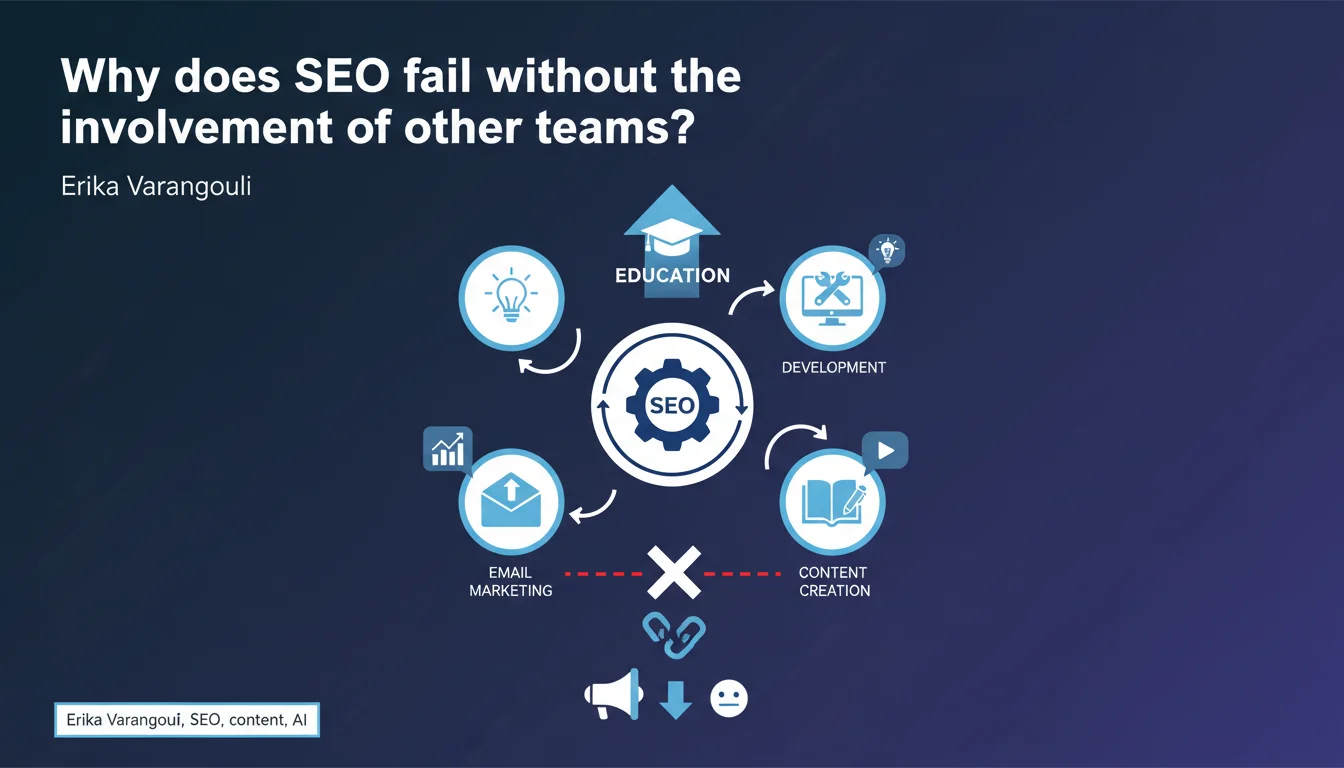
Google reminds us that SEO cannot work in isolation: developers, content writers, and email marketing teams must collaborate actively. The main challenge? Educating these teams on SEO priorities, otherwise technical recommendations fall on deaf ears.
What you need to understand
Is SEO really a cross-functional discipline?
Yes, and it's actually its biggest source of organizational friction. Unlike paid media where one team controls budget and campaigns, SEO depends on decisions made by others: a developer who changes HTML structure, a writer who ignores search intent, a CRM team sending emails with broken links.
This Google statement doesn't reveal anything new technically — it simply points to an organizational reality that many SEOs know all too well: your audit can be perfect, but if no one puts their hands on the code or CMS, you won't move forward.
Which teams are actually involved in this collaboration?
Developers are obviously on the front lines: page load speed, canonical tags, structured data, redirects — it all goes through them. But content teams are equally critical, because they produce what Google actually indexes.
Email marketing might seem secondary, but it affects internal linking and the consistency of URLs being shared. Product management impacts product page structure, marketing handles event landing pages. In short, SEO is everywhere — and nowhere at once if no one takes ownership of it.
Why does Google emphasize the educational aspect?
Because most SEO errors don't come from malice, but from ignorance. A developer who decides to block CSS in robots.txt isn't trying to sabotage the site — they probably don't know Googlebot needs it for rendering.
Education transforms passive stakeholders into active allies. If a writer understands why you're asking them to structure their H2s differently, they'll do it on their own in future content. Otherwise, you spend your life correcting the same mistakes.
- SEO doesn't directly control technical levers — it depends on other teams to execute
- Development, content, and email marketing are the three most frequent dependency pillars
- Educating stakeholders is as important as the technical recommendations themselves
- Without collaboration, even the best SEO strategies remain theoretical
SEO Expert opinion
Does this statement really reflect reality on the ground?
Yes, but it underestimates the political complexity of this collaboration. In a SMB where SEO talks directly with dev, it works. In a multinational where every change goes through three validation levels, it's another story.
The real problem? Competing priorities. The developer has their product roadmap, the writer has their editorial calendar. SEO shows up with requests — often urgent ones — and hits a wall of "we'll look at it next sprint." Google doesn't talk about that.
Is education alone really enough to unlock the situation?
Not always. You can train for hours, but if incentives aren't aligned, nothing changes. A developer evaluated on their ability to ship features will never prioritize SEO optimizations — unless their manager explicitly tells them to.
The educational aspect works when there's already willingness to listen. Otherwise, you're evangelizing into a void. SEO needs internal champions, not just well-meaning colleagues.
What risks does this dependency create for SEO performance?
The main risk is slow execution. Between audits, prioritization, team coordination, approvals, testing, and deployment — weeks or even months can pass. Meanwhile, your competitors are moving forward.
Another risk: cascading errors. A developer who doesn't understand the importance of a canonical tag can break indexation on thousands of pages in a single release. And you discover it three weeks later in Search Console. [To verify] Google gives no guidance on how to minimize these operational risks — just a general statement.
Practical impact and recommendations
How do you practically structure this cross-functional collaboration?
First, identify key contacts in each team — not managers, but the people who actually work in the code or CMS. Set up recurring meetings (biweekly minimum) where you present the SEO impact of their recent actions.
Next, create simple reference documents: an SEO checklist for writers, a common errors guide for developers. Not a 50-page document — actionable one-pagers. If it's too long, no one will read it.
What organizational mistakes should you absolutely avoid?
Don't play "SEO police" showing up after the fact to point out errors. Get involved upstream — on content briefs, technical specs, email campaigns. The earlier you intervene, the less you correct later.
Also avoid drowning your contacts in requests without context. A developer who gets "fix H1 tags on 300 pages" with no explanation will procrastinate. But "current H1s are creating cannibalization on these strategic queries" — that speaks to them.
How do you measure collaboration effectiveness?
Track the time to implementation of your recommendations. If a critical SEO ticket stays open three months, there's a prioritization problem — or a comprehension issue. Also track repeat errors: if the same mistake comes back after correction, the education didn't stick.
A good indicator? How often other teams reach out to you proactively rather than for fixes. When a developer calls you before deploying a structural change, you've won.
- Schedule regular meetings with dev, content, and marketing teams
- Create simple checklists and guides by function (1-2 pages max)
- Get involved upstream of projects, not just in post-mortem audits
- Contextualize every request with business impact, not just technical details
- Measure implementation time and error recurrence rates
- Identify internal champions who carry SEO at the executive level
❓ Frequently Asked Questions
Le SEO peut-il vraiment fonctionner en silo sans collaboration ?
Pourquoi l'aspect éducatif est-il aussi important selon Google ?
Quelles sont les équipes les plus critiques pour le SEO ?
Comment convaincre les autres équipes de prioriser le SEO ?
Que faire si les équipes ne suivent pas malgré la formation ?
🎥 From the same video 11
Other SEO insights extracted from this same Google Search Central video · published on 19/09/2024
🎥 Watch the full video on YouTube →
💬 Comments (0)
Be the first to comment.